Chinese LLMs Split into Two Businesses
💡Their reports reveal whether LLM businesses will scale through API volume, cheaper inference, agents, or global consumer
⚡ 30-Second TL;DR
What Changed
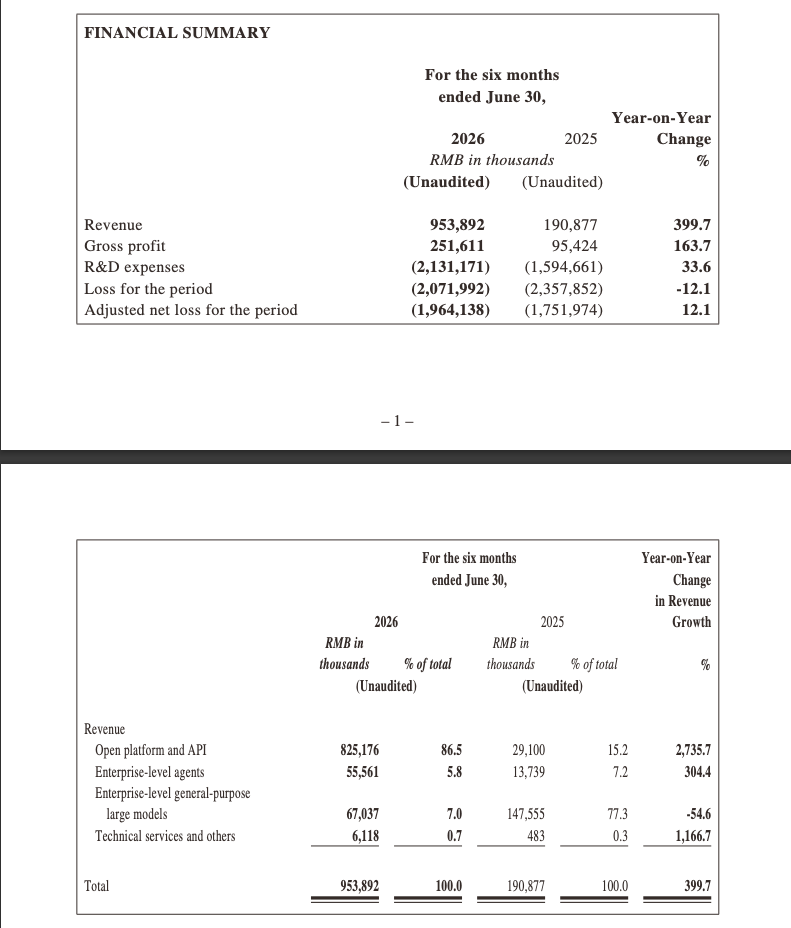
智譜 reported RMB 954 million in first-half revenue, up 399.7%, with API and open-platform revenue accounting for 86.5% of total revenue.
Why It Matters
The results suggest that Chinese foundation-model companies are moving from deployment projects toward recurring API consumption, agent workflows, and global products. For AI builders, the key competitive variables are shifting toward inference cost, long-context task completion, developer adoption, and the ability to monetize end-to-end work.
What To Do Next
Benchmark GLM-5.3-Flash against your current coding or agent model on task completion rate, latency, and cost per successful task before switching production traffic.
Key Points
- •智譜 reported RMB 954 million in first-half revenue, up 399.7%, with API and open-platform revenue accounting for 86.5% of total revenue.
- •智譜’s MaaS token volume grew more than 40 times from the start of the year, while GLM-5.3-Flash targets lower-cost high-volume inference.
- •MiniMax generated USD 117 million in first-half revenue, up 283.1%, with overseas revenue representing 60.8% of the total.
- •Both companies had adjusted losses close to USD 300 million, showing that rapid ARR growth has not yet translated into profitability.
- •The companies represent two commercialization paths: selling scalable model APIs and task capabilities versus expanding global consumption of cheaper multimodal intelligence.
Weekly AI Recap
Read this week's curated digest of top AI events →
👉Related Updates

AI-curated news aggregator. All content rights belong to original publishers.
Original source: 极客公园 ↗
This is a summary, not the original. Read the source, or get the weekly briefing.
Weekly AI briefing
One email a week. Unsubscribe anytime.