Gemini 3.8 Flash Cuts Agent Costs
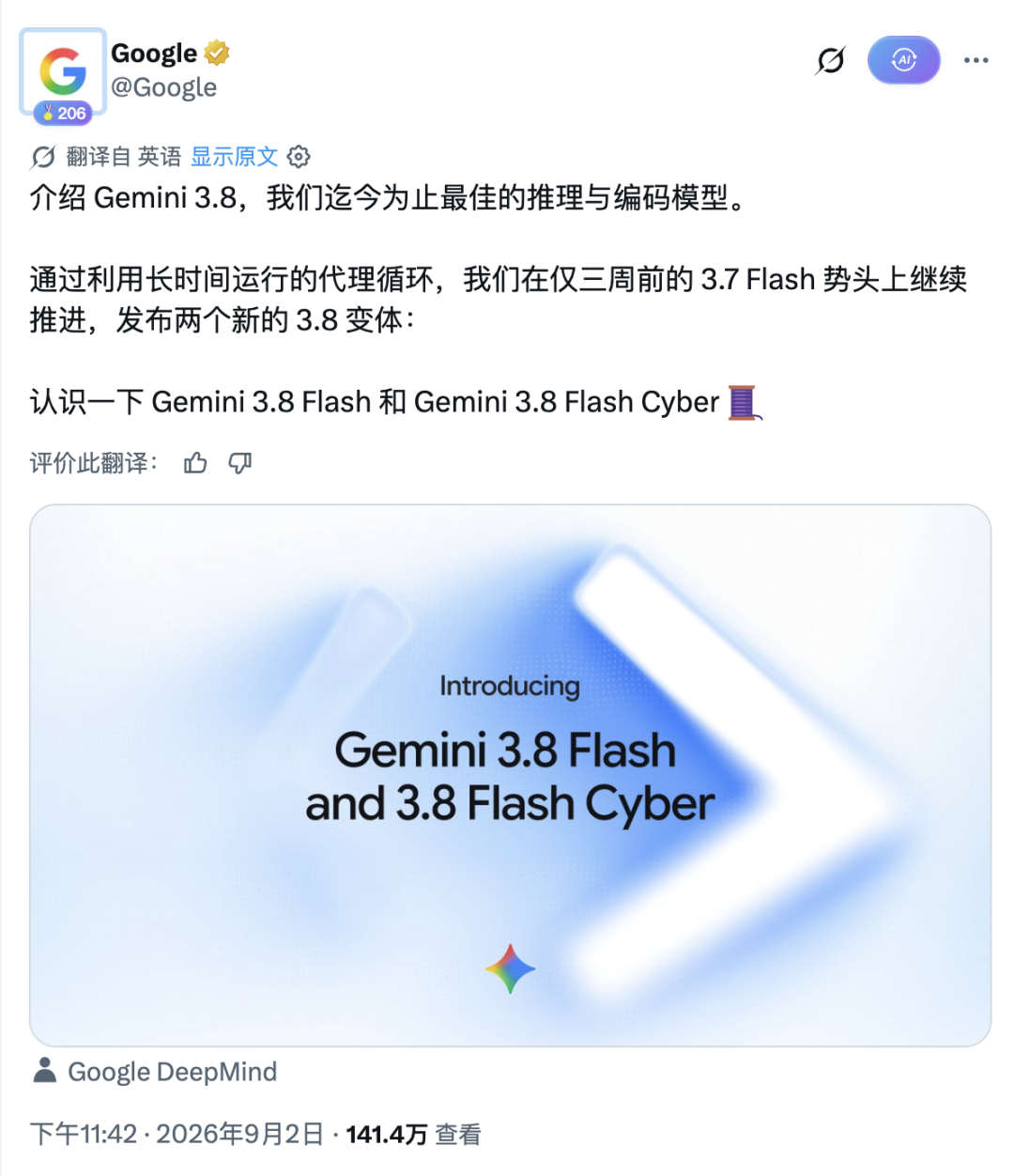
💡Gemini and Meta show that agent performance is shifting from benchmark scores to cost per completed task.
⚡ 30-Second TL;DR
What Changed
Gemini 3.8 Flash reportedly scores about 74% on DeepSWE v1.1, a long-horizon software engineering benchmark.
Why It Matters
The article suggests that agent pricing will increasingly be judged by the cost of completing real tasks rather than by token prices alone. Cheaper frontier-level coding and more efficient tool use could make long-running coding and research agents more commercially viable.
What To Do Next
Benchmark Gemini 3.8 Flash on your own repository-based coding workflow, recording total task cost, token usage, tool-call count, and completion rate.
Key Points
- •Gemini 3.8 Flash reportedly scores about 74% on DeepSWE v1.1, a long-horizon software engineering benchmark.
- •Its launch pricing remains $0.75 per 1M input tokens and $3.75 per 1M output tokens, with an average DeepSWE task cost of $2.36.
- •Muse Spark 1.3 reportedly reaches 75.4% on DeepSWE, surpassing Gemini 3.8 Flash, Claude Opus 5, and GPT-5.6 Sol.
- •Muse Spark 1.3 reduces tool calls by about 20% and token consumption by about 25% through better workflow management and uncertainty handling.
🧠 Deep Insight
Background and context from public sources — not the original article. 14 sources cited.
🔑 Enhanced Key Takeaways
- •Google has adopted an aggressive six-week release cadence for its Flash-tier models, with 3.8 Flash being the third iteration in that timeframe.
- •The current $0.75/$3.75 pricing is an introductory rate that is scheduled to double on January 1, 2027.
- •Gemini 3.8 Flash features a 'work harder' design philosophy that intentionally increases token consumption to improve reasoning depth and tool-use accuracy.
- •Google released a specialized 'Cyber' variant of the model, tuned for vulnerability discovery, available exclusively via the Fairwind Program.
- •The model achieved a 90.8% score on Terminal-Bench 2.1, representing a significant performance jump over the 81.6% score of its predecessor, Gemini 3.7 Flash.
📊 Competitor Analysis▸ Show
| Model | DeepSWE v1.1 Score | Avg. Task Cost | Key Advantage |
|---|---|---|---|
| Gemini 3.8 Flash | 74% | $2.36 | High-efficiency agentic reasoning |
| Muse Spark 1.3 | 75.4% | N/A | Reduced tool calls & token usage |
| Claude Opus 5 | N/A | ~$2.34 | Frontier-level reasoning depth |
| GPT-5.6 Sol | N/A | N/A | High-end specialized agent performance |
🛠️ Technical Deep Dive
- Employs an iterative tool-calling architecture that prioritizes reasoning depth over immediate token economy.
- Optimized for long-horizon software engineering tasks, specifically showing gains in Terminal-Bench 2.1.
- Utilizes a specialized fine-tuning path for the Cyber variant to enhance vulnerability discovery and automated patching capabilities.
- Designed for high-frequency updates, allowing for rapid integration of new agentic workflow patterns.
🔮 Future ImplicationsAI analysis grounded in cited sources
⏳ Timeline
📎 Sources (14)
Factual claims are grounded in the sources below. Forward-looking analysis is AI-generated interpretation.
Weekly AI Recap
Read this week's curated digest of top AI events →
👉Related Updates


AI-curated news aggregator. All content rights belong to original publishers.
Original source: 虎嗅 ↗
This is a summary, not the original. Read the source, or get the weekly briefing.
Weekly AI briefing
One email a week. Unsubscribe anytime.