Chinese Firms Present Physical AI at CVPR 2026
💡See how Chinese firms are setting the standard for Physical AI loops alongside Nvidia and Tesla at CVPR 2026.
⚡ 30-Second TL;DR
What Changed
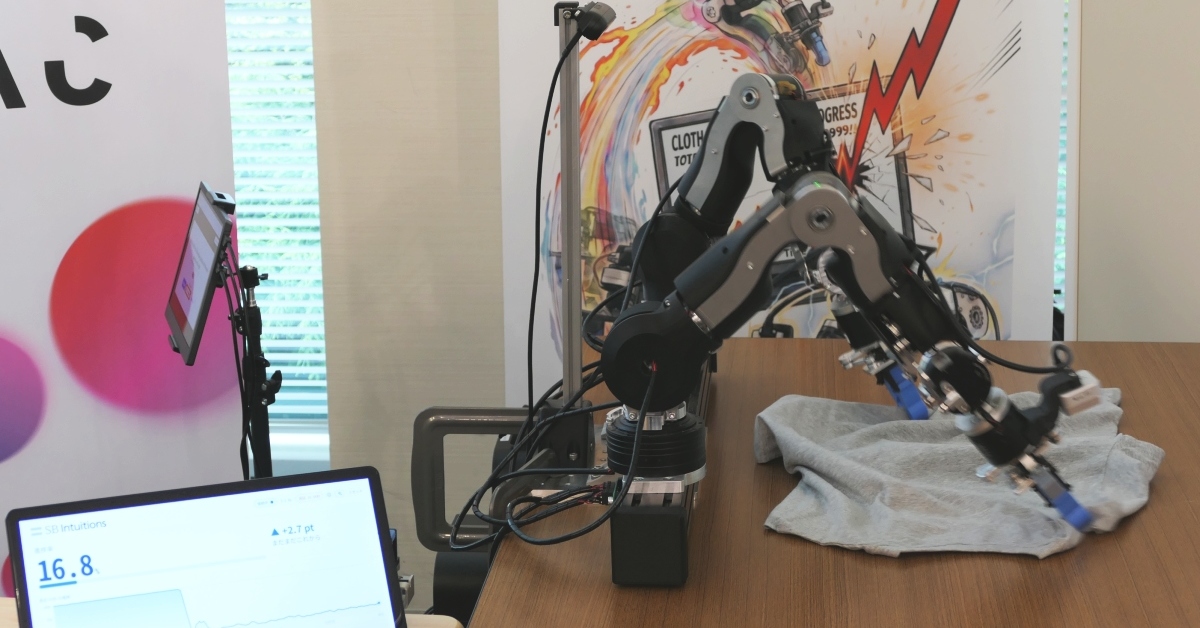
Chinese firms demonstrated Physical AI capabilities at the CVPR 2026 conference.
Why It Matters
This signals a shift toward embodied AI where simulation-to-reality pipelines are becoming standardized. It suggests Chinese firms are gaining significant influence in the global robotics and autonomous systems research landscape.
What To Do Next
Review the latest CVPR 2026 proceedings on Physical AI to understand the data-loop architectures being adopted for robotics.
Key Points
- •Chinese firms demonstrated Physical AI capabilities at the CVPR 2026 conference.
- •Industry giants including Nvidia, Tesla, and Waymo attended the presentation.
- •The core achievement involves establishing a closed-loop flywheel for physical AI development.
- •The research focuses on bridging the gap between digital AI models and physical world interaction.
🧠 Deep Insight
Background and context from public sources — not the original article. 19 sources cited.
🔑 Enhanced Key Takeaways
- •Chinese startup Spirit AI's foundation model, Spirit v1.6, recently surpassed Nvidia's Cosmos3-Nano-Policy on the RoboArena global leaderboard for embodied intelligence, marking a significant competitive achievement in core AI model capabilities for physical interaction.
- •China's robust manufacturing base and existing leadership in electric vehicles provide a strategic advantage, allowing for the repurposing of components like batteries, sensors, and lidar for physical AI systems, which accelerates hardware localization efforts.
- •The Chinese government actively supports Physical AI development through national policies like the "Robot+" initiative and "AI + Manufacturing" roadmap, aiming to double manufacturing robot density by 2030 and projecting the domestic market to exceed 1 trillion yuan ($146 billion) by 2035.
- •The core achievement of a "closed-loop flywheel" for physical AI involves a continuous cycle of real-world data collection, model refinement through techniques like reinforcement learning and simulation, and subsequent deployment, with teleoperation playing a crucial role in generating valuable training data.
- •Chinese firms are rapidly moving towards mass production and commercialization of humanoid robots, with over 80% of global humanoid robot installations in 2025 attributed to China, and companies like UBTech showcasing innovations such as self-charging capabilities for 24/7 operation.
📊 Competitor Analysis▸ Show
| Feature/Benchmark | Spirit AI (Spirit v1.6) | Nvidia (Cosmos3-Nano-Policy) |
|---|---|---|
| Category | Foundation model for embodied intelligence | Foundation model for physical AI |
| RoboArena Score | 1,924 | 1,881 |
| Global Ranking | 1st | 2nd |
| Origin | China (Hangzhou, Zhejiang province) | USA |
🛠️ Technical Deep Dive
- Physical AI systems utilize a range of sensors, including cameras, microphones, temperature sensors, inertial measurement units (IMUs), radar, and lidar, along with actuators to perceive and interact with the physical world.
- Reinforcement learning is a primary mechanism for these systems, enabling them to learn by trial and error through positive or negative feedback to improve task performance.
- The development heavily relies on world foundation models (WFMs) that learn the dynamics of the physical world (geometry, motion, physics) from extensive real-world data, facilitating the generation of realistic, physics-aware scenarios for training, often through digital twins.
- The closed-loop flywheel process encompasses continuous data processing, model customization (e.g., using large language model techniques like domain adaptive pretraining (DAPT), LoRA, and supervised fine-tuning (SFT)), rigorous model evaluation, and subsequent deployment.
- Simulation is a critical component, allowing engineers to integrate and test AI models within high-fidelity digital twins of physical systems and environments before hardware deployment, thereby minimizing risk and cost.
- Physical AI systems are designed for real-time performance, robustness to noise and uncertainty in sensor data, and require extensive safety and reliability testing due to real-world consequences of failure.
- Chinese firms are developing vision-language-action (VLA) models that integrate perception, locomotion, and reasoning functionalities for more capable and versatile robots.
🔮 Future ImplicationsAI analysis grounded in cited sources
⏳ Timeline
📎 Sources (19)
Factual claims are grounded in the sources below. Forward-looking analysis is AI-generated interpretation.
Weekly AI Recap
Read this week's curated digest of top AI events →
👉Related Updates

AI-curated news aggregator. All content rights belong to original publishers.
Original source: 量子位 ↗
This is a summary, not the original. Read the source, or get the weekly briefing.
The weekly digest
One email a week. Unsubscribe anytime.