China's RISC-V ecosystem sees rapid diversification
💡RISC-V is a critical alternative for custom AI silicon development and edge computing efficiency.
⚡ 30-Second TL;DR
What Changed
RISC-V is moving from research to large-scale commercial use
Why It Matters
The rise of RISC-V reduces reliance on proprietary instruction sets, potentially lowering costs for custom AI silicon development.
What To Do Next
Evaluate RISC-V based hardware for edge AI deployment to optimize performance-per-watt.
Key Points
- •RISC-V is moving from research to large-scale commercial use
- •Diverse hardware applications are adopting the architecture
- •China's ecosystem is showing significant growth and maturity
🧠 Deep Insight
Background and context from public sources — not the original article. 26 sources cited.
🔑 Enhanced Key Takeaways
- •China is implementing nationwide policies to promote RISC-V adoption, driven by a strategic imperative for technological self-sufficiency and reducing reliance on foreign instruction set architectures (ISAs) like x86 and ARM, especially amid U.S. export controls.
- •Chinese entities are developing high-performance RISC-V processors for demanding applications such as artificial intelligence (AI), cloud computing, and servers, with examples like Alibaba's XuanTie C950 and the Chinese Academy of Sciences' (CAS) Xiangshan achieving internationally advanced performance levels in benchmarks.
- •Alongside hardware development, there is a concerted effort in China to build a robust software ecosystem for RISC-V, including native operating systems like Ruyi and the porting of mainstream AI/machine learning (ML) frameworks (e.g., TensorFlow, PyTorch, LLaMA) and libraries (e.g., OpenCV) to RISC-V.
- •China has seen substantial investment in RISC-V research and development, with over $1.4 billion invested by 2026, coupled with a strong focus on talent cultivation through initiatives like the Shanghai Open Processor Industry Innovation Center (SOPIC) training hundreds of engineers annually.
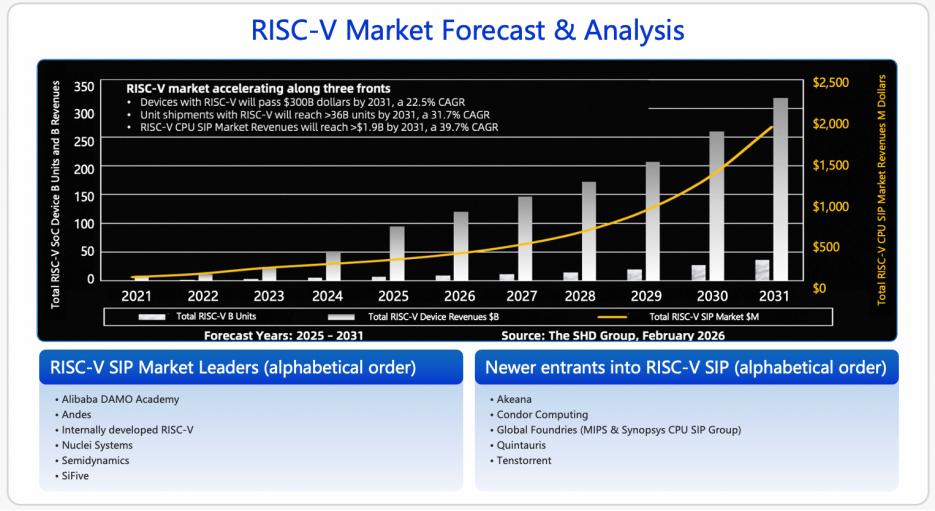
- •China accounted for approximately 50% of global RISC-V chip shipments by 2022, and global RISC-V chip shipments are projected to reach 60 billion units by 2025 and 36 billion by 2031, with China being a major driving force behind this growth.
📊 Competitor Analysis▸ Show
| Feature | RISC-V | ARM | x86 |
|---|---|---|---|
| Architecture | Open-standard ISA, royalty-free | Proprietary ISA, licensing fees required | Proprietary ISA, licensing fees required |
| Flexibility | Highly customizable, extensible | Moderate customization (via licenses) | Limited customization |
| Cost | Lower development costs (no licensing fees) | Higher licensing costs | High licensing costs |
| Ecosystem | Rapidly growing, strong government backing in China, emerging software support | Mature, extensive software and hardware ecosystem | Very mature, dominant in PC/Server software |
| Primary Use | Microcontrollers, IoT, AI, embedded, servers (emerging in China) | Mobile, embedded, IoT, increasingly PC/Server | PC, Workstations, Servers, High-Performance Computing |
| Market Share (Global) | Emerging, significant growth, ~10 billion units shipped by 2022, projected 60 billion by 2025 | Dominant in mobile (>90%), growing in PC (8% by 2024) | Dominant in PC (78.9% Intel, 21.1% AMD in Q2 2024), Servers (88% in 2023) |
| Performance (Chinese High-End) | CAS Xiangshan: 16.5 SPEC CPU2006/GHz; Alibaba XuanTie C950: 3.2 GHz server chip, "highest performing RISC-V CPU in the world" (as of March 2026) | Arm Cortex-A75 surpassed by StarFive Dubhe-83 (8.5 SPECint2006/GHz) | High performance in data centers (e.g., AMD Epyc, Intel Xeon) |
🛠️ Technical Deep Dive
- Modular Design: RISC-V features a modular design with a base instruction set architecture (ISA) and optional extensions (e.g., M for multiplication, A for atomics, F/D/Q for floating-point, V for vector operations), allowing for customization and extensibility.
- Xiangshan Processor: Developed by the Chinese Academy of Sciences (CAS), Xiangshan is an open-source, high-performance RISC-V processor system that achieved 16.5 points per GHz in the SPEC CPU2006 benchmark and includes the world's first open-source network-on-chip IP.
- Ruyi Operating System: A native RISC-V operating system developed in China, Ruyi is notable for being the first to support the RVA23 high-performance international standard.
- Alibaba XuanTie C950: This 3.2 GHz server chip, unveiled in March 2026, was described as the "highest performing RISC-V CPU in the world" at the time, designed for AI agents and high-performance tasks in cloud computing and AI.
- Alibaba XuanTie C930: A server-grade processor from Alibaba, the C930 achieved over 15 SPECint2006/GHz and is geared towards high-performance computing applications, including data centers and autonomous vehicles.
- StarFive Dubhe-83: This RISC-V processor core features a 10-stage+ pipeline and a 3-issue superscalar architecture with deep out-of-order execution. It complies with the RVA23 specification and supports extensions like RV64GC, Bit Manipulation (B), Vector (V), Hypervisor (H), and Vector Crypto. It achieved 8.5 SPECint2006/GHz, surpassing the Arm Cortex-A75, and supports mainstream AI/ML frameworks.
- SpacemiT VitalStone V100: Announced in January 2025, this server processor can feature up to 64 RISC-V cores, is built on a 12nm-class process technology, and supports virtualization and memory virtualization via an IOMMU.
- RiVAI Lingyu CPU: Launched in April 2025, this is China's first domestically designed high-performance RISC-V server processor, adopting a one-core, dual architecture approach that integrates 32 general-purpose computing cores (CPU) with eight specialized intelligent computing cores (LPU) for efficient handling of open-source large language models.
🔮 Future ImplicationsAI analysis grounded in cited sources
⏳ Timeline
📎 Sources (26)
Factual claims are grounded in the sources below. Forward-looking analysis is AI-generated interpretation.
- tomshardware.com
- riscstar.com
- eetimes.com
- yahoo.com
- tomshardware.com
- asiatimes.com
- marketanalysis.com
- eetimes.com
- patentpc.com
- itnews.asia
- yidaiyilu.gov.cn
- cctv.com
- cas.cn
- scmp.com
- youtube.com
- substack.com
- institutmontaigne.org
- reddit.com
- aicerts.ai
- starfivetech.com
- abachy.com
- semicone.com
- wikipedia.org
- semiwiki.com
- wikipedia.org
- people.cn
Weekly AI Recap
Read this week's curated digest of top AI events →
👉Related Updates



AI-curated news aggregator. All content rights belong to original publishers.
Original source: 钛媒体 ↗
This is a summary, not the original. Read the source, or get the weekly briefing.
Weekly AI briefing
One email a week. Unsubscribe anytime.