China’s AI Efficiency Machine
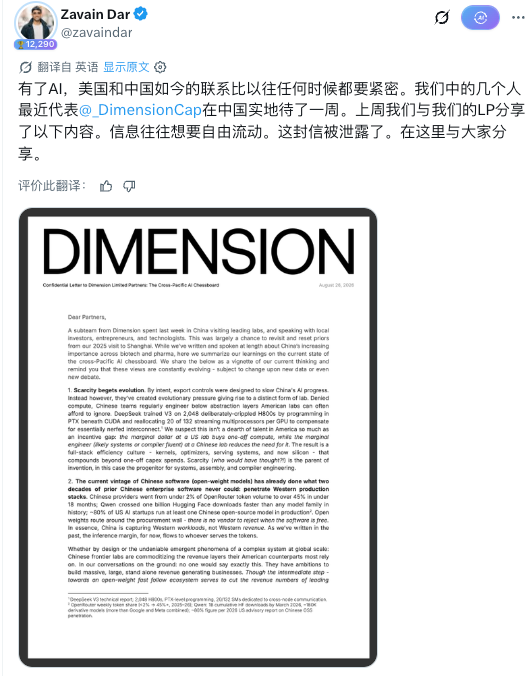
💡See how chip restrictions are driving PTX-level optimization, open models, and a cross-border AI supply chain.
⚡ 30-Second TL;DR
What Changed
The article says Chinese teams compensate for restricted hardware through full-stack optimization, including PTX-level GPU programming and communication redesign.
Why It Matters
The analysis suggests that export controls may accelerate efficiency-focused innovation and increase the strategic importance of open-weight models. AI builders should treat hardware efficiency, model interoperability, and cross-border dependency as core product and infrastructure considerations.
What To Do Next
Benchmark DeepSeek V3 and Qwen with Nsight Systems on your target GPUs, then profile communication overhead before investing in additional compute.
Key Points
- •The article says Chinese teams compensate for restricted hardware through full-stack optimization, including PTX-level GPU programming and communication redesign.
- •DeepSeek, Qwen, Kimi, Doubao, and GLM are described as tightly competing through rapid iteration and open-source releases.
- •China’s AI ecosystem is expanding beyond data labeling into evaluation and verification infrastructure, including the startup UniPat.
- •The article describes a cross-border model loop in which Chinese open-weight models are distilled, fine-tuned, and embedded into Western AI applications.
- •Chinese AI companies are portrayed as prioritizing practical monetization, including e-commerce commissions, despite lower revenue than leading US labs.
🧠 Deep Insight
Background and context from public sources — not the original article. 7 sources cited.
🔑 Enhanced Key Takeaways
- •ModelBest has introduced 'Forge Engineering,' a paradigm utilizing Recursive Self-Improvement (RSI) to enable AI systems to autonomously optimize their own training frameworks without human intervention.
- •The 'ForgeTrain' framework has demonstrated training speeds for the MiniCPM5-1B model that exceed NVIDIA’s Megatron-LM performance by 10% through specialized resource overhead reduction.
- •China's daily AI token consumption experienced a 1,000-fold increase between early 2024 and March 2026, rising from 100 billion to over 140 trillion tokens.
- •As of February 2026, Chinese-developed models captured 61% of total token usage on OpenRouter, the world's primary API aggregation platform.
- •The Chinese government, via the MIIT, is mandating the creation of a national ecosystem of over 2,000 AI service providers by late 2026 to standardize modular, lightweight AI deployment in industrial sectors.
📊 Competitor Analysis▸ Show
| Feature | Chinese Efficiency Models (e.g., MiniCPM, GLM) | US Frontier Models (e.g., GPT-4o, Claude 3.5) |
|---|---|---|
| Training Efficiency | High (ForgeTrain/RSI-optimized) | Moderate (Compute-intensive scaling) |
| Deployment | Lightweight/Modular/Industrial-focused | Cloud-heavy/General-purpose |
| Pricing | Aggressive/Low-cost (Deflationary pressure) | Premium/Tiered |
| Benchmarks | High performance per FLOP | State-of-the-art absolute capability |
🛠️ Technical Deep Dive
- Forge Engineering: Implements Recursive Self-Improvement (RSI) to automate the refinement of training pipelines and model architecture parameters.
- ForgeTrain Framework: A specialized training architecture designed to outperform NVIDIA Megatron-LM by optimizing communication overhead and memory utilization on constrained hardware.
- Modular Industrial Integration: Focuses on 'small, fast to deploy' model architectures that prioritize inference latency and throughput for manufacturing and quality control environments.
- Data Infrastructure: Utilization of high-quality, professional-grade datasets curated under the National Data Administration to improve cognitive depth in domain-specific models.
🔮 Future ImplicationsAI analysis grounded in cited sources
⏳ Timeline
📎 Sources (7)
Factual claims are grounded in the sources below. Forward-looking analysis is AI-generated interpretation.
Weekly AI Recap
Read this week's curated digest of top AI events →
👉Related Updates


AI-curated news aggregator. All content rights belong to original publishers.
Original source: 虎嗅 ↗
This is a summary, not the original. Read the source, or get the weekly briefing.
Weekly AI briefing
One email a week. Unsubscribe anytime.