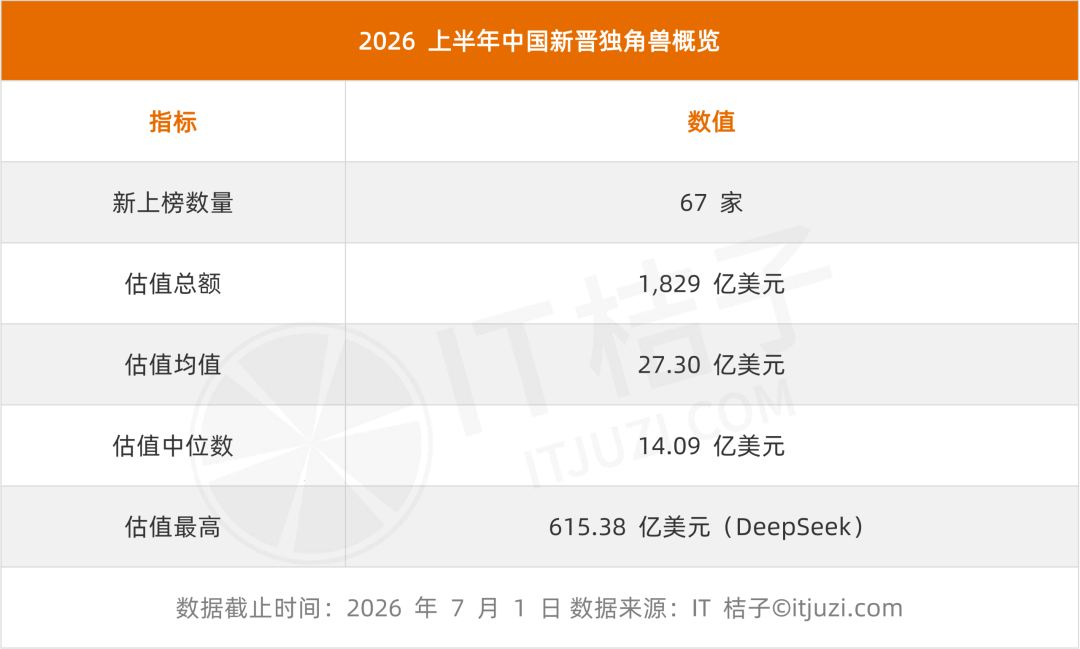
China adds 67 unicorns in H1 2026, led by AI
💡Discover the top-funded AI and robotics startups driving China's latest unicorn boom.
⚡ 30-Second TL;DR
What Changed
67 new unicorns emerged in H1 2026, the highest in five years.
Why It Matters
The data confirms a massive capital shift from consumer internet to embodied AI and large-scale model infrastructure.
What To Do Next
Analyze the investment patterns in robotics and AI infrastructure to identify potential partnership or acquisition targets.
Key Points
- •67 new unicorns emerged in H1 2026, the highest in five years.
- •Robotics (19) and AI (17) are the primary drivers of this growth cycle.
- •DeepSeek leads the sector with a $61.5 billion valuation, highlighting the dominance of LLM-focused firms.
🧠 Deep Insight
AI-generated analysis for this event — not the original article.
🔑 Enhanced Key Takeaways
- •The surge in unicorn creation is heavily concentrated in the Yangtze River Delta and Greater Bay Area, which together account for 62% of the new H1 2026 valuations.
- •Government-backed 'Guidance Funds' (Government Guidance Funds) contributed to 40% of the capital raised by these 67 new unicorns, marking a shift from traditional venture capital dominance.
- •The average time to reach unicorn status for these 67 companies has compressed to 3.2 years, down from 4.8 years in 2023, driven by accelerated commercialization cycles in AI infrastructure.
- •Semiconductor and advanced material startups saw a 25% increase in valuation premiums compared to H2 2025, reflecting a strategic pivot toward supply chain autonomy.
- •Exit activity for early-stage investors remains constrained, with only 8% of these new unicorns having clear IPO pathways in the next 18 months, leading to a focus on secondary market liquidity.
📊 Competitor Analysis▸ Show
| Feature | DeepSeek (LLM) | Baidu (Ernie) | Alibaba (Qwen) |
|---|---|---|---|
| Primary Focus | Open-weights/Efficiency | Enterprise/Search | Cloud/Ecosystem |
| Architecture | Mixture-of-Experts (MoE) | Transformer-based | Transformer-based |
| Pricing | Highly competitive/API | Tiered/Enterprise | Consumption-based |
| Benchmark (MMLU) | SOTA (2026) | Competitive | Competitive |
🛠️ Technical Deep Dive
- DeepSeek's current valuation is underpinned by its proprietary DeepSeek-V3/R1 architecture, which utilizes a highly optimized Mixture-of-Experts (MoE) framework.
- The model achieves significant computational efficiency through Multi-Head Latent Attention (MLA), reducing KV cache memory usage by up to 90% compared to standard attention mechanisms.
- Implementation relies on custom-built hardware acceleration clusters that utilize specialized interconnects to minimize latency during distributed training across thousands of GPUs.
- The training pipeline incorporates reinforcement learning from human feedback (RLHF) specifically tuned for reasoning-heavy tasks, distinguishing it from general-purpose generative models.
🔮 Future ImplicationsAI analysis grounded in cited sources
⏳ Timeline
Weekly AI Recap
Read this week's curated digest of top AI events →
👉Related Updates

AI-curated news aggregator. All content rights belong to original publishers.
Original source: 虎嗅 ↗
This is a summary, not the original. Read the source, or get the weekly briefing.
Weekly AI briefing
One email a week. Unsubscribe anytime.