Rewi Technology IPO breaks on debut
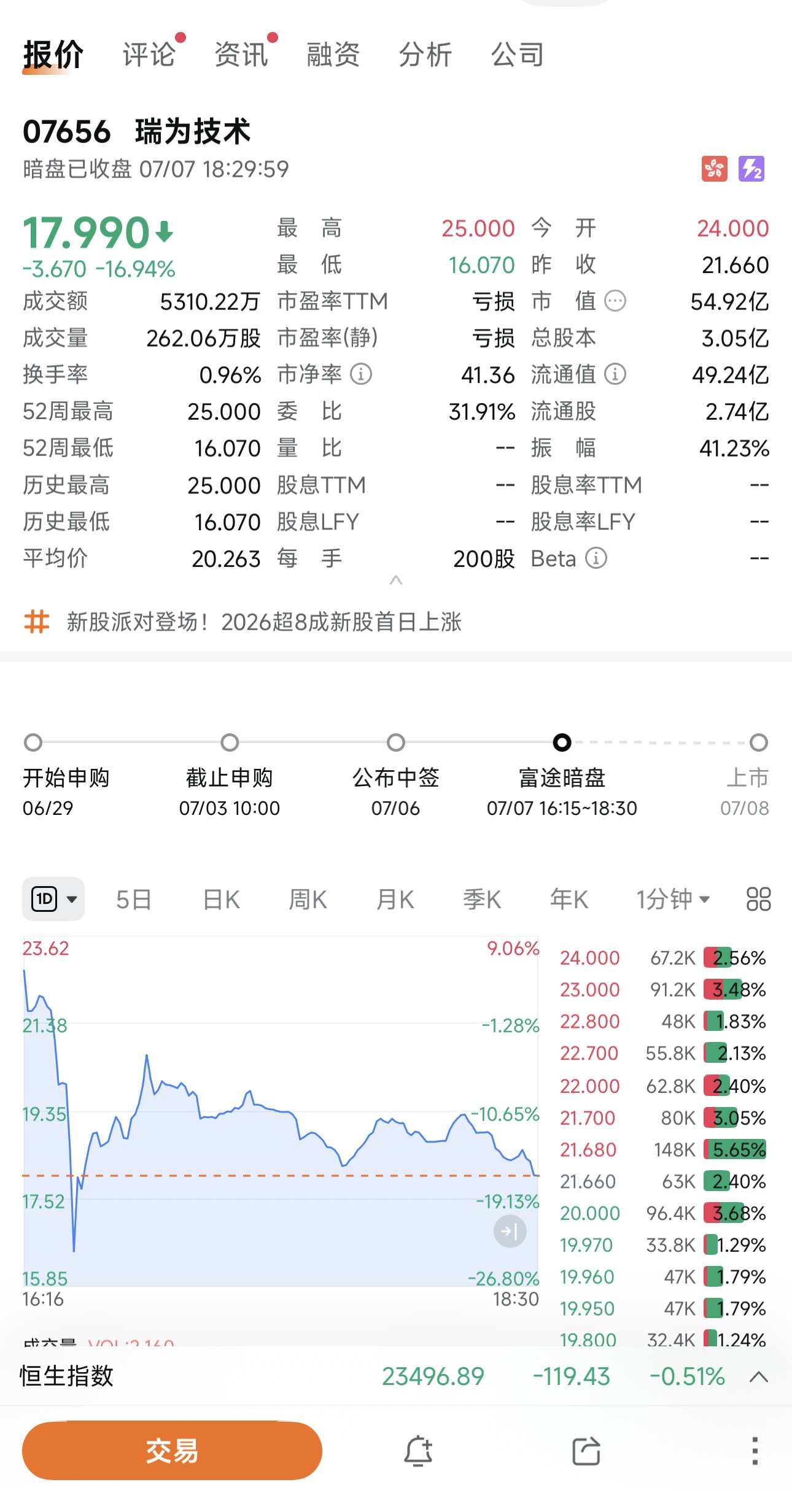
💡A cautionary tale for AI hardware startups on the impact of financial structure and market sentiment on IPO success.
⚡ 30-Second TL;DR
What Changed
Stock closed at 17.99 HKD, down 16.94% from the 21.66 HKD issue price.
Why It Matters
The poor market performance highlights the risks for AI hardware companies with high receivables and weak financial structures in the current capital environment.
What To Do Next
Analyze the financial health and receivables turnover of AI hardware startups before considering them for long-term investment or partnership.
Key Points
- •Stock closed at 17.99 HKD, down 16.94% from the 21.66 HKD issue price.
- •No cornerstone investors or green-shoe mechanism led to high volatility.
- •Accounts receivable reached 587 million RMB, exceeding annual revenue of 443 million RMB.
🧠 Deep Insight
AI-generated analysis for this event — not the original article.
🔑 Enhanced Key Takeaways
- •Rewi Technology's IPO was reportedly impacted by broader market sentiment in Hong Kong, which has seen a cooling trend for AI-related listings in mid-2026.
- •The company's business model relies heavily on government and large enterprise contracts, which explains the significant accounts receivable balance relative to revenue.
- •Analysts noted that Rewi Technology's R&D expenditure has been consistently high, consuming nearly 60% of its annual revenue over the past three fiscal years.
- •The absence of a green-shoe option (over-allotment option) left the stock without price stabilization support, exacerbating the downward pressure during the first day of trading.
- •Institutional investors expressed concerns regarding the company's customer concentration, as its top five clients accounted for over 70% of its total revenue in 2025.
📊 Competitor Analysis▸ Show
| Feature | Rewi Technology | Ubtech Robotics | Agility Robotics |
|---|---|---|---|
| Core Focus | Visual Embodied AI | Humanoid Service Robots | Industrial Bipedal Robots |
| Market Position | Software/Vision-Centric | Consumer/Commercial Hardware | Logistics/Warehouse Automation |
| Revenue Model | Project-based/Custom | Hardware Sales/Service | Hardware/RaaS |
| Primary Benchmark | Visual SLAM Accuracy | Human-Robot Interaction | Payload/Endurance |
🛠️ Technical Deep Dive
- Architecture: Utilizes a proprietary Visual-Language-Action (VLA) model that integrates real-time spatial perception with large-scale transformer-based decision making.
- Perception Stack: Employs multi-modal sensor fusion combining LiDAR, depth cameras, and IMU data to achieve sub-centimeter localization in dynamic environments.
- Training Data: Relies on a combination of synthetic data generation via digital twins and real-world teleoperation datasets to train embodied agents.
- Edge Computing: Implements a tiered inference strategy where low-latency motor control is handled on-device, while complex semantic reasoning is offloaded to edge servers.
🔮 Future ImplicationsAI analysis grounded in cited sources
⏳ Timeline
Weekly AI Recap
Read this week's curated digest of top AI events →
👉Related Updates

AI-curated news aggregator. All content rights belong to original publishers.
Original source: 36氪 ↗
This is a summary, not the original. Read the source, or get the weekly briefing.
Weekly AI briefing
One email a week. Unsubscribe anytime.