CHAI Releases Comprehensive AI Governance Framework for Healthcare
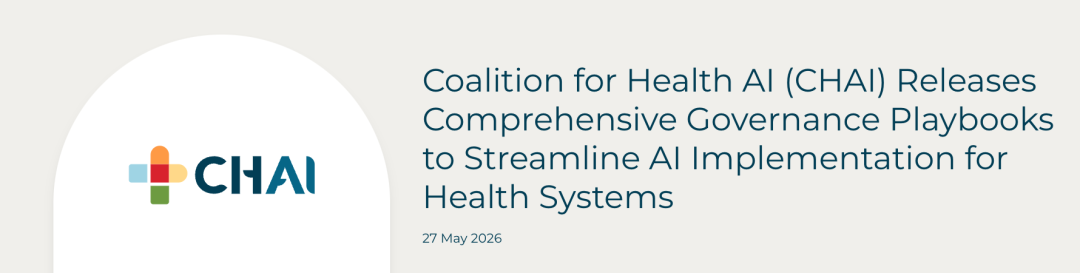
💡The first systematic, clinical-led AI governance manual for hospitals to mitigate risk and ensure compliance.
⚡ 30-Second TL;DR
What Changed
Framework covers four domains: Policy, Organizational Structures, Resources, and Processes.
Why It Matters
This framework sets a new standard for clinical AI adoption, forcing hospitals to move from ad-hoc implementation to structured, risk-managed governance. It will likely influence future regulatory requirements for medical AI in China and globally.
What To Do Next
Download the CHAI Playbooks and map your current AI deployment pipeline against their 'Decision Gate' lifecycle management model.
Key Points
- •Framework covers four domains: Policy, Organizational Structures, Resources, and Processes.
- •Implements a risk-based approach categorizing AI tools into Low, Medium, and High risk tiers.
- •Provides specific guidelines for managing 'Shadow AI' and third-party vendor audits.
- •Includes requirements for AI transparency and patient informed consent in clinical settings.
🧠 Deep Insight
Background and context from public sources — not the original article. 9 sources cited.
🔑 Enhanced Key Takeaways
- •The Coalition for Health AI (CHAI) released a series of eight governance playbooks on May 28, 2026, offering practical guidance and baseline controls for health systems to implement AI safely and transparently.
- •These playbooks were developed through extensive collaboration, involving over 100 healthcare organizations and more than 150 health AI leaders, including academic medical centers, regional care facilities, and community health centers, to ensure adaptability across diverse care settings.
- •The newly released playbooks are designed to provide the foundational structure for The Joint Commission's upcoming voluntary AI certification program, which aims to further standardize responsible AI adoption in healthcare.
- •A core principle embedded in the CHAI framework is that AI should augment, rather than replace, human clinical judgment, emphasizing the necessity of human oversight in all care decision-making for accountability and patient safety.
- •Beyond the initial four domains, the framework's eight critical elements include specific guidance on responsible AI lifecycle management, risk and impact assessments, responsible data management and use, and comprehensive education, training, and feedback mechanisms.
🛠️ Technical Deep Dive
- The framework recommends implementing and maintaining an AI inventory registry to audit internal and third-party models for gaps, capture model details, vendor contact information, and usage restrictions, with capabilities for automated monitoring of renewal dates and policy compliance.
- It requires pre-implementation validation testing for every AI model, including baseline validation tests to assess usefulness, fairness, and safety.
- Guidelines emphasize ensuring data completeness, representativeness, and freedom from bias during both the training and production phases of AI models, along with mechanisms for continuous monitoring of data quality.
- Healthcare organizations are advised to have robust cybersecurity infrastructure and specific tools for continuous monitoring of AI model performance post-deployment.
- The framework addresses adaptive algorithms, which learn and evolve based on new data, necessitating rigorous change management and a Total Product Lifecycle (TPLC) approach.
🔮 Future ImplicationsAI analysis grounded in cited sources
⏳ Timeline
📎 Sources (9)
Factual claims are grounded in the sources below. Forward-looking analysis is AI-generated interpretation.
Weekly AI Recap
Read this week's curated digest of top AI events →
👉Related Updates



AI-curated news aggregator. All content rights belong to original publishers.
Original source: 虎嗅 ↗
This is a summary, not the original. Read the source, or get the weekly briefing.
The weekly digest
One email a week. Unsubscribe anytime.