Brain Cells Power Data Centers
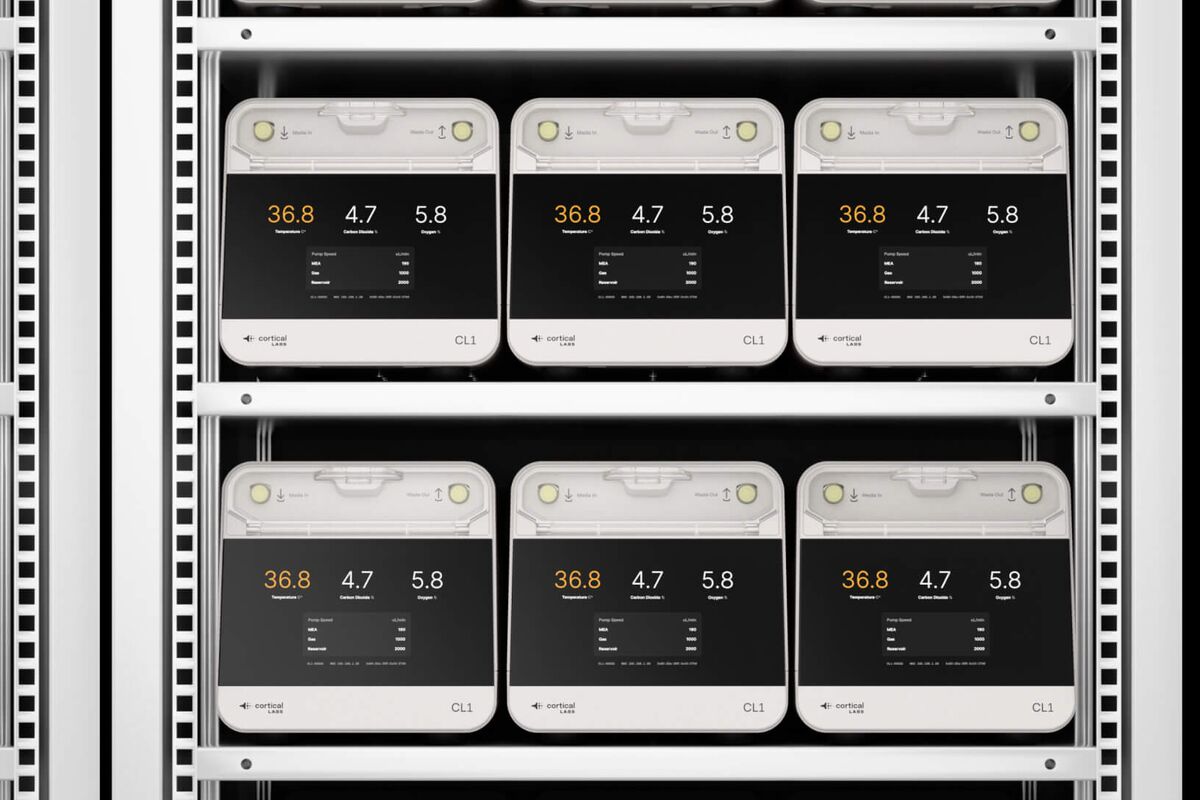
💡Brain cells on silicon challenge Nvidia in data centers—bio-AI hardware breakthrough.
⚡ 30-Second TL;DR
What Changed
Cortical Labs launches brain-cell data centers
Why It Matters
Pioneers neuromorphic alternatives to GPUs, potentially slashing AI compute costs. Signals shift in data center tech toward bio-hybrid systems.
What To Do Next
Check Cortical Labs' site for biocompute platform demos and research papers.
Key Points
- •Cortical Labs launches brain-cell data centers
- •Sites in Singapore and Melbourne
- •Neurons on silicon to challenge Nvidia chips
- •Biotech for energy-efficient computing
🧠 Deep Insight
Background and context from public sources — not the original article. 6 sources cited.
🔑 Enhanced Key Takeaways
- •Cortical Labs' CL1 is the world's first code-deployable biological computer, allowing users to deploy code directly to lab-grown neurons on custom silicon chips.[3]
- •The company's DishBrain system uses around 200,000 neurons on a microelectrode array to interface with software, demonstrated by learning to play Pong and Doom via feedback loops.[4][5][6]
- •Backed by In-Q-Tel (US intelligence community VC) and Horizons Ventures, Cortical Labs plans revenue from biological computer sales by end-2024 and cloud services by early 2025.[1][5]
- •Applications include drug testing for neurological disorders like dementia and epilepsy using human neurons to assess efficacy and side effects, partnering with firms like Bit Bio.[1]
🛠️ Technical Deep Dive
- •CL1 device integrates lab-grown human neurons (from adult stem cells via skin or blood) onto custom silicon chips with microelectrode arrays, housed in a shoebox-sized unit providing nutrients, air, and waste removal.[1][3]
- •Neurons act as the CPU, receiving electrical signals from simulations (e.g., Pong or Doom) and responding with firing patterns interpreted as actions, enabling closed-loop learning in minutes without extensive training data.[4][5][6]
- •DishBrain setup features ~200,000-1,000,000 neurons; a rack of 30 CL1 units offers low energy consumption compared to traditional AI hardware.[2][6]
- •Cortical Cloud provides remote 'Wetware as a Service' access to clusters (e.g., 120 units) for programming neurons on tasks.[1][3]
🔮 Future ImplicationsAI analysis grounded in cited sources
⏳ Timeline
📎 Sources (6)
Factual claims are grounded in the sources below. Forward-looking analysis is AI-generated interpretation.
- 311institute.com — This Startup Is Scaling Biological Computers to Challenge Nvidia in AI
- cointribune.com — AI Cortical Labs Connects Human Neurons to a Chip
- corticallabs.com
- singularityhub.com — How Scientists Are Growing Computers From Human Brain Cells and Why They Want to Keep Doing It
- timesofindia.indiatimes.com — 129274963
- futurism.com — Doom Human Brain Cells
Weekly AI Recap
Read this week's curated digest of top AI events →
👉Related Updates


AI-curated news aggregator. All content rights belong to original publishers.
Original source: Bloomberg Technology ↗
This is a summary, not the original. Read the source, or get the weekly briefing.
Weekly AI briefing
One email a week. Unsubscribe anytime.