Bios Life Launches Continuous AI Cancer Surveillance
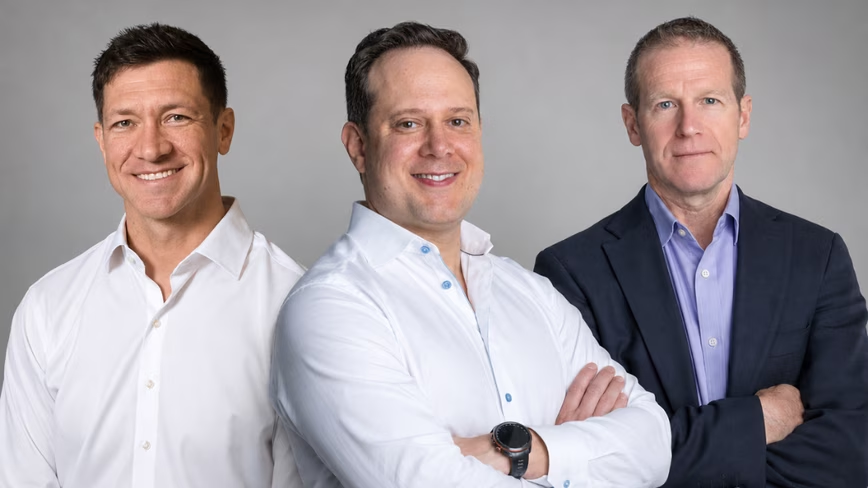
A BioNTech alumni team is replacing periodic cancer screening with continuous AI surveillance.
30-Second TL;DR
What Changed
Bios Life raised $25 million in a funding round.
Why It Matters
Continuous monitoring could enable earlier detection and more personalized follow-up than periodic screening alone. For AI builders, the Tempus alliance highlights the importance of high-quality clinical data partnerships in deploying healthcare models.
What To Do Next
Evaluate Bios Life’s eventual clinical validation and data-governance disclosures before considering its surveillance approach for a healthcare AI pilot.
Key Points
- •Bios Life raised $25 million in a funding round.
- •Its product aims to provide continuous rather than one-off cancer screening.
- •The platform will use AI-driven surveillance and data from an alliance with Tempus.
Deep Insight
AI-generated analysis for this event — not the original article.
Enhanced Key Takeaways
- •Bios Life's platform utilizes a proprietary 'digital twin' architecture to simulate patient physiological responses and predict oncological progression over time.
- •The partnership with Tempus grants Bios Life access to one of the world's largest multimodal libraries of clinical and molecular data, specifically focusing on longitudinal patient outcomes.
- •The $25 million Series A funding round was led by Andreessen Horowitz (a16z) Bio + Health, signaling strong venture capital interest in AI-native diagnostic infrastructure.
- •Bios Life is targeting a 'liquid biopsy-plus' approach, integrating circulating tumor DNA (ctDNA) analysis with real-time electronic health record (EHR) monitoring.
- •The company's regulatory strategy focuses on achieving FDA De Novo classification for its surveillance algorithm as a Software as a Medical Device (SaMD) by late 2027.
Competitor Analysis
- Bios Life
- Continuous Surveillance
- GRAIL (Galleri)
- Point-in-time Screening
- Exact Sciences (Cologuard)
- Point-in-time Screening
- Bios Life
- Multimodal (EHR + ctDNA)
- GRAIL (Galleri)
- Genomic/Methylation
- Exact Sciences (Cologuard)
- Molecular/Stool-based
- Bios Life
- High-risk longitudinal monitoring
- GRAIL (Galleri)
- Population-level screening
- Exact Sciences (Cologuard)
- Population-level screening
- Bios Life
- Subscription/Value-based
- GRAIL (Galleri)
- Per-test fee
- Exact Sciences (Cologuard)
- Per-test fee
| Feature | Bios Life | GRAIL (Galleri) | Exact Sciences (Cologuard) |
|---|---|---|---|
| Primary Model | Continuous Surveillance | Point-in-time Screening | Point-in-time Screening |
| Data Integration | Multimodal (EHR + ctDNA) | Genomic/Methylation | Molecular/Stool-based |
| Target Market | High-risk longitudinal monitoring | Population-level screening | Population-level screening |
| Pricing Model | Subscription/Value-based | Per-test fee | Per-test fee |
Technical Deep Dive
- Architecture: Employs a Transformer-based temporal model designed to process irregular time-series data from patient EHRs and liquid biopsy results.
- Data Fusion: Uses a multimodal fusion layer that aligns high-dimensional genomic data with clinical metadata to reduce false-positive rates common in single-point screenings.
- Surveillance Loop: Implements an active learning feedback loop where clinician interventions and subsequent diagnostic outcomes are fed back into the model to refine risk stratification scores.
- Infrastructure: Built on a cloud-native, HIPAA-compliant environment utilizing federated learning techniques to train models across partner hospital networks without moving raw patient data.
Future ImplicationsAI analysis grounded in cited sources
Timeline
- 2025-03Bios Life incorporated and begins development of its proprietary surveillance engine.
- 2025-11Company completes initial pilot study validating the longitudinal tracking algorithm.
- 2026-06Strategic data alliance agreement signed with Tempus.
- 2026-08Bios Life exits stealth mode with $25 million Series A funding.
Weekly AI Recap
Read this week's curated digest of top AI events →
Related Updates


AI-curated news aggregator. All content rights belong to original publishers.
Original source: The Next Web (TNW) ↗
This is a summary, not the original. Read the source, or get the weekly briefing.
The weekly digest
One email a week. Unsubscribe anytime.