Battery Makers Pivot to Data Centers
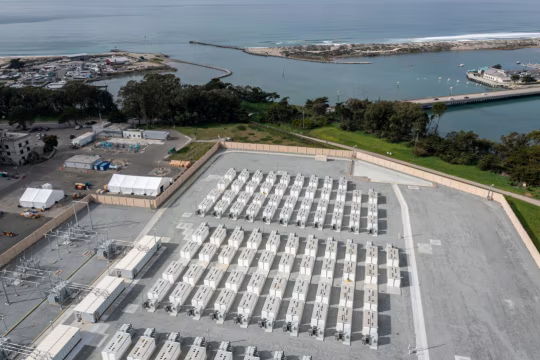
💡Battery shift bolsters AI data center power needs amid EV slump
⚡ 30-Second TL;DR
What Changed
Battery vendors redirecting from EVs to data center and grid storage
Why It Matters
This pivot ensures reliable energy storage supply for power-hungry AI data centers, potentially lowering costs and stabilizing infrastructure amid EV slowdown.
What To Do Next
Assess suppliers like those serving Ford for scalable data center battery storage solutions.
Key Points
- •Battery vendors redirecting from EVs to data center and grid storage
- •Trump policies end EV subsidies and fuel penalties, cooling market
- •Prior US investments boomed under pro-EV incentives
- •Includes Ford and other automakers adapting
🧠 Deep Insight
Background and context from public sources — not the original article. 7 sources cited.
🔑 Enhanced Key Takeaways
- •Ford plans to invest $2 billion over two years to repurpose its Glendale, Kentucky plant for 5+ MWh storage systems targeting data centers, with production starting in 2027.[1]
- •LG Energy Solution and SK On are repurposing EV battery lines for stationary storage, while GM partners with Redwood Energy to deploy new and used EV batteries in hybrid data center solutions.[1]
- •Converting EV battery plants to stationary storage costs up to one-third of total capex and takes up to 18 months, involving retooling for larger cells with thicker electrodes and grid-ready racks.[1]
- •Data centers use BESS for UPS, load buffering against AI-induced MW-scale power swings, faster grid interconnections, and demonstrating flexibility to utilities.[2]
🛠️ Technical Deep Dive
- •Shift from EV batteries prioritizing energy density to stationary storage emphasizing cycle life requires larger cells, thicker electrodes, different additives, and replacing pack assembly lines for bigger grid racks.[1]
- •Data center BESS roles include UPS (with VRLA-to-Li-ion transitions and long-duration needs), real-time load buffering for AI workloads, interconnection enablement, and grid flexibility; alternatives like sodium-ion, redox flow, nickel-zinc, and second-life EV batteries are under review.[2]
🔮 Future ImplicationsAI analysis grounded in cited sources
⏳ Timeline
📎 Sources (7)
Factual claims are grounded in the sources below. Forward-looking analysis is AI-generated interpretation.
- latitudemedia.com — The Ev Batteries to Stationary Storage Switch
- futuremarketsinc.com — Battery Storage for Data Centers Commercial Industry 2026 2036
- blog.heatspring.com — How the Shift From Evs to Data Centers Is Reshaping the Battery Market
- energy-storage.news — US Renewables and Battery Storage Are Poised for Sustained Growth As Data Centre Demand Accelerates
- ess-news.com — Whats Next for Battery Technology in 2026
- veckta.com — 2026 Energy Predictions Batteries AI Data Centers and the Institutional Capital Shift
- batterybusinessclub.com — The Top 5 Battery Industry Trends Driving Innovation in 2026
Weekly AI Recap
Read this week's curated digest of top AI events →
👉Related Updates


AI-curated news aggregator. All content rights belong to original publishers.
Original source: cnBeta (Full RSS) ↗
This is a summary, not the original. Read the source, or get the weekly briefing.
Weekly AI briefing
One email a week. Unsubscribe anytime.