Autonomous Delivery Cart Blocks a Truck for 20 Minutes
💡A real-world autonomy failure shows why delivery robots need robust recovery and human-intervention workflows.
⚡ 30-Second TL;DR
What Changed
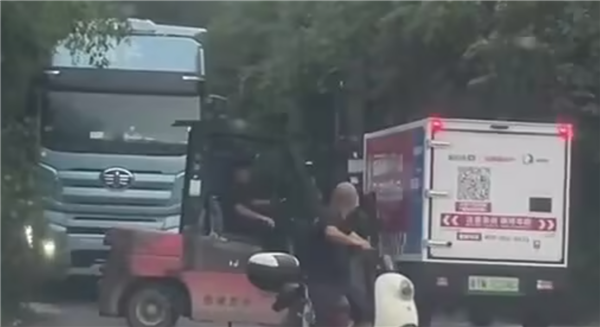
The autonomous delivery vehicle stopped in the middle of a tree-lined rural road.
Why It Matters
The incident illustrates a practical deployment risk for autonomous delivery fleets: unusual encounters with human-driven vehicles can cause service disruption and safety concerns. Operators may need stronger remote-assistance, roadside recovery, and road-sharing policies before scaling these systems.
What To Do Next
Add a ROS 2/Nav2 recovery scenario that detects prolonged standstill conflicts, requests remote assistance, and safely navigates the vehicle to a roadside fallback position.
Key Points
- •The autonomous delivery vehicle stopped in the middle of a tree-lined rural road.
- •An approaching logistics truck was unable to pass, creating a 20-minute traffic blockage.
- •The incident was resolved manually with a forklift, highlighting the importance of recovery and remote-intervention procedures.
🧠 Deep Insight
AI-generated analysis for this event.
🔑 Enhanced Key Takeaways
- •The incident occurred in a rural area of China, involving a delivery robot operated by a major e-commerce logistics provider, which reportedly suffered a sensor calibration failure due to the dense tree canopy.
- •Local traffic regulations in the region currently lack specific protocols for autonomous vehicle (AV) obstruction, leading to a legal gray area regarding liability for the 20-minute delay.
- •The autonomous unit utilized a 'fail-safe' mode that locked its wheels upon detecting a perceived obstacle, which was actually a shadow, preventing it from maneuvering to the side of the road.
- •Industry experts noted that this specific model lacks a 'remote override' capability for steering, necessitating physical intervention when the onboard AI enters a non-recoverable state.
- •The viral nature of the video has prompted local transport authorities to initiate a review of safety requirements for sidewalk and rural road delivery robots operating in public spaces.
📊 Competitor Analysis▸ Show
| Feature | Autonomous Delivery Cart (Subject) | Starship Technologies | Nuro |
|---|---|---|---|
| Primary Environment | Rural/Sidewalk | Sidewalk | Public Road |
| Remote Intervention | Limited (Physical Only) | High (Teleoperation) | High (Teleoperation) |
| Obstacle Handling | Fail-safe (Lock) | Dynamic Rerouting | Dynamic Rerouting |
| Pricing Model | Per Delivery | Subscription/Per Delivery | Partnership/Fleet |
🛠️ Technical Deep Dive
- Sensor Suite: Utilizes a combination of LiDAR, ultrasonic sensors, and monocular cameras for obstacle detection.
- Fail-Safe Mechanism: Implements a hardware-level braking system that engages when the central processing unit loses heartbeat signals from the navigation stack.
- Navigation Architecture: Relies on pre-mapped high-definition (HD) tiles; failure to match real-time sensor data with HD maps triggers a 'stop-and-wait' state.
- Connectivity: Operates on 5G/V2X protocols, though signal attenuation in rural tree-lined areas frequently causes latency spikes.
🔮 Future ImplicationsAI analysis grounded in cited sources
⏳ Timeline
Weekly AI Recap
Read this week's curated digest of top AI events →
👉Related Updates

AI-curated news aggregator. All content rights belong to original publishers.
Original source: cnBeta (Full RSS) ↗