Apple's supply chain leaks in India
💡Understand the risks of global supply chain diversification for hardware product security.
⚡ 30-Second TL;DR
What Changed
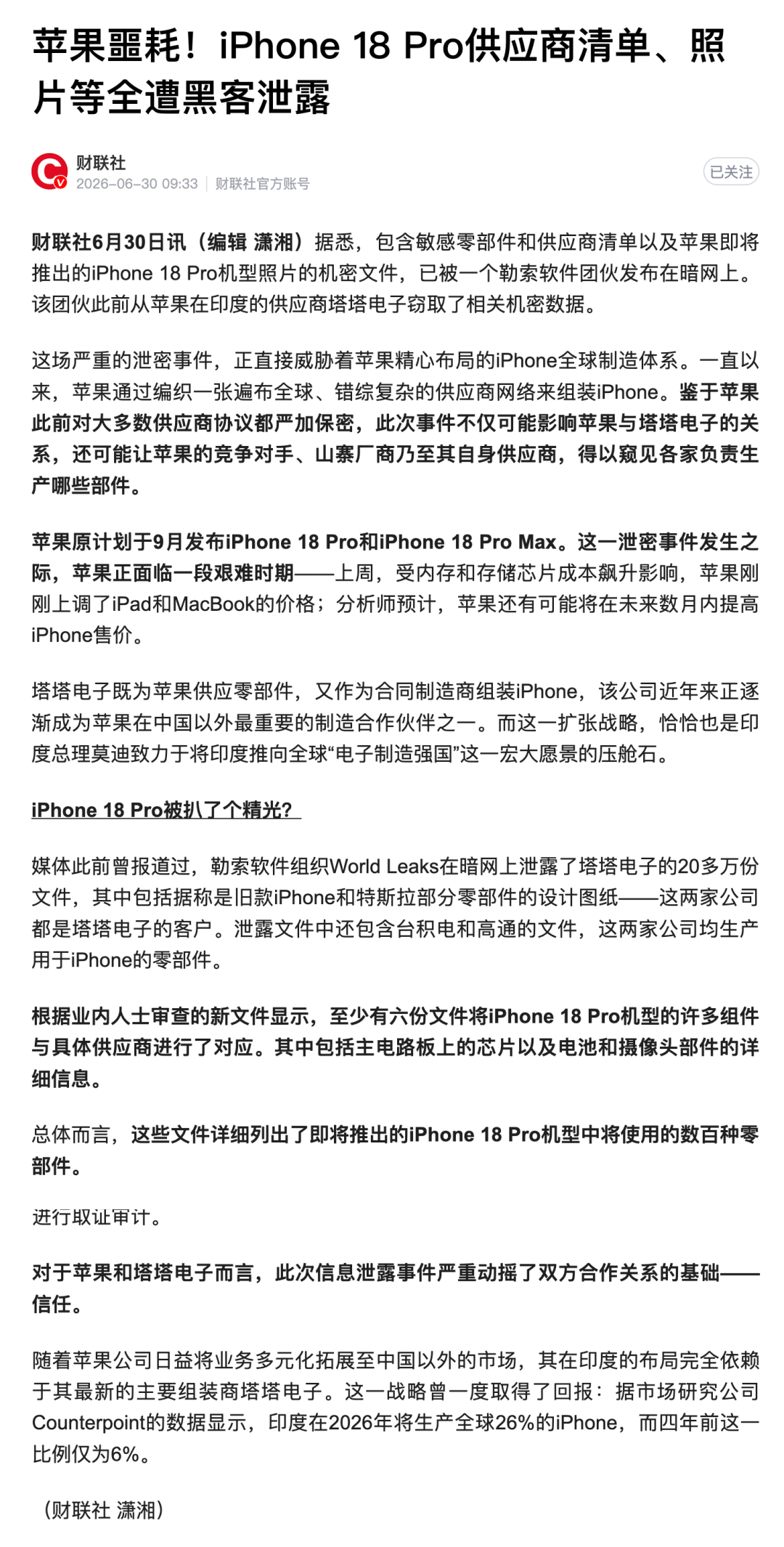
New iPhone product details, including design and supplier lists, were leaked from the Indian supply chain.
Why It Matters
Supply chain security failures can lead to loss of competitive advantage and intellectual property. This incident may force Apple to re-evaluate its diversification strategy.
What To Do Next
Implement stricter data loss prevention (DLP) protocols for third-party manufacturing partners.
Key Points
- •New iPhone product details, including design and supplier lists, were leaked from the Indian supply chain.
- •The scale of the leak is described as unprecedented compared to previous Apple security incidents.
- •The article questions the operational stability and security standards of manufacturing in India.
🧠 Deep Insight
AI-generated analysis for this event — not the original article.
🔑 Enhanced Key Takeaways
- •The leaks reportedly originated from mid-level management at a key Indian assembly partner, highlighting vulnerabilities in internal data access controls compared to Apple's more mature Chinese supply chain operations.
- •Internal investigations suggest the breach involved the exfiltration of CAD files and bill-of-materials (BOM) data, which were allegedly sold to third-party accessory manufacturers to facilitate 'day-one' clone production.
- •Apple has initiated a 'Project Shield' audit in India, mandating stricter biometric access for physical design labs and implementing real-time digital watermarking on all shared engineering documents.
- •The Indian government has launched a parallel inquiry into the incident, concerned that the security failure could jeopardize the 'Make in India' initiative's reputation for high-tech manufacturing reliability.
- •Industry analysts note that the leak has forced Apple to reconsider its 'China Plus One' strategy, potentially slowing the transition of high-end Pro model production to Indian facilities until security parity is achieved.
🛠️ Technical Deep Dive
- Implementation of digital watermarking: Apple is deploying steganographic tracking pixels embedded in CAD files to trace document origin if leaked.
- Biometric access control: Transitioning from badge-based entry to multi-factor biometric authentication (iris and palm scanning) for all sensitive R&D zones in Indian facilities.
- Data Loss Prevention (DLP) upgrades: Deployment of AI-driven network monitoring tools that flag anomalous data transfer patterns, specifically targeting large-file exports of proprietary schematics.
🔮 Future ImplicationsAI analysis grounded in cited sources
⏳ Timeline
Weekly AI Recap
Read this week's curated digest of top AI events →
👉Related Updates

AI-curated news aggregator. All content rights belong to original publishers.
Original source: 虎嗅 ↗
This is a summary, not the original. Read the source, or get the weekly briefing.
Weekly AI briefing
One email a week. Unsubscribe anytime.