Apple LiTo: Single Image to Realistic 3D
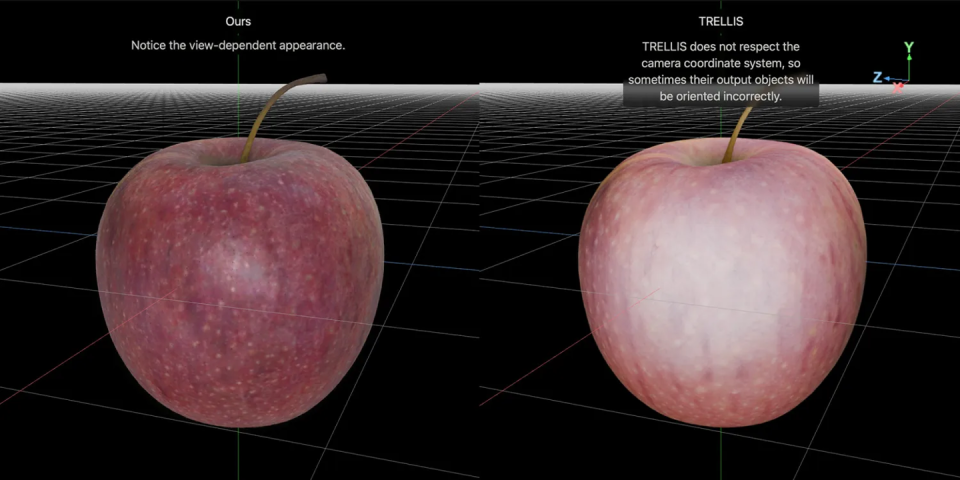
💡Apple's single-photo 3D with perfect lighting—breakthrough for vision researchers.
⚡ 30-Second TL;DR
What Changed
Reconstructs full 3D from single planar image
Why It Matters
LiTo could transform AR/VR content creation and computer vision apps by simplifying 3D modeling workflows for developers and creators.
What To Do Next
Test LiTo on GitHub or Apple's research repo for single-image 3D experiments.
Key Points
- •Reconstructs full 3D from single planar image
- •Accurately renders multi-view light and shadow
- •Surface Light Field Tokenization technique
- •Overcomes multi-angle input requirement
🧠 Deep Insight
Background and context from public sources — not the original article. 6 sources cited.
🔑 Enhanced Key Takeaways
- •LiTo uses a Perceiver-IO encoder to process up to one million surface light field samples into 8192 latent tokens of 32 dimensions each.[1][4]
- •The model employs higher-order spherical harmonics in its Gaussian decoder to capture specularities, highlights, and Fresnel effects.[1][5]
- •A latent flow matching model is trained on the representation to generate 3D objects conditioned on a single input image.[3][4]
- •LiTo outperforms baselines like TRELLIS in visual quality, input fidelity, and correct camera coordinate orientation.[6]
📊 Competitor Analysis▸ Show
| Feature | LiTo (Apple) | TRELLIS |
|---|---|---|
| Single-image 3D generation | Yes | Yes |
| View-dependent effects (specular, Fresnel) | High fidelity with spherical harmonics | Lower fidelity |
| Latent space size | Compact (8192 x 32-dim tokens) | Larger |
| Camera coordinate respect | Yes (correct orientation) | No (sometimes incorrect) |
| Benchmarks | Higher visual quality and input fidelity | Outperformed by LiTo |
🛠️ Technical Deep Dive
- •Encoder: Perceiver-IO architecture with cross-attention and voxel-based self-attention; processes N surface light field samples (position, color, viewing direction) into k=8192, d=32-dimensional latent vectors.[1][4]
- •Decoders: Geometry decoder via flow matching for surface reconstruction; 3D Gaussian decoder predicts higher-order spherical harmonics for view-dependent radiance.[1][5]
- •Training: Uses multi-view RGB-D data; latent flow matching enables single-image conditioned generation.[3][4]
- •Input processing: Up to 1 million randomly subsampled observations per object, normalized for explicit direction-dependent supervision.[1]
🔮 Future ImplicationsAI analysis grounded in cited sources
⏳ Timeline
📎 Sources (6)
Factual claims are grounded in the sources below. Forward-looking analysis is AI-generated interpretation.
Weekly AI Recap
Read this week's curated digest of top AI events →
👉Related Updates


AI-curated news aggregator. All content rights belong to original publishers.
Original source: cnBeta (Full RSS) ↗
This is a summary, not the original. Read the source, or get the weekly briefing.
Weekly AI briefing
One email a week. Unsubscribe anytime.