Amazon UAE Data Centres Targeted by Drones
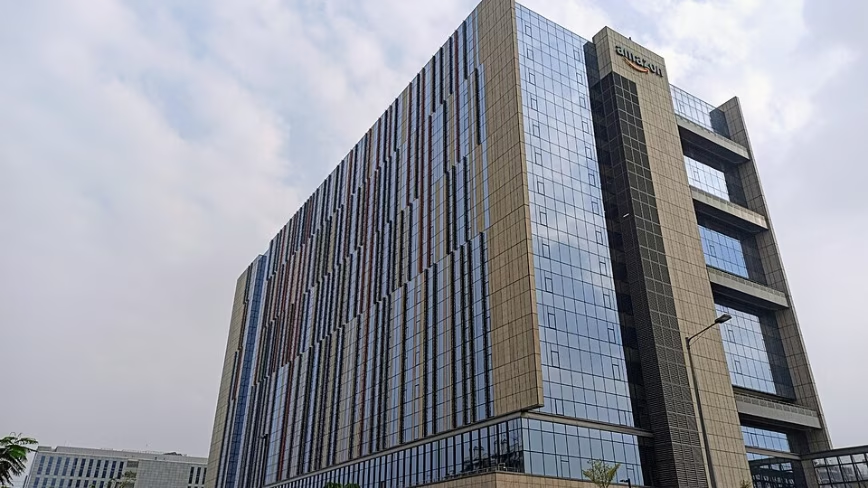
Understand how geopolitical risks impact the physical infrastructure underpinning global AI development.
30-Second TL;DR
What Changed
Two AWS data centres in the UAE were targeted by drones
Why It Matters
Geopolitical instability in key AI infrastructure hubs may force companies to reconsider their data center geographic distribution strategies.
What To Do Next
Review your cloud provider's regional disaster recovery and multi-region failover capabilities for your mission-critical AI workloads.
Key Points
- •Two AWS data centres in the UAE were targeted by drones
- •The incident threatens the Gulf's AI infrastructure development
- •Regional instability is testing the resilience of global cloud providers
Deep Insight
Background and context from public sources — not the original article. 15 sources cited.
Enhanced Key Takeaways
- •The drone strikes, attributed to Iran following joint U.S.-Israeli actions, represent the first confirmed military attack on a hyperscale cloud provider's physical infrastructure, impacting AWS's ME-CENTRAL-1 region in the UAE and ME-SOUTH-1 in Bahrain.
- •The attacks on March 1, 2026, directly struck two AWS availability zones in the UAE (mec1-az2 and mec1-az3) and damaged a third in Bahrain (mes1-az2) from a nearby explosion, causing structural damage, power disruptions, fires, and water damage from fire suppression systems.
- •The incident led to widespread outages across core AWS services including EC2, S3, DynamoDB, Lambda, and RDS, prompting AWS to advise customers to migrate workloads to unaffected regions due to a 'prolonged' recovery period.
- •The disruption highlights the vulnerability of cloud infrastructure in geopolitically unstable regions, challenging the Gulf's strategy to attract significant AI investment by altering the region's risk profile and potentially pausing data center projects.
- •The architectural resilience of AWS S3, designed to withstand the loss of a single availability zone, failed when two zones were simultaneously compromised, demonstrating a critical vulnerability to coordinated multi-zone physical attacks.
Competitor Analysis
- UAE Data Center Presence
- Middle East (UAE) Region (me-central-1) launched August 2022 with three Availability Zones; Middle East (Bahrain) Region launched July 2019.
- AI Infrastructure & Resilience Notes
- Two UAE availability zones directly struck by drones, a third in Bahrain damaged, causing widespread outages across core services. Resilience against single AZ failure was tested and failed against coordinated multi-AZ attack.
- UAE Data Center Presence
- Dedicated data centers in UAE (UAE North in Dubai and UAE Central in Abu Dhabi) with three availability zones in Dubai. Significant expansion (200MW) announced with G42, expected online before end of 2026, strengthening AI and cloud infrastructure.
- AI Infrastructure & Resilience Notes
- Offers data residency, low latency, and paired regions for disaster recovery within the UAE. Actively investing in and expanding secure, scalable, and sovereign cloud services in the region.
- UAE Data Center Presence
- No dedicated data center region in Dubai or the UAE. Middle East presence includes Doha, Qatar, and Dammam, Saudi Arabia.
- AI Infrastructure & Resilience Notes
- Workloads for UAE customers are routed through nearby regions, which may not satisfy strict UAE data residency requirements or ultra-low latency needs.
| Cloud Provider | UAE Data Center Presence | AI Infrastructure & Resilience Notes |
|---|---|---|
| Amazon Web Services (AWS) | Middle East (UAE) Region (me-central-1) launched August 2022 with three Availability Zones; Middle East (Bahrain) Region launched July 2019. | Two UAE availability zones directly struck by drones, a third in Bahrain damaged, causing widespread outages across core services. Resilience against single AZ failure was tested and failed against coordinated multi-AZ attack. |
| Microsoft Azure | Dedicated data centers in UAE (UAE North in Dubai and UAE Central in Abu Dhabi) with three availability zones in Dubai. Significant expansion (200MW) announced with G42, expected online before end of 2026, strengthening AI and cloud infrastructure. | Offers data residency, low latency, and paired regions for disaster recovery within the UAE. Actively investing in and expanding secure, scalable, and sovereign cloud services in the region. |
| Google Cloud | No dedicated data center region in Dubai or the UAE. Middle East presence includes Doha, Qatar, and Dammam, Saudi Arabia. | Workloads for UAE customers are routed through nearby regions, which may not satisfy strict UAE data residency requirements or ultra-low latency needs. |
Technical Deep Dive
- The drone strikes specifically targeted AWS availability zones mec1-az2 and mec1-az3 in the UAE, and mes1-az2 in Bahrain.
- Physical damage included structural compromise, disruption of power delivery, and secondary water damage from activated fire suppression systems.
- AWS's S3 storage service, designed for resilience against a single availability zone failure, experienced collapse when two zones were simultaneously hit, indicating a vulnerability to coordinated multi-zone physical attacks.
- Recovery efforts were complicated and prolonged due to the extent of physical damage and the requirement for approvals from local authorities before re-energizing affected infrastructure.
Future ImplicationsAI analysis grounded in cited sources
Timeline
- 2017-10UAE Government announces National Strategy for Artificial Intelligence 2031.
- 2019-07AWS Middle East (Bahrain) Region opens.
- 2022-08AWS Middle East (UAE) Region (me-central-1) launches with three Availability Zones.
- 2026-03-01Iranian drone strikes hit two AWS data centers in the UAE and a third in Bahrain.
- 2026-03-02AWS confirms direct strikes on UAE facilities and damage to Bahrain facility, causing widespread outages.
- 2026-03-03AWS advises customers to migrate critical data and switch to servers in other parts of the world due to prolonged recovery.
Sources (15)
Factual claims are grounded in the sources below. Forward-looking analysis is AI-generated interpretation.
Weekly AI Recap
Read this week's curated digest of top AI events →
Related Updates



AI-curated news aggregator. All content rights belong to original publishers.
Original source: The Next Web (TNW) ↗
This is a summary, not the original. Read the source, or get the weekly briefing.
The weekly digest
One email a week. Unsubscribe anytime.