Alipay Launches Radical AI-Powered Conversational Revamp
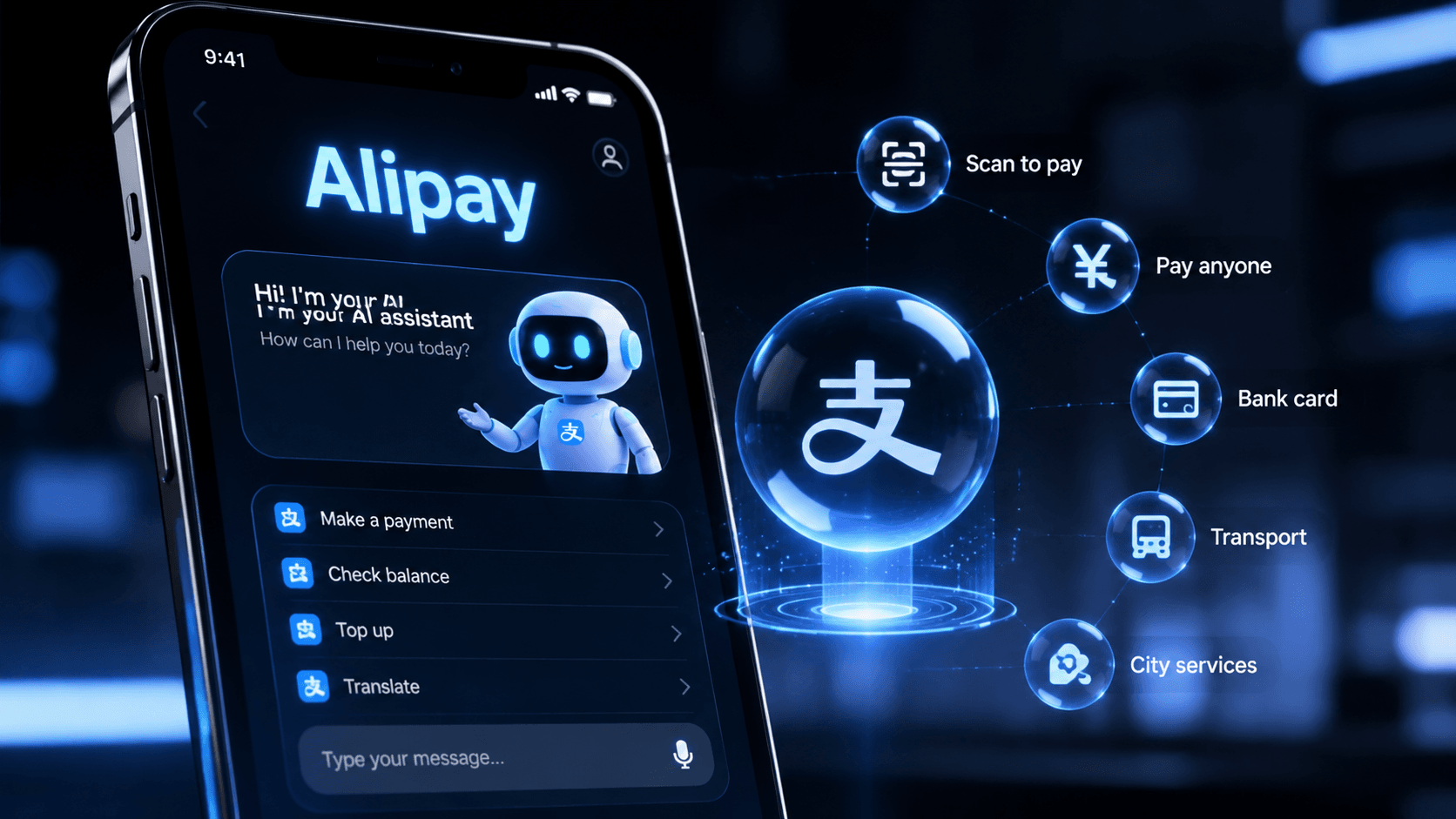
See how a global payment giant is replacing traditional UI with AI agents to redefine the super-app experience.
30-Second TL;DR
What Changed
Transition from static app menus to conversational AI interaction
Why It Matters
This move validates the 'Agentic UI' trend, where conversational interfaces replace traditional navigation. It sets a new standard for super-apps to integrate LLMs directly into user workflows.
What To Do Next
Explore implementing a conversational intent-matching layer if your product has a complex menu structure that could be simplified by an AI agent.
Key Points
- •Transition from static app menus to conversational AI interaction
- •Ant Group's most significant platform overhaul in 20 years
- •Integration of AI agents to handle complex service requests
Deep Insight
Background and context from public sources — not the original article. 26 sources cited.
Enhanced Key Takeaways
- •The conversational AI revamp, internally codenamed "Bao Plan," introduces an AI assistant named "Ah Bao" (or "Abao") that allows users to switch to a completely new, conversation-driven interface with a single click, moving beyond simply embedding an AI assistant.
- •Alipay employs a dual-track approach for integrating its vast ecosystem of services: encouraging willing merchants to actively integrate their services as AI-callable functions (MCP interfaces) and simultaneously using AI-powered visual interface comprehension ("screen-reading") to operate unmodified mini-programs under user authorization.
- •Ant Group has been developing its own large language models (LLMs), including the Ling, Ring, and Ming series, with trillion-parameter models like Ling-1T, Ring-1T, Ling-2.5-1T, and Ring-2.5-1T being open-sourced and designed for efficient reasoning and agent interaction.
- •Alipay AI Pay, an AI-native payment solution introduced in 2025, had already surpassed 100 million users by February 2026 and processed over 300 million AI payment transactions by May 2026, demonstrating significant early adoption of AI-driven payments.
- •The shift to an AI-first super app is a strategic response by Ant Group following regulatory interventions in 2020 that halted its IPO and placed restrictions on its lending operations, pushing the company to innovate and expand into new business areas like AI.
Competitor Analysis
- Alipay (Ah Bao)
- Radical conversational AI interface overhaul, optional one-click switch to AI-native UI.
- WeChat (AI Agent)
- Embedded AI agent within existing social contexts (chats, official accounts), no separate interface.
- ByteDance (Douyin/Doubao)
- AI deeply integrated across services, Doubao as an AI-native app for e-commerce.
- Alibaba (Qwen)
- LLM app integrated with ecosystem agents, full integration with Taobao for AI shopping.
- Alipay (Ah Bao)
- Coordinates 10,000+ services (ride-hailing, food delivery, mutual funds, etc.) via natural language.
- WeChat (AI Agent)
- Expected to invoke all ecosystem capabilities (mini-programs, payments, official accounts) via natural language.
- ByteDance (Douyin/Doubao)
- Direct orders and payments within Doubao app for e-commerce, general AI services.
- Alibaba (Qwen)
- Handles 100M+ conversational requests daily across maps, ride-hailing, shopping, etc.
- Alipay (Ah Bao)
- AI agents can complete payments with explicit user authorization; launched Token Pay and AI Wallet.
- WeChat (AI Agent)
- AI agent can execute investment operations and other financial tasks with authorization.
- ByteDance (Douyin/Doubao)
- Users can place orders and complete payments directly within the Doubao app.
- Alibaba (Qwen)
- AI-powered shopping journey includes order placement and fulfillment.
- Alipay (Ah Bao)
- Dual-track: encourages merchant integration as AI-callable functions (MCP) or uses AI screen-reading for unmodified mini-programs.
- WeChat (AI Agent)
- Two modes: developers authorize source code access or encapsulate services into "Skills."
- ByteDance (Douyin/Doubao)
- (Details not specified for developer integration with AI agents)
- Alibaba (Qwen)
- (Details not specified for developer integration with AI agents)
- Alipay (Ah Bao)
- ~1 billion users.
- WeChat (AI Agent)
- ~1.432 billion monthly active users.
- ByteDance (Douyin/Doubao)
- (Not specified, but Douyin is widely used)
- Alibaba (Qwen)
- (Qwen serves 100M+ conversational requests daily)
| Feature/Platform | Alipay (Ah Bao) | WeChat (AI Agent) | ByteDance (Douyin/Doubao) | Alibaba (Qwen) |
|---|---|---|---|---|
| Core Approach | Radical conversational AI interface overhaul, optional one-click switch to AI-native UI. | Embedded AI agent within existing social contexts (chats, official accounts), no separate interface. | AI deeply integrated across services, Doubao as an AI-native app for e-commerce. | LLM app integrated with ecosystem agents, full integration with Taobao for AI shopping. |
| Service Scope | Coordinates 10,000+ services (ride-hailing, food delivery, mutual funds, etc.) via natural language. | Expected to invoke all ecosystem capabilities (mini-programs, payments, official accounts) via natural language. | Direct orders and payments within Doubao app for e-commerce, general AI services. | Handles 100M+ conversational requests daily across maps, ride-hailing, shopping, etc. |
| Payment Integration | AI agents can complete payments with explicit user authorization; launched Token Pay and AI Wallet. | AI agent can execute investment operations and other financial tasks with authorization. | Users can place orders and complete payments directly within the Doubao app. | AI-powered shopping journey includes order placement and fulfillment. |
| Developer Integration | Dual-track: encourages merchant integration as AI-callable functions (MCP) or uses AI screen-reading for unmodified mini-programs. | Two modes: developers authorize source code access or encapsulate services into "Skills." | (Details not specified for developer integration with AI agents) | (Details not specified for developer integration with AI agents) |
| User Base (approx.) | ~1 billion users. | ~1.432 billion monthly active users. | (Not specified, but Douyin is widely used) | (Qwen serves 100M+ conversational requests daily) |
Technical Deep Dive
- Ant Group's AI models (Ling, Ring, Ming series) are built on an advanced Mixture-of-Experts (MoE) architecture.
- Ling-2.5-1T and Ring-2.5-1T are trillion-parameter models, with Ling-2.5-1T designed for efficient reasoning and agent interaction, supporting context lengths up to one million tokens.
- Ling-2.5-1T demonstrates high reasoning efficiency, matching frontier models on the AIME 2026 benchmark while using significantly fewer tokens (approx. 5,890 tokens compared to 15,000-23,000 for comparable systems).
- Ring-2.5-1T utilizes a hybrid linear architecture to improve structured problem-solving, achieving gold-medal standards on academic mathematics benchmarks like the International Mathematical Olympiad 2025.
- Ling-1T, a trillion-parameter model, was pretrained on 20 trillion tokens, with over 40% of the final pretraining data consisting of chain-of-thought data.
- Fine-tuning for Ling-1T involved CoT-Evo (generating and evolving chains of thought) and an internal reinforcement learning algorithm called Linguistic-Unit Policy Optimization (LPO), which treats sentences as semantic action units for precise reward alignment.
- Alipay's AI system can use "screen-reading" operations to understand and interact with unmodified mini-programs under user authorization, enabling compatibility without requiring developers to rewrite their services.
- The Alipay AI Pay solution supports 95% of general intelligent agent frameworks.
- Alipay has introduced "Token Pay" to handle extremely small, high-frequency payments and "AI Wallet" for autonomous agent spending, forming key infrastructure for the Agent Economy.
Future ImplicationsAI analysis grounded in cited sources
Timeline
- 2020-11Ant Group's planned IPO halted by Chinese regulators, leading to a strategic pivot towards AI development.
- 2025Alipay AI Pay, an AI-native payment solution, was introduced.
- 2025-10Ant Group released Ling-1T, a trillion-parameter general-purpose large language model, and the Ling 2.0 series, demonstrating its foundational AI capabilities.
- 2026-02Alipay AI Pay surpassed 100 million users and processed over 120 million transactions in a week, marking significant adoption of its AI-native payment solution.
- 2026-05Alipay announced over 300 million AI payment transactions and launched Token Pay and AI Wallet, further building out its AI payment ecosystem.
- 2026-06-16Alipay officially unveiled its AI-powered conversational revamp with the "Ah Bao" assistant, representing its biggest platform overhaul in two decades.
Sources (26)
Factual claims are grounded in the sources below. Forward-looking analysis is AI-generated interpretation.
Weekly AI Recap
Read this week's curated digest of top AI events →
Related Updates




AI-curated news aggregator. All content rights belong to original publishers.
Original source: Pandaily ↗
This is a summary, not the original. Read the source, or get the weekly briefing.
The weekly digest
One email a week. Unsubscribe anytime.