AI Is Turning Kids’ Cartoons Toxic
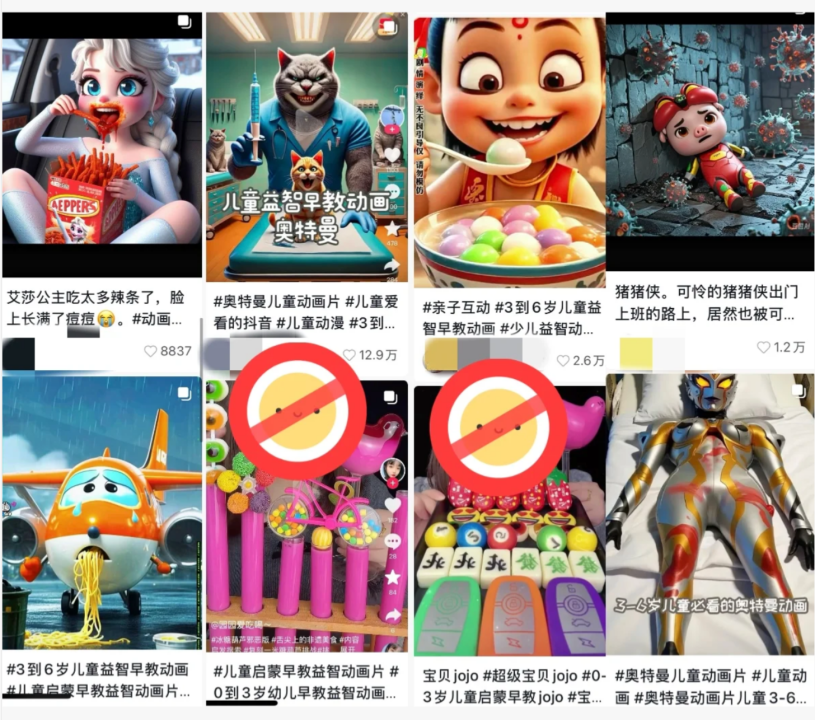
💡AI video makes disturbing children’s content cheap to produce—and recommendation systems can deliver it at scale.
⚡ 30-Second TL;DR
What Changed
AI-generated videos remix characters such as Nezha, Elsa, Peppa Pig, and Minions into disturbing or inappropriate scenarios.
Why It Matters
For AI video platforms and children’s media products, safety cannot rely solely on parental supervision or user reporting. Character recognition, age-aware recommendation, provenance labeling, and stronger generation and distribution filters are becoming core product requirements.
What To Do Next
If you build an AI video or recommendation product, add a child-safety test set covering violence, sexualization, and familiar-character misuse before releasing new generation features.
Key Points
- •AI-generated videos remix characters such as Nezha, Elsa, Peppa Pig, and Minions into disturbing or inappropriate scenarios.
- •A repeatable formula—familiar characters, uncanny visuals, and meaningless extreme actions—supports high-volume production.
- •Children often select content based on recognizable characters rather than quality, allowing engagement signals to reinforce harmful recommendations.
- •Youth modes can be easily unlocked or disrupted by account switching, leaving parents with limited visibility and control.
- •Repeated exposure may shape children’s understanding of violence, mockery, sexuality, hierarchy, and social behavior.
🧠 Deep Insight
AI-generated analysis for this event.
🔑 Enhanced Key Takeaways
- •The phenomenon is often referred to as 'Elsagate 2.0,' drawing parallels to the 2017 controversy where human-curated disturbing content targeted children on YouTube.
- •Generative AI tools have reduced the cost of production for these videos to near zero, allowing bad actors to generate thousands of clips per day using automated workflows.
- •Platform algorithms prioritize 'watch time' and 'retention rate' metrics, which these bizarre, high-stimulus AI videos excel at capturing, inadvertently incentivizing the spread of harmful content.
- •Many of these videos utilize 'low-effort' AI animation tools that suffer from temporal inconsistency, which paradoxically increases the 'uncanny valley' effect that keeps children watching out of curiosity.
- •Regulatory bodies in multiple jurisdictions are currently debating whether to classify AI-generated content targeting minors as 'synthetic media' requiring mandatory watermarking and stricter age-gating.
🛠️ Technical Deep Dive
- Production pipelines typically integrate Large Language Models (LLMs) for script generation, text-to-image models (like Midjourney or Stable Diffusion) for character assets, and text-to-video models (such as Kling, Sora, or Runway Gen-3) for animation.
- Automated workflows often use Python-based scripts to batch-process character swaps, applying LoRA (Low-Rank Adaptation) models to maintain character consistency across different scenes.
- Content farms utilize headless browser automation to upload videos to multiple platforms simultaneously, bypassing manual review processes through high-volume, low-metadata uploads.
- Recommendation engines utilize collaborative filtering that groups these AI videos with legitimate children's content based on shared metadata tags, effectively 'piggybacking' on the traffic of popular IPs.
🔮 Future ImplicationsAI analysis grounded in cited sources
⏳ Timeline
Weekly AI Recap
Read this week's curated digest of top AI events →
👉Related Updates

AI-curated news aggregator. All content rights belong to original publishers.
Original source: 虎嗅 ↗