Encrypted CoT Replay Exposes Hidden Reasoning
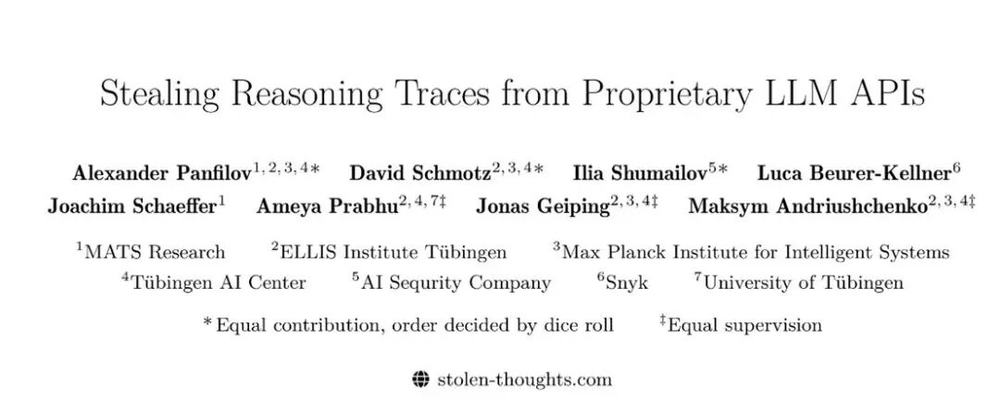
💡A low-cost attack may turn hidden chain-of-thought into plaintext—and expose user data with it.
⚡ 30-Second TL;DR
What Changed
Weak sibling models can act as fuzzy decoders for encrypted reasoning traces.
Why It Matters
AI providers may need to redesign stateless context handling, key management, model routing, and chain-of-thought privacy controls. Developers using hidden reasoning should assume that client-returned encrypted artifacts may become cross-model disclosure channels.
What To Do Next
Audit your application logs and client-side state for retained encrypted reasoning blocks, and remove or encrypt them with per-session, server-controlled keys.
Key Points
- •Weak sibling models can act as fuzzy decoders for encrypted reasoning traces.
- •The attack exploits client-held encrypted blocks, cross-model compatibility, and apparently shared encryption keys.
- •Decoding 10,000 traces with Claude Haiku 4.5 was estimated to cost about $720 in API fees.
- •Shared Agent logs on GitHub and Hugging Face may expose sensitive encrypted reasoning without requiring frontier-model access.
- •OpenAI and Anthropic were reportedly notified months earlier but initially assessed the risk as difficult to reproduce or lacking security impact.
🧠 Deep Insight
AI-generated analysis for this event.
🔑 Enhanced Key Takeaways
- •The vulnerability relies on 'latent space alignment' between models of the same family, where the internal representation of reasoning tokens remains consistent even when the model size varies significantly.
- •Researchers identified that the encryption mechanism used for CoT blocks often utilizes a static, model-family-specific salt, which facilitates the 'fuzzy decoding' process across different model tiers.
- •The attack vector is particularly effective against 'Reasoning-as-a-Service' architectures where the client-side application stores CoT logs locally for debugging or UI rendering purposes.
- •Security researchers have proposed a 'CoT-scrubbing' mitigation strategy that involves re-encoding reasoning traces with ephemeral, user-specific keys before they are stored in client-side logs.
- •The vulnerability has been categorized under a new class of 'Side-Channel Reasoning Attacks' (SCRAs), which specifically target the leakage of hidden cognitive processes rather than just the final output tokens.
🛠️ Technical Deep Dive
- The attack utilizes a technique called 'Cross-Model Latent Projection' where the encrypted CoT block is treated as a sequence of high-dimensional embeddings.
- The 'fuzzy decoder' model (e.g., Claude Haiku 4.5) is prompted with a prefix that forces it to treat the encrypted block as a continuation of its own internal reasoning state.
- Because the underlying transformer architecture shares positional encoding schemes, the smaller model can map the encrypted tokens back to its own vocabulary space with high semantic fidelity.
- The process bypasses standard token-level encryption by exploiting the model's ability to perform 'semantic reconstruction' based on the statistical distribution of the encrypted reasoning tokens.
🔮 Future ImplicationsAI analysis grounded in cited sources
⏳ Timeline
Weekly AI Recap
Read this week's curated digest of top AI events →
👉Related Updates

AI-curated news aggregator. All content rights belong to original publishers.
Original source: 虎嗅 ↗