AI-generated content volume surpasses human output
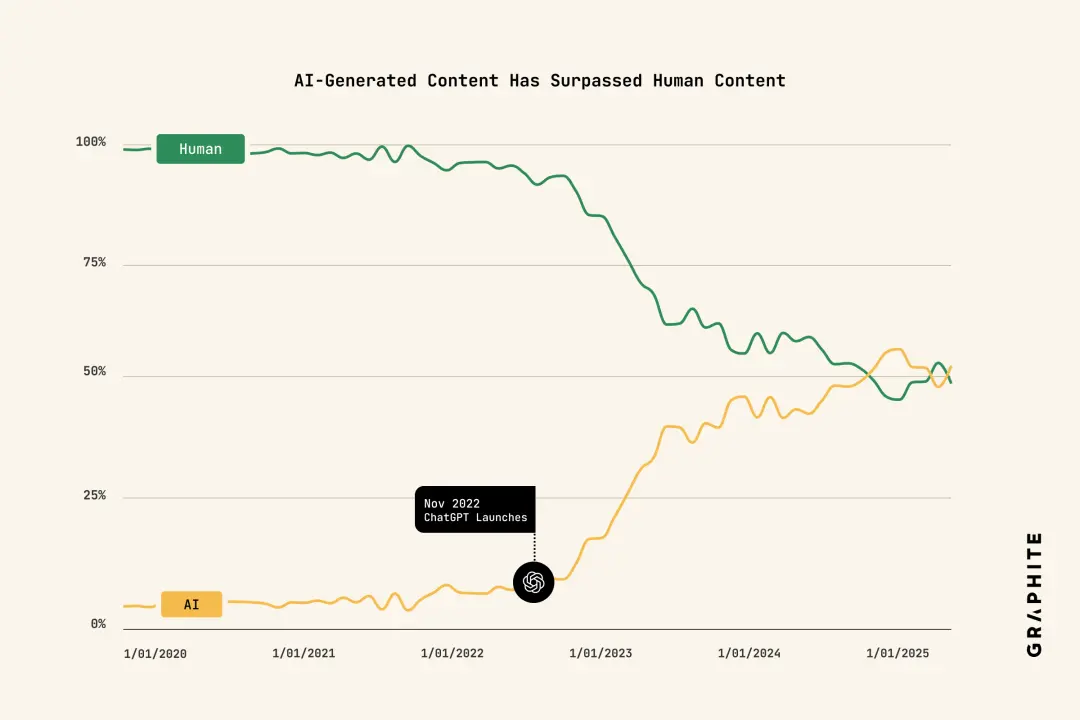
💡Understand the existential risks of model collapse and the future of data quality in the age of synthetic content.
⚡ 30-Second TL;DR
What Changed
AI-generated content volume exceeded human output in Nov 2024
Why It Matters
The saturation of AI-generated content threatens the quality of future datasets and the diversity of human thought. It forces a re-evaluation of how we curate data for LLM training.
What To Do Next
Implement strict data filtering and provenance tracking in your training pipelines to avoid training on low-quality synthetic 'slop'.
Key Points
- •AI-generated content volume exceeded human output in Nov 2024
- •Merriam-Webster named 'slop' as the 2025 word of the year
- •Risk of model collapse due to AI training on AI-generated data
🧠 Deep Insight
Web-grounded analysis with 34 cited sources.
🔑 Enhanced Key Takeaways
- •By mid-2025, approximately 35% of newly published websites were classified as AI-generated or AI-assisted, a substantial increase from negligible amounts before ChatGPT's launch in late 2022.
- •Merriam-Webster officially designated 'slop' as its 2025 Word of the Year, defining it as 'digital content of low quality that is produced usually in quantity by means of artificial intelligence,' reflecting the pervasive influx of such content online.
- •AI model collapse is characterized by the progressive degradation of a model's performance and its inability to accurately represent the original data distribution, leading to homogenized outputs and the loss of rare or minority patterns.
- •The global market for AI-generated content (AIGC) was valued at an estimated USD 12.88 billion in 2024 and is projected to grow to USD 53.79 billion by 2033, driven by the increasing demand for automated and scalable content creation.
- •Current AI content detection tools are struggling to keep pace with the rapid advancements in AI language models, with their accuracy significantly reduced by even minor human edits or paraphrasing, making reliable distinction between human and AI-generated text increasingly difficult.
🛠️ Technical Deep Dive
- Model Collapse: This phenomenon is primarily caused by recursive data training, where AI models are repeatedly fed data generated by other AI systems. Contributing factors include reduced access to original human-authored data, contamination from synthetic datasets, feedback loops in data aggregation, and a lack of provenance tracking for content sources.
- Data Poisoning: This involves the deliberate injection of malicious or misleading information into AI training datasets to manipulate a model's behavior, thereby compromising its accuracy, reliability, and ethical performance. Common attack methods include backdoor poisoning, mislabeling, data injection, data manipulation, label flipping, and clean-label poisoning.
- Synthetic Data: Artificially generated data is designed to mimic the statistical properties of real-world information, offering solutions for data scarcity, privacy concerns, and cost reduction in AI development. However, if the generative models used to create synthetic data are trained on biased real data, these biases can be amplified. Over-reliance on synthetic data can also contribute to model collapse.
- AI Content Detection Challenges: The effectiveness of AI content detection tools is diminishing as generative AI models become more sophisticated. Simple adversarial techniques, such as introducing spelling mistakes, varying sentence lengths (burstiness), or increasing syntactic complexity, can significantly reduce detection rates. Studies indicate that human accuracy in distinguishing AI-generated text from human-written content barely exceeds 50%.
🔮 Future ImplicationsAI analysis grounded in cited sources
⏳ Timeline
📎 Sources (34)
Factual claims are grounded in the sources below. Forward-looking analysis is AI-generated interpretation.
- arxiv.org
- merriam-webster.com
- pbs.org
- hola.com
- smithsonianmag.com
- mashable.com
- witness.ai
- datacamp.com
- analyticsvidhya.com
- digitalbricks.ai
- grandviewresearch.com
- medium.com
- sunycreate.cloud
- superannotate.com
- cloudflare.com
- owasp.org
- cmu.edu
- knostic.ai
- sentinelone.com
- ibm.com
- moveworks.com
- dataversity.net
- medium.com
- oeaw.ac.at
- github.io
- onyxgs.com
- ibm.com
- krater.ai
- dataversity.net
- rigb.org
- bernardmarr.com
- askmona.ai
- grammarly.com
- graphite.io
Weekly AI Recap
Read this week's curated digest of top AI events →
👉Related Updates
Same topic
Explore #data-quality
Same product
More on generative-ai
Same source
Latest from cnBeta (Full RSS)

PACA: Open-source tool for ancient fossil coordinate mapping

First atmosphere detected on habitable-zone exoplanet

Samsung Secures $200B Broadcom AI Infrastructure Deal

How AMD's 2006 ATI Acquisition Built Today's AI Empire
AI-curated news aggregator. All content rights belong to original publishers.
Original source: cnBeta (Full RSS) ↗