AI Data Centers Trigger BBU Cell Rush
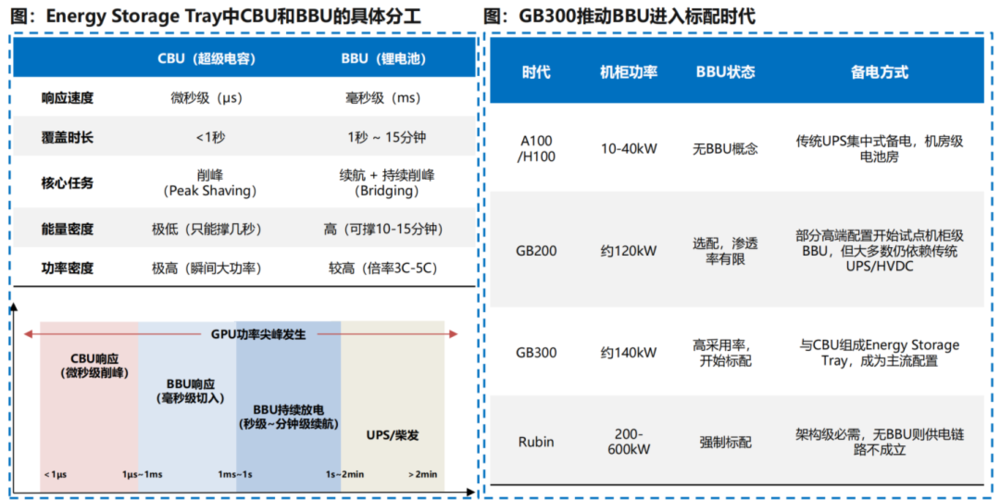
💡AI racks are jumping from 120kW to 600kW+, making BBU cells the next critical infrastructure bottleneck.
⚡ 30-Second TL;DR
What Changed
Global BBU cell shipments rose from about 50 million units in 2024 to approximately 276 million in the first half of 2026.
Why It Matters
BBU shortages could become a physical bottleneck for deploying high-density AI clusters, affecting server delivery schedules, data-center commissioning, and power reliability. AI infrastructure buyers may need multi-source strategies and earlier battery qualification to avoid supply-chain delays.
What To Do Next
For any new AI data-center deployment, add BBU cell qualification and dual-source approval to the procurement schedule at least 12 months before production.
Key Points
- •Global BBU cell shipments rose from about 50 million units in 2024 to approximately 276 million in the first half of 2026.
- •BBU demand is projected to approach 400 million cells in 2026 and nearly 2.8 billion by 2030.
- •Nvidia's GB300 and Rubin-era systems increasingly integrate BBU or energy-storage trays as standard equipment.
- •Panasonic, Murata, and Samsung SDI control more than 80% of the BBU cell market, while Chinese suppliers face lengthy customer qualification cycles.
🧠 Deep Insight
Background and context from public sources — not the original article. 16 sources cited.
🔑 Enhanced Key Takeaways
- •AI server rack density has quadrupled since 2021, reaching an average of 27 kilowatts in 2026, with Nvidia's GB200 platform operating at 100-137 kW and the upcoming Vera Rubin platform projected to reach 200-300 kW per rack, potentially exceeding 600 kW for Rubin Ultra.
- •The increasing adoption of rack-level Battery Backup Units (BBUs) is a direct response to the rapid and drastic power fluctuations inherent in GPU-intensive AI workloads, enabling immediate power compensation closer to the load and improving system resilience.
- •Lithium-ion batteries are the preferred chemistry for AI data center BBUs due to their superior energy density, faster charging capabilities, and extended cycle life compared to traditional lead-acid alternatives, facilitating more compact, lighter, and modular designs.
- •The global BBU power supply market for AI data centers was valued at approximately $1.276 billion in 2024 and is projected to grow to $2.993 billion by 2032, demonstrating a Compound Annual Growth Rate (CAGR) of 13.8%.
- •Chinese manufacturers, including BAK Power, are actively developing advanced BBU cell technologies, such as new ultra-high-power long-life 2170 cylindrical cells with enhanced charge/discharge rates and thermal stability, specifically for high-density, liquid-cooled AI data center architectures.
🛠️ Technical Deep Dive
- Purpose: BBUs provide short-duration power (typically seconds to minutes) at the server or rack level to ensure ride-through during momentary power interruptions, smooth out rapid power fluctuations from GPU loads, and facilitate orderly system shutdowns to prevent data loss.
- Chemistry & Form Factor: Lithium-ion batteries are dominant, with NMC (Nickel Manganese Cobalt) offering high energy density for space-constrained systems and LiFePO4 (Lithium Iron Phosphate) providing robust thermal stability and long cycle life. LTO (Lithium Titanate Oxide) is considered for exceptionally high-cycle applications. Common form factors include 18650 and 2170 cylindrical cells.
- Integration & Architecture: The trend is shifting from centralized UPS systems to distributed, rack-level or server-level BBUs. These are often integrated into higher-voltage DC architectures (e.g., 48V or 800V DC) to reduce power conversion stages, minimize losses, and deliver power more efficiently and closer to the load.
- Nvidia Systems: Nvidia's GB300 NVL72 rack-scale system, designed for liquid cooling, incorporates 8 power shelves, each rated at 33 kW and containing six 5.5 kW PSUs, with a full rack potentially requiring up to 142 kW. These systems utilize energy storage for power smoothing to handle synchronous GPU load ramps.
- OCP Standards: The Open Compute Project (OCP) ORV3 BBU standard specifies a 15 kW power output for 4 minutes of system operation per BBU unit, based on Li-Ion 18650 type cells (3.5V-4.2V cell voltage, minimum 1.5 Ah capacity, 30A continuous discharge current) in an 11S6P configuration.
- Battery Management Systems (BMS): Critical for reliability, BMS monitor key parameters like voltage, current, temperature, State of Charge (SOC), and State of Health (SOH). They manage charging/discharging, cell balancing, fault detection, and communication with facility controllers.
- Dynamic Load Handling: BBUs for AI servers must deliver fast response to dynamic AI loads, providing power during short load peaks, absorbing energy when demand falls, and stabilizing the DC bus, often operating at high switching frequencies (10 kHz to 1 MHz).
- Safety & Standards: The proliferation of lithium-ion BBUs necessitates robust safety measures, including secondary protection mechanisms against overcurrent, overcharging, and over-temperature. Compliance with standards such as UN 38.3, IEC 62619, UL 1973, and UL 9540 is crucial.
🔮 Future ImplicationsAI analysis grounded in cited sources
⏳ Timeline
📎 Sources (16)
Factual claims are grounded in the sources below. Forward-looking analysis is AI-generated interpretation.
Weekly AI Recap
Read this week's curated digest of top AI events →
👉Related Updates
AI-curated news aggregator. All content rights belong to original publishers.
Original source: 虎嗅 ↗
This is a summary, not the original. Read the source, or get the weekly briefing.
Weekly AI briefing
One email a week. Unsubscribe anytime.