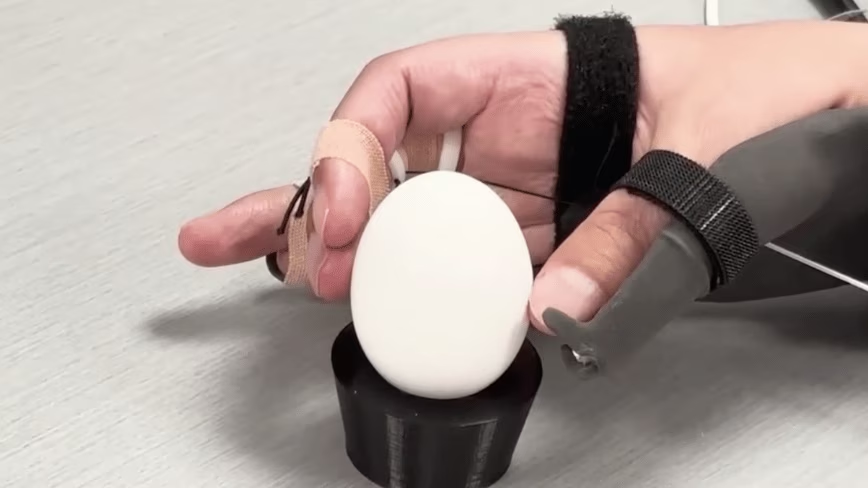
來源較早收集於 26m

AI 腦部植入物成功恢復癱瘓患者的運動與觸覺

閱讀原文: The Next Web (TNW)
#bci#neuroscience#healthcare

突破性的 BCI 研究,展示了 AI 驅動的神經繞道技術,能恢復複雜的人類感官與運動功能。

30 秒速覽

有什麼變化

系統使用「雙神經繞道」技術重新連接大腦與脊髓。

為什麼重要

這項技術為先進的腦機介面(BCI)鋪平了道路,使其功能超越單純的運動控制,進而包含感官恢復。

下一步行動

探索 Kaggle 或 Nature 開放研究儲存庫上的最新 BCI 數據集,以了解神經訊號解碼技術。

誰應關注:Researchers & Academics

關鍵要點

  • 系統使用「雙神經繞道」技術重新連接大腦與脊髓。
  • 成功恢復了一名癱瘓男性的運動功能與感官回饋。
  • 研究發表於《Nature Medicine》,標誌著神經 AI 整合的重大突破。

深度解析

本篇為 AI 生成分析,非原文內容。

增強重點摘要

  • The study utilized a high-density microelectrode array implanted in the motor cortex to decode neural signals, which were then processed by a machine learning algorithm to stimulate the spinal cord.
  • Sensory feedback was achieved through a closed-loop system that stimulated the somatosensory cortex, allowing the patient to 'feel' the pressure of objects being grasped.
  • This research represents a significant advancement over previous 'single' bypass systems by simultaneously addressing both efferent (motor) and afferent (sensory) pathways.
  • The patient involved in the study had a chronic spinal cord injury (SCI) sustained several years prior, demonstrating the potential for neuroplasticity even in long-term paralysis cases.
  • The AI model employed a real-time decoding architecture that adapts to signal drift, a common challenge in long-term brain-computer interface (BCI) stability.

競品分析

Primary Focus
Double Neural Bypass (Nature Medicine)
Restoration of motor & sensory
Neuralink (Telepathy)
Communication & device control
Synchron (Stentrode)
Motor control via blood vessels
Invasiveness
Double Neural Bypass (Nature Medicine)
High (Cortical Implants)
Neuralink (Telepathy)
High (Cortical Implants)
Synchron (Stentrode)
Low (Endovascular)
Sensory Feedback
Double Neural Bypass (Nature Medicine)
Yes (Closed-loop)
Neuralink (Telepathy)
No
Synchron (Stentrode)
No
Clinical Status
Double Neural Bypass (Nature Medicine)
Research/Clinical Trial
Neuralink (Telepathy)
Human Trials
Synchron (Stentrode)
Human Trials

技術深入

  • System Architecture: Utilizes a dual-pathway closed-loop neural interface that bridges the gap between the brain and spinal cord.
  • Signal Processing: Employs a machine learning decoder trained on real-time neural firing patterns to predict intended movement.
  • Stimulation Protocol: Uses epidural electrical stimulation (EES) on the spinal cord to execute motor commands decoded from the motor cortex.
  • Sensory Integration: Implements intracortical microstimulation (ICMS) in the somatosensory cortex to provide artificial tactile feedback.
  • Latency: The system operates with sub-100ms latency to ensure the sensory feedback is perceived as synchronous with the motor action.

前景展望基於引用來源的 AI 分析

Standardization of bidirectional BCIs in clinical rehabilitation
The success of this study provides a clinical roadmap for integrating sensory feedback into existing motor-only neuroprosthetics.
Reduction in hardware size for fully implantable systems
The transition from external processing units to fully internalized AI chips will be the next critical hurdle for commercial viability.

時間線

2023-05
Researchers demonstrate a digital bridge between brain and spinal cord to restore walking.
2024-09
Initial clinical testing of bidirectional neural interfaces begins for upper limb control.
2026-05
Publication of the double neural bypass study in Nature Medicine.

事件追蹤

AI 週報

閱讀本週精選 AI 大事摘要 →

AI 策展新聞聚合。所有內容版權歸原始發布者所有。
原始來源: The Next Web (TNW)

這是摘要,不是原文。去看原站,或訂閱每週簡報。

每週電子報

每週一封,可隨時退訂。