Zoox Begins Charging for Las Vegas Robotaxi Rides
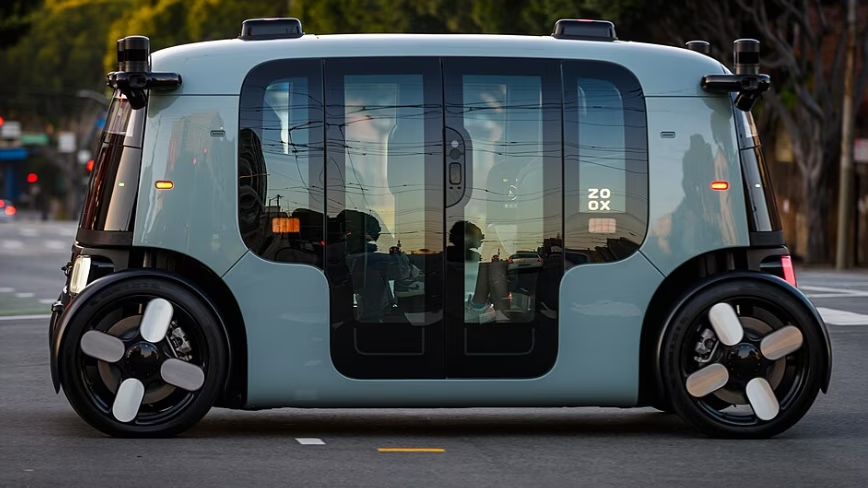
Zoox is turning its Las Vegas robotaxi experiment into a measurable paid service.
30-Second TL;DR
What Changed
Zoox will start charging for Las Vegas robotaxi rides on August 10.
Why It Matters
The move marks a shift from robotaxi testing toward a paid commercial service, providing a clearer path to measuring demand and unit economics. It also gives AI and autonomy developers a visible benchmark for operating driverless transportation at consumer prices.
What To Do Next
Track Zoox’s Las Vegas launch pricing and compare it with Waymo comfort-tier fares to estimate the commercial benchmark for autonomous ride services.
Key Points
- •Zoox will start charging for Las Vegas robotaxi rides on August 10.
- •Pricing will include a base fare plus distance and time charges.
- •Airport trips will incur additional destination fees.
- •Zoox says its fares will be competitive with comfort-tier ride-hailing services.
Deep Insight
AI-generated analysis for this event — not the original article.
Enhanced Key Takeaways
- •Zoox's vehicle design is purpose-built as a carriage-style robotaxi without a steering wheel or pedals, distinguishing it from retrofitted passenger vehicles used by many competitors.
- •The Las Vegas expansion follows years of rigorous testing in the city, including public road trials that began in 2023 and the successful completion of driverless operations with employees.
- •Zoox operates under the umbrella of Amazon's 'Autonomous Vehicles' division, leveraging the parent company's massive logistics and cloud computing infrastructure for fleet management.
- •The service utilizes a proprietary sensor suite that provides a 270-degree field of view at each corner of the vehicle, eliminating blind spots common in traditional automotive designs.
- •Regulatory approval for this commercial phase was granted by the Nevada Department of Motor Vehicles following extensive safety validation and data reporting requirements.
Competitor Analysis
- Zoox
- Purpose-built (No steering wheel)
- Waymo
- Retrofitted (Jaguar I-PACE)
- Uber/Lyft (Human)
- Standard consumer vehicles
- Zoox
- Robotaxi-only
- Waymo
- Robotaxi-only
- Uber/Lyft (Human)
- Hybrid (Human/Autonomous)
- Zoox
- Urban/Dense environments
- Waymo
- Urban/Suburban
- Uber/Lyft (Human)
- Global/Mass market
- Zoox
- Comfort-tier competitive
- Waymo
- Dynamic/Market-based
- Uber/Lyft (Human)
- Dynamic/Surge-based
| Feature | Zoox | Waymo | Uber/Lyft (Human) |
|---|---|---|---|
| Vehicle Design | Purpose-built (No steering wheel) | Retrofitted (Jaguar I-PACE) | Standard consumer vehicles |
| Operational Model | Robotaxi-only | Robotaxi-only | Hybrid (Human/Autonomous) |
| Primary Market | Urban/Dense environments | Urban/Suburban | Global/Mass market |
| Pricing Strategy | Comfort-tier competitive | Dynamic/Market-based | Dynamic/Surge-based |
Technical Deep Dive
- Vehicle Architecture: Bidirectional driving capability allowing the vehicle to change direction without performing a U-turn.
- Safety Systems: 100+ safety innovations including airbag designs for carriage-style seating and redundant braking/steering systems.
- Sensor Suite: Integration of LiDAR, radar, and cameras at all four corners to achieve a 270-degree field of view per sensor module.
- Compute Platform: Utilizes high-performance onboard computing to process sensor data in real-time for path planning and obstacle avoidance.
- Fleet Management: Cloud-based orchestration system for remote assistance and vehicle dispatching.
Future ImplicationsAI analysis grounded in cited sources
Timeline
- 2020-06Amazon officially acquires Zoox to accelerate autonomous vehicle development.
- 2020-12Zoox unveils its purpose-built, carriage-style autonomous robotaxi.
- 2023-02Zoox conducts the first driverless run of its purpose-built vehicle on public roads in California.
- 2023-06Zoox begins public road testing of its robotaxi in Las Vegas.
- 2024-05Zoox receives expanded testing permits in Nevada to operate without human safety drivers.
Event Coverage
Weekly AI Recap
Read this week's curated digest of top AI events →
Related Updates



AI-curated news aggregator. All content rights belong to original publishers.
Original source: The Next Web (TNW) ↗
This is a summary, not the original. Read the source, or get the weekly briefing.
The weekly digest
One email a week. Unsubscribe anytime.