XPeng Q4 Earnings Reveal AI Advances
💡XPeng's 750 TOPS chip + VLA 2.0 accelerate China robotaxi/humanoid race
⚡ 30-Second TL;DR
What Changed
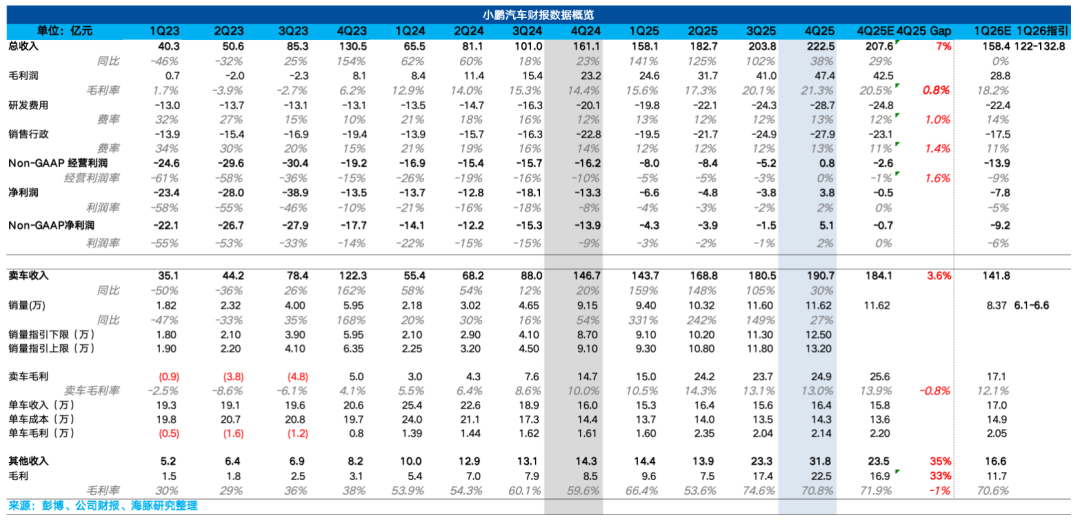
Revenue hit 223B CNY, driven by 32B services income from VW tech and carbon credits
Why It Matters
XPeng's weak Q1 2026 guidance signals delivery pressures, but AI and overseas expansion could drive 52万 unit deliveries. High-margin AI services offset auto losses, positioning as 'Eastern Tesla' in embodied AI.
What To Do Next
Test XPeng VLA 2.0 demos for visual-language-action integration in robot prototypes.
Key Points
- •Revenue hit 223B CNY, driven by 32B services income from VW tech and carbon credits
- •Auto gross margin stuck at 13% despite X9 mix shift, due to cost hikes
- •Launched VLA 2.0 visual-language-action model and 750 TOPS Turing chip
- •2026 Robotaxi with 3000 TOPS and no HD maps; Ironman robot with solid-state battery
🧠 Deep Insight
Background and context from public sources — not the original article. 12 sources cited.
🔑 Enhanced Key Takeaways
- •Turing Chip Architecture: The 750 TOPS chip features a 40-core processor and dual NPUs specifically designed to run 30-billion-parameter models with 100% utilization, effectively replacing three Nvidia Orin-X chips in performance.
- •VLA 2.0 'Vision-to-Action': Unlike traditional modular stacks, VLA 2.0 utilizes a 'Vision-Implicit Token-Action' path that bypasses intermediate language translation, resulting in a 13x improvement in takeover mileage (MPI) on complex narrow roads.
- •Cross-Platform VW Integration: The XPeng-VW partnership has expanded the China Electronic Architecture (CEA) to include internal combustion engine (ICE) and hybrid platforms, not just BEVs, significantly scaling XPeng's tech licensing revenue.
- •Robotaxi Hardware Redundancy: The 2026 Robotaxi fleet will utilize four Turing chips (3000 TOPS) and a dual-redundant hardware architecture for steering and braking to meet L4 safety standards without relying on lidar or HD maps.
- •Ironman's Solid-State Advantage: The humanoid robot's all-solid-state battery achieves 500 Wh/kg energy density, doubling the capacity of traditional lithium-ion packs in the same footprint while ensuring safety in indoor environments.
📊 Competitor Analysis▸ Show
| Feature | XPeng (VLA 2.0 / Turing) | Tesla (FSD v14 / AI5) | Huawei (ADS 4.0) |
|---|---|---|---|
| Compute (TOPS) | 2250 - 3000 (In-house) | 3000 - 7200 (In-house) | ~400 - 800 (Ascend) |
| Sensor Strategy | Pure Vision (Robotaxi/Ultra) | Pure Vision | Multi-sensor Fusion (Lidar) |
| Map Dependency | No HD Maps | No HD Maps | High (for L3/L4 features) |
| Model Parameters | Up to 30 Billion | Estimated 10B - 50B | Proprietary |
| Price (Software) | Included in Ultra/Robo | ~64,000 CNY (FSD) | ~30,000 - 36,000 CNY |
🛠️ Technical Deep Dive
- Turing AI Chip: 40-core CPU architecture with dual-independent Image Signal Processors (ISPs) and an 'independent safety island' for L4 redundancy.
- VLA 2.0 Training: Trained on a dataset of 100 million real-world driving clips, equivalent to 65,000 years of human driving experience.
- Ironman Robot Mechanics: 82 total degrees of freedom (DoF) with 22 DoF in each hand, utilizing the industry's smallest harmonic joints to achieve 1:1 human hand scale.
- Solid-State Battery: 500 Wh/kg density; capable of withstanding 250°C environments and 3mm nail penetration without fire, specifically chosen for indoor robot safety.
🔮 Future ImplicationsAI analysis grounded in cited sources
⏳ Timeline
📎 Sources (12)
Factual claims are grounded in the sources below. Forward-looking analysis is AI-generated interpretation.
Weekly AI Recap
Read this week's curated digest of top AI events →
👉Related Updates


AI-curated news aggregator. All content rights belong to original publishers.
Original source: 虎嗅 ↗
This is a summary, not the original. Read the source, or get the weekly briefing.
Weekly AI briefing
One email a week. Unsubscribe anytime.