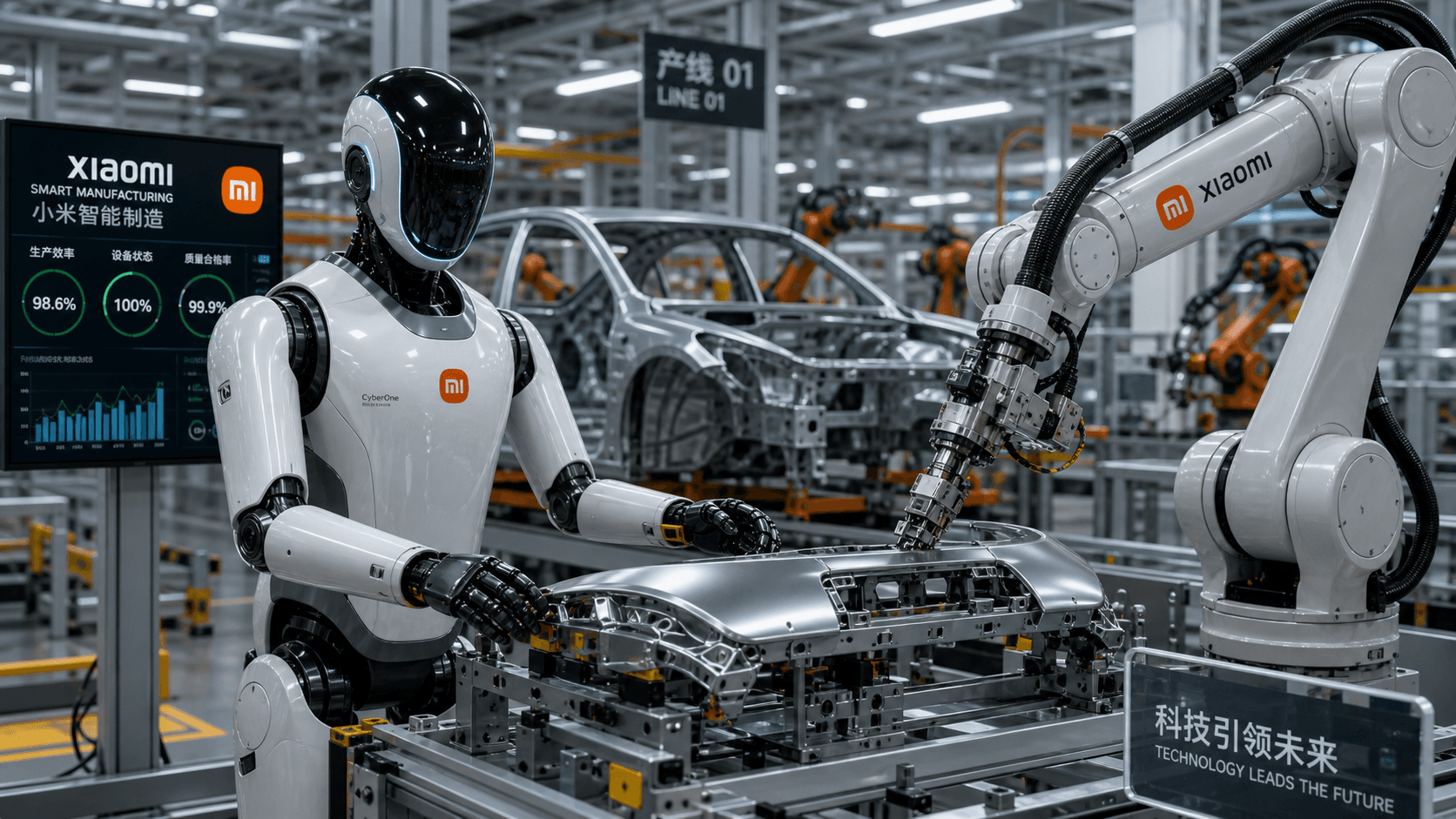
Xiaomi humanoid robot achieves 98% task success rate

💡See how embodied AI is closing the gap with human precision in real-world industrial manufacturing.
⚡ 30-Second TL;DR
What Changed
Robot success rate for nut loading improved from 90.2% to 98% over four months.
Why It Matters
This progress demonstrates the rapid maturation of embodied AI in industrial manufacturing. It signals a shift where humanoid robots are becoming viable for high-precision assembly tasks.
What To Do Next
Analyze the error logs of your robotic vision systems to identify the specific failure modes that prevent your models from reaching 99%+ reliability.
Key Points
- •Robot success rate for nut loading improved from 90.2% to 98% over four months.
- •Performance gap with human workers narrowed to just one percentage point.
- •Deployment focused on real-world automotive factory assembly line tasks.
🧠 Deep Insight
AI-generated analysis for this event.
🔑 Enhanced Key Takeaways
- •Xiaomi's humanoid robot, CyberOne, utilizes a proprietary Mi-Sense depth vision module combined with an AI interaction algorithm to perceive 3D space and recognize individuals, gestures, and expressions.
- •The robot's integration into automotive manufacturing is part of a broader 'Xiaomi Smart Factory' initiative, which aims to automate complex assembly tasks that previously required high-precision human dexterity.
- •Xiaomi has leveraged its internal R&D in autonomous driving and AI large models to accelerate the robot's motor control and environmental adaptation capabilities.
- •The 98% success rate milestone was achieved through iterative reinforcement learning, where the robot simulated millions of assembly cycles in a digital twin environment before physical deployment.
- •Beyond nut loading, Xiaomi is actively testing the robot's capability for quality inspection and material handling to create a multi-functional workforce for its EV production lines.
📊 Competitor Analysis▸ Show
| Feature | Xiaomi CyberOne | Tesla Optimus | Figure AI (Figure 02) |
|---|---|---|---|
| Primary Focus | Smart Factory/EV Assembly | General Purpose/Labor | General Purpose/Logistics |
| Key Tech | Mi-Sense/AI Interaction | FSD-derived Vision/Actuators | Neural Networks/End-to-End AI |
| Market Status | Pilot/Factory Deployment | Pilot/Factory Deployment | Commercial Pilot/Partnerships |
| Pricing | Not Publicly Available | Estimated $20k-$30k (Target) | Not Publicly Available |
🛠️ Technical Deep Dive
- Actuation: Utilizes high-torque density motors with a peak torque of 300Nm for the hip joints and precise control for fine motor tasks.
- Vision System: Employs a Mi-Sense depth vision module capable of 3D reconstruction and real-time object recognition.
- Control Architecture: Features a whole-body control algorithm that balances stability with fluid movement, allowing for human-like interaction.
- AI Integration: Incorporates large language models (LLMs) for semantic understanding and task planning, enabling the robot to interpret complex assembly instructions.
- Digital Twin: Uses high-fidelity simulation environments to train neural networks on assembly tasks, significantly reducing the time required for physical fine-tuning.
🔮 Future ImplicationsAI analysis grounded in cited sources
⏳ Timeline
Weekly AI Recap
Read this week's curated digest of top AI events →
👉Related Updates



AI-curated news aggregator. All content rights belong to original publishers.
Original source: TechNode ↗