Xcimer Ignites World's Largest Private 'Phoenix' Laser System
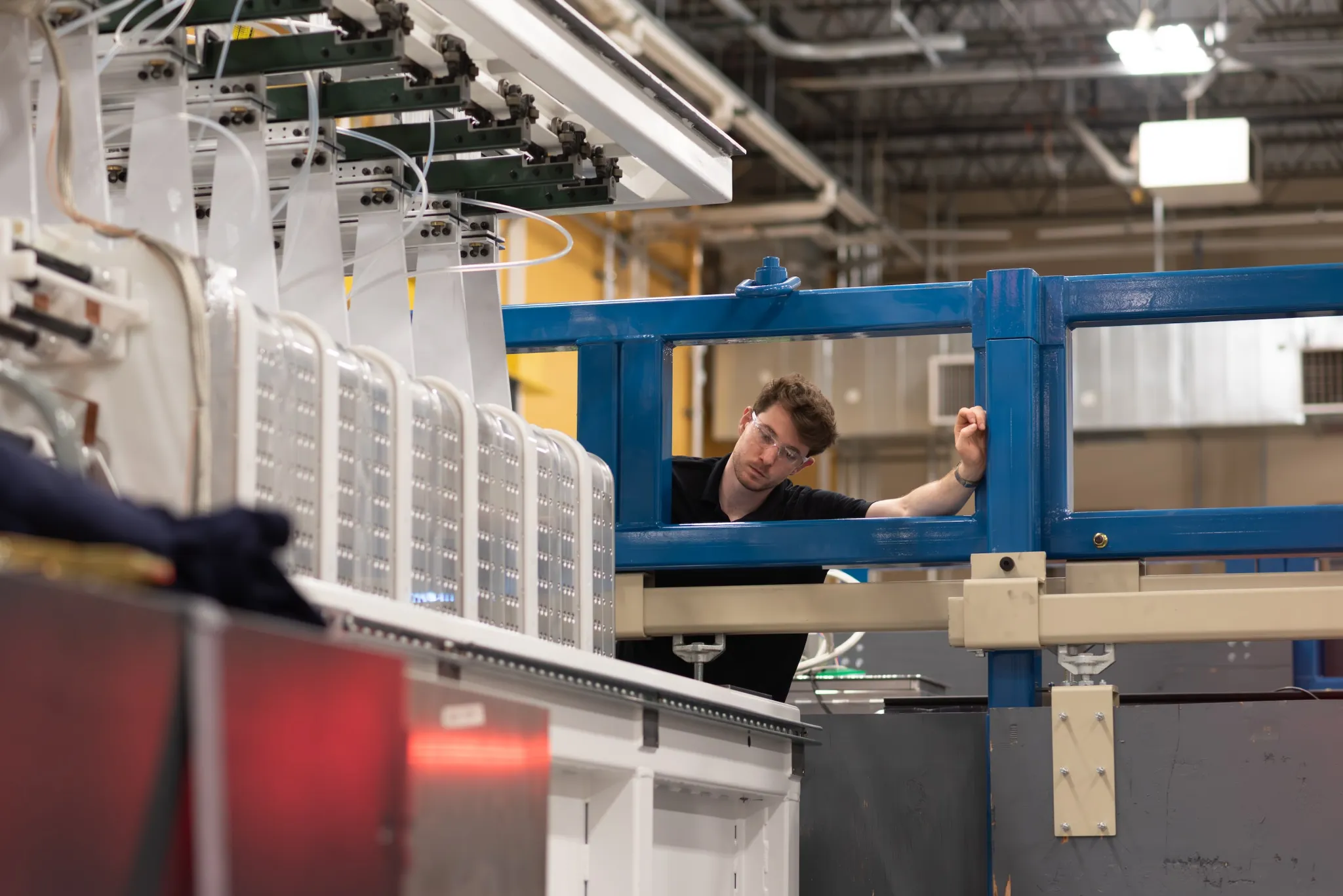
💡Could fusion energy power your future AI clusters? Learn about the latest breakthrough in private laser fusion.
⚡ 30-Second TL;DR
What Changed
Phoenix system is the world's largest privately-owned laser facility
Why It Matters
Successful commercial fusion could provide virtually unlimited clean energy, drastically reducing the power costs for massive AI training clusters.
What To Do Next
Track Xcimer's progress to understand the long-term energy landscape for future AI data center infrastructure.
Key Points
- •Phoenix system is the world's largest privately-owned laser facility
- •Focuses on commercializing inertial confinement fusion energy
- •Builds upon foundational research from the National Ignition Facility (NIF)
🧠 Deep Insight
Background and context from public sources — not the original article. 17 sources cited.
🔑 Enhanced Key Takeaways
- •Xcimer's laser technology utilizes krypton fluoride (KrF) excimer laser amplifiers, which are gas-based, offering a more cost-effective and robust alternative to the solid-state glass lasers used by facilities like NIF, aiming for a 30x reduction in cost per joule.
- •The Phoenix system integrates Stimulated Brillouin Scattering (SBS) for pulse compression, a technique that shortens microsecond-long excimer laser pulses to nanoseconds, and represents the highest-energy application of SBS globally.
- •Xcimer Energy has secured a total of $101 million in funding, including a $100 million Series A round in June 2024 led by Hedosophia, and a $9 million award from the U.S. Department of Energy's Milestone-Based Fusion Development Program.
- •The company's fusion chamber design, based on HYLIFE-III, employs a flowing lithium salt to absorb fusion energy and protect the chamber walls, which is projected to enable a 40-year facility lifetime with minimal maintenance.
- •Xcimer's development roadmap targets achieving 'wall-plug breakeven' with its Vulcan system by 2031 and aims to deploy its Athena power plant, capable of delivering 400 megawatts of electricity to the grid, by 2035.
📊 Competitor Analysis▸ Show
| Company | Fusion Approach | Key Technology/Feature | Funding (approx.) | Key Milestone/Target |
|---|---|---|---|---|
| Xcimer Energy | Laser-driven Inertial Confinement Fusion (ICF) | KrF excimer lasers, SBS pulse compression, 2 beamlines, HYLIFE-III chamber | $101M | Wall-plug breakeven by 2031, commercial plant by 2035 |
| Commonwealth Fusion Systems (CFS) | Magnetic Confinement (Tokamak) | High-temperature superconducting (REBCO) magnets | ~$3 Billion | SPARC device targets Q>1 by 2027 |
| Helion Energy | Magneto-Inertial Fusion | Pulsed-field-reversed configuration | Undisclosed (significant) | Polaris prototype achieved 150M °C plasma in Feb 2026, commercial plant by 2028 |
| First Light Fusion | Inertial Confinement Fusion | Two-stage gas gun to fire projectile at target | Undisclosed (significant) | Achieving ignition by compressing fuel target |
| Pacific Fusion | Inertial Confinement Fusion | Coordinated electromagnetic pulses | $900M (Series A) | Magnetically-driven inertial confinement |
| TAE Technologies | Magnetic Confinement (Field-Reversed Configuration) | Colliding-beam FRC, p-B11 fuel | >$1.3 Billion | Oldest private fusion company (25+ years) |
🛠️ Technical Deep Dive
- Laser Technology: Employs Krypton Fluoride (KrF) excimer laser amplifiers, which use gas as the laser gain medium, offering advantages in cost and durability over solid-state lasers.
- Pulse Compression: Utilizes Stimulated Brillouin Scattering (SBS) to convert microsecond-long laser pulses into nanosecond pulses required for fusion, with Phoenix demonstrating the highest-energy use of SBS globally.
- Beamline Architecture: Designed to operate with only two laser beamlines, a significant reduction compared to NIF's 192, aiming to simplify operations and maintenance.
- Target Energy Delivery: The technology is being developed to deliver 12 MJ of laser light to a fuel capsule from two beams, with each capsule potentially releasing up to 2 GJ of energy.
- Fusion Chamber Design: Incorporates a HYLIFE-III fusion chamber that uses a flowing lithium salt to absorb fusion energy and protect the chamber walls from neutron damage, contributing to a projected 40-year lifespan.
- Repetition Rate: The system is engineered for a low repetition rate, firing the laser and injecting a new fuel capsule every two seconds.
- Cost Efficiency: Aims for a 30x reduction in laser cost per joule compared to the National Ignition Facility (NIF).
- Long Pulse Kinetics (LPK) Platform: A key component of Phoenix, the LPK platform, achieved a record 3-microsecond pulse length for a KrF laser, validating critical aspects of Xcimer's design.
🔮 Future ImplicationsAI analysis grounded in cited sources
⏳ Timeline
📎 Sources (17)
Factual claims are grounded in the sources below. Forward-looking analysis is AI-generated interpretation.
Weekly AI Recap
Read this week's curated digest of top AI events →
👉Related Updates
AI-curated news aggregator. All content rights belong to original publishers.
Original source: cnBeta (Full RSS) ↗
This is a summary, not the original. Read the source, or get the weekly briefing.
The weekly digest
One email a week. Unsubscribe anytime.