Wild Zebra Raises $6M for Socratic AI Tutor
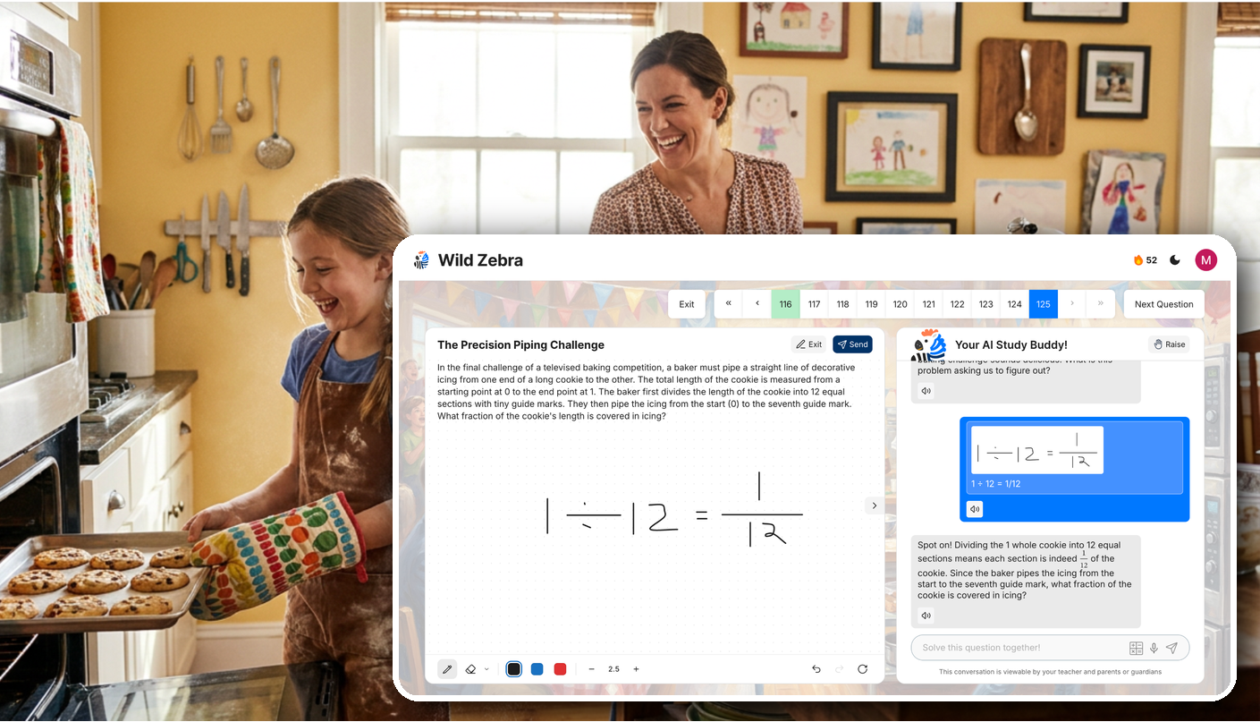
See how Wild Zebra is using question-led AI to scale personalized math and reading support.
30-Second TL;DR
What Changed
Wild Zebra secured $6 million in new funding.
Why It Matters
The funding signals continued investor interest in AI tools designed for learning rather than answer generation. Wild Zebra’s question-led approach could offer a useful model for building educational AI that supports reasoning and reduces overreliance on automated answers.
What To Do Next
Prototype a question-led tutoring flow with an LLM and evaluate whether guided prompts improve student reasoning versus direct-answer responses.
Key Points
- •Wild Zebra secured $6 million in new funding.
- •Its AI tutor covers math and reading for students in grades 2 through 9.
- •The platform uses question-led guidance to encourage students to solve problems independently.
- •The company says its product now reaches tens of thousands of students.
Deep Insight
AI-generated analysis for this event — not the original article.
Enhanced Key Takeaways
- •Wild Zebra was founded by former executives from major EdTech firms, specifically leveraging expertise from companies like Khan Academy and Duolingo to refine their pedagogical approach.
- •The $6 million seed round was led by Reach Capital, a venture firm specializing in early-stage education technology investments.
- •The platform utilizes a proprietary 'Socratic Engine' that integrates with existing school district Learning Management Systems (LMS) to track student progress against Common Core standards.
- •The company plans to utilize the new capital to hire additional AI researchers and pedagogical experts to expand their curriculum coverage to include science and social studies by 2027.
- •Wild Zebra has implemented a 'human-in-the-loop' safety protocol where AI interactions are periodically audited by certified educators to ensure alignment with age-appropriate learning standards.
Competitor Analysis
- Wild Zebra
- Socratic/Question-led
- Khan Academy (Khanmigo)
- Socratic/Guided
- Duolingo (Max)
- Gamified/Direct
- Wild Zebra
- 2-9
- Khan Academy (Khanmigo)
- K-12 & Higher Ed
- Duolingo (Max)
- K-12 & Adult
- Wild Zebra
- Math, Reading
- Khan Academy (Khanmigo)
- Math, Science, Humanities
- Duolingo (Max)
- Language, Math
| Feature | Wild Zebra | Khan Academy (Khanmigo) | Duolingo (Max) |
|---|---|---|---|
| Pedagogical Style | Socratic/Question-led | Socratic/Guided | Gamified/Direct |
| Target Grades | 2-9 | K-12 & Higher Ed | K-12 & Adult |
| Core Subjects | Math, Reading | Math, Science, Humanities | Language, Math |
Technical Deep Dive
- The platform employs a fine-tuned Large Language Model (LLM) architecture optimized for low-latency inference to ensure real-time conversational feedback.
- Uses Reinforcement Learning from Human Feedback (RLHF) specifically trained on transcripts of successful human tutoring sessions to mimic Socratic questioning patterns.
- Implements a vector database for Retrieval-Augmented Generation (RAG) to ground AI responses in verified educational content and curriculum standards.
- Features a proprietary safety layer that filters out direct answers and prevents the model from generating non-educational content.
Future ImplicationsAI analysis grounded in cited sources
Timeline
- 2024-03Wild Zebra is founded by a team of EdTech veterans.
- 2024-11Beta version of the Socratic AI tutor launches for pilot testing in select elementary schools.
- 2025-09Public release of the platform covering math and reading for grades 2-9.
- 2026-08Company secures $6 million in seed funding led by Reach Capital.
Weekly AI Recap
Read this week's curated digest of top AI events →
Related Updates
AI-curated news aggregator. All content rights belong to original publishers.
Original source: GeekWire ↗
This is a summary, not the original. Read the source, or get the weekly briefing.
The weekly digest
One email a week. Unsubscribe anytime.