Amazon Blocks Meta’s Muse Shopping Agent
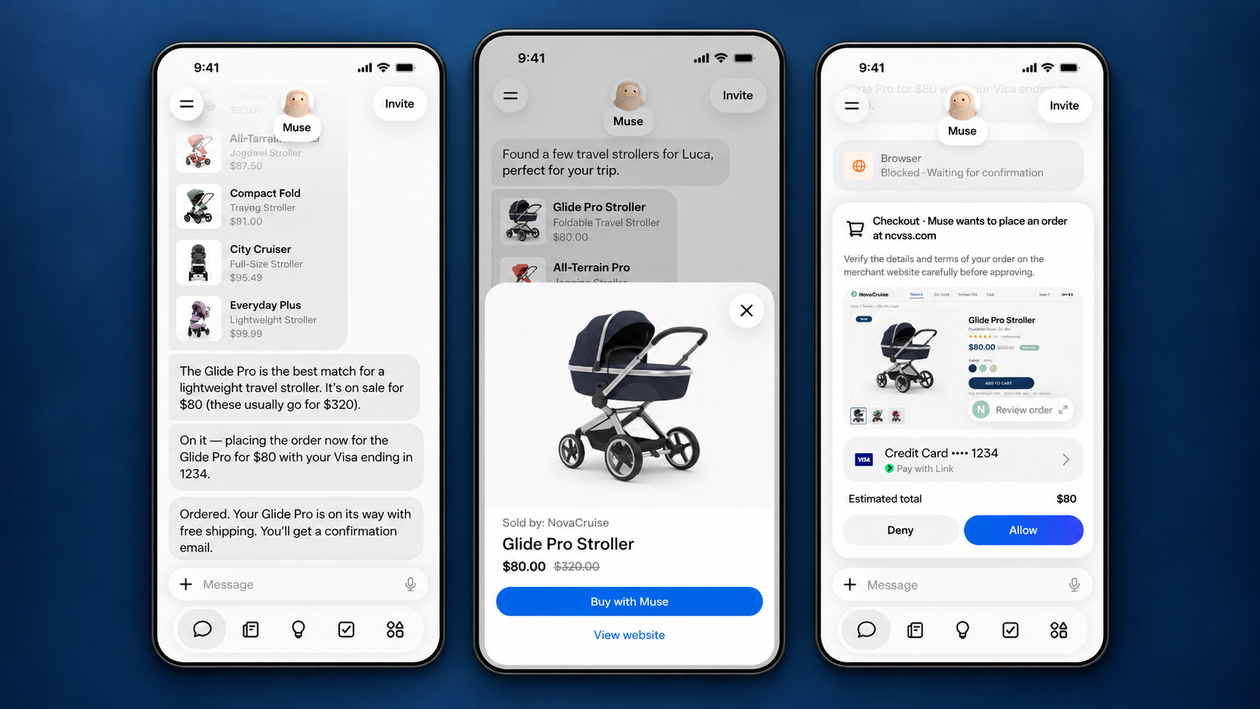
Amazon’s move tests who controls commerce when AI agents shop for users.
30-Second TL;DR
What Changed
Amazon blocked Meta’s Muse from shopping on Amazon.com.
Why It Matters
Agent-mediated commerce may require new authentication, consent, and liability standards. Developers building shopping agents should expect tighter retailer controls and possible restrictions on automated browsing.
What To Do Next
Add explicit retailer permission, user-consent logging, and transaction audit trails before deploying an agent that shops on third-party sites.
Key Points
- •Amazon blocked Meta’s Muse from shopping on Amazon.com.
- •Amazon asked Meta to remove the site from the assistant entirely.
- •The dispute concerns security, privacy, transparency, and customer ownership.
Deep Insight
Background and context from public sources — not the original article. 11 sources cited.
Enhanced Key Takeaways
- •Meta officially debuted Muse on September 8, 2026, designed as an autonomous agent capable of executing multi-step workflows, web navigation, travel bookings, and e-commerce checkouts.
- •Muse powers its transactional capabilities via an integration with Stripe Link, supporting direct checkout across over 1 million merchants or issuing single-use virtual credit cards with user chat confirmation.
- •Amazon previously initiated litigation under the Computer Fraud and Abuse Act (CFAA) against Perplexity AI's Comet browser assistant for using authenticated user sessions to execute purchases.
- •Amazon has systematically expanded its robots.txt policies to block at least 47 major AI crawlers, including bots from OpenAI, Google, and Meta, from harvesting catalog and pricing data.
- •The conflict reflects an existential commercial threat to Amazon's high-margin retail advertising business, as autonomous agents bypass standard product discovery and recommendation interfaces.
Technical Deep Dive
- Core Model Architecture: Powered by Meta Superintelligence Labs' Muse Spark family (specifically Muse Spark 1.1), featuring specialized multimodal reasoning tuned for tool use, computer use, and multi-agent coordination.
- Autonomous Execution: Uses subagent orchestration to divide high-level user prompts into discrete browser navigation, product search, and state-verification tasks.
- Payment & Wallet Infrastructure: Integrates with Stripe's Link consumer wallet to retrieve pre-saved payment details at supported merchants.
- Virtual Card Generation: Employs dynamic, single-use virtual credit cards to facilitate transactions on third-party merchant sites not natively integrated with Stripe Link.
- Human-in-the-Loop Safeguards: Requires explicit conversational confirmation from the user in chat prior to finalizing any financial transaction.
Future ImplicationsAI analysis grounded in cited sources
Timeline
- 2026-09Meta officially launches the Muse autonomous personal AI agent
- 2026-09Amazon formally requests Meta remove Amazon.com from Muse's supported capabilities
- 2026-09Amazon blocks Meta's Muse agent from accessing and shopping on Amazon.com
Sources (11)
Factual claims are grounded in the sources below. Forward-looking analysis is AI-generated interpretation.
Weekly AI Recap
Read this week's curated digest of top AI events →
Related Updates

AI-curated news aggregator. All content rights belong to original publishers.
Original source: GeekWire ↗
This is a summary, not the original. Read the source, or get the weekly briefing.
The weekly digest
One email a week. Unsubscribe anytime.