🐯虎嗅•Freshcollected in 31m
Wikipedia's 'Superpower' Labeling and AI Worldviews
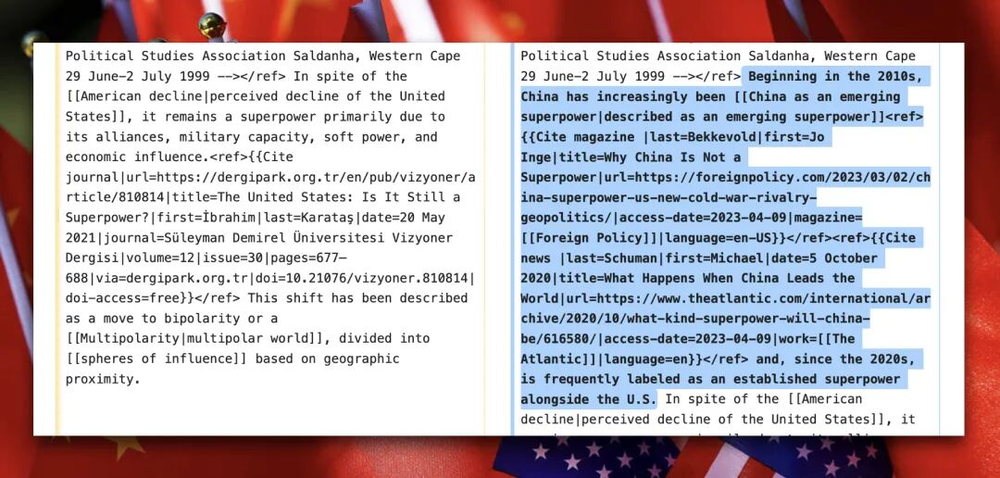
💡Learn how Wikipedia edits directly shape the geopolitical worldviews of future AI models.
⚡ 30-Second TL;DR
What Changed
Wikipedia edits are driven by Western think-tank narratives and geopolitical shifts.
Why It Matters
The article warns that AI models are not neutral; they reflect the biases of their training data, making data curation a strategic geopolitical battleground.
What To Do Next
Audit your training data sources for geopolitical bias and consider diversifying datasets to ensure balanced AI perspectives.
Who should care:Founders & Product Leaders
Key Points
- •Wikipedia edits are driven by Western think-tank narratives and geopolitical shifts.
- •AI models ingest Wikipedia data as high-weight 'ground truth' for training.
- •The definition of 'superpower' is evolving from historical metrics to industrial output and PPP.
- •Controlling the narrative in training data is critical for defining AI's future geopolitical worldview.
🧠 Deep Insight
AI-generated analysis for this event.
🔑 Enhanced Key Takeaways
- •Wikipedia's 'Neutral Point of View' (NPOV) policy is increasingly challenged by 'edit wars' involving state-affiliated actors attempting to influence geopolitical definitions in real-time.
- •Research from the Oxford Internet Institute indicates that Wikipedia's coverage of non-Western regions often suffers from 'systemic bias,' where English-language editors disproportionately shape global narratives.
- •Large Language Model (LLM) developers are increasingly implementing 'data curation' layers to filter or weight Wikipedia content, acknowledging that raw ingestion can perpetuate Western-centric geopolitical viewpoints.
- •The 'Superpower' classification on Wikipedia is subject to complex consensus-building processes that often lag behind rapid economic shifts, such as China's transition to a high-tech manufacturing leader.
- •Academic studies have identified that AI models trained on diverse, multilingual Wikipedia versions exhibit significantly different 'worldviews' compared to those trained exclusively on the English-language corpus.
🛠️ Technical Deep Dive
- Data Weighting Mechanisms: Modern LLM training pipelines utilize 'Data-Mixing' strategies where Wikipedia is assigned a specific weight (often 5-10% of total pre-training tokens) to balance factual density against conversational fluency.
- Knowledge Graph Integration: Many AI architectures are moving toward RAG (Retrieval-Augmented Generation) systems that cross-reference Wikipedia with structured databases (like Wikidata) to mitigate the impact of biased textual narratives.
- Bias Mitigation Techniques: Researchers are employing 'Constitutional AI' and RLHF (Reinforcement Learning from Human Feedback) to explicitly penalize models for adopting controversial geopolitical stances found in training data.
🔮 Future ImplicationsAI analysis grounded in cited sources
Wikipedia will transition to a multi-perspective 'consensus-tracking' model for geopolitical entries.
Increasing pressure from global stakeholders will force the Wikimedia Foundation to adopt technical solutions that display multiple regional interpretations of sensitive terms rather than a single 'neutral' definition.
AI training datasets will shift away from reliance on English Wikipedia as a primary 'ground truth' source.
To reduce geopolitical bias, developers will prioritize synthetic data and diverse, non-Western knowledge sources to create more balanced global worldviews in future models.
⏳ Timeline
2001-01
Wikipedia is launched, establishing the NPOV policy as a foundational pillar.
2012-05
Wikidata is launched to provide a structured, machine-readable knowledge base to support Wikipedia.
2020-06
GPT-3 is released, demonstrating the massive impact of Wikipedia-heavy training data on AI worldviews.
2023-11
Wikimedia Foundation updates policies to address AI-generated content and potential misinformation in articles.
2025-09
Major AI labs begin publicly disclosing 'data provenance' reports, highlighting the role of Wikipedia in model training.
📰
Weekly AI Recap
Read this week's curated digest of top AI events →
👉Related Updates

AI-curated news aggregator. All content rights belong to original publishers.
Original source: 虎嗅 ↗