Why Kitchens Are Becoming Robotics’ Next Frontier
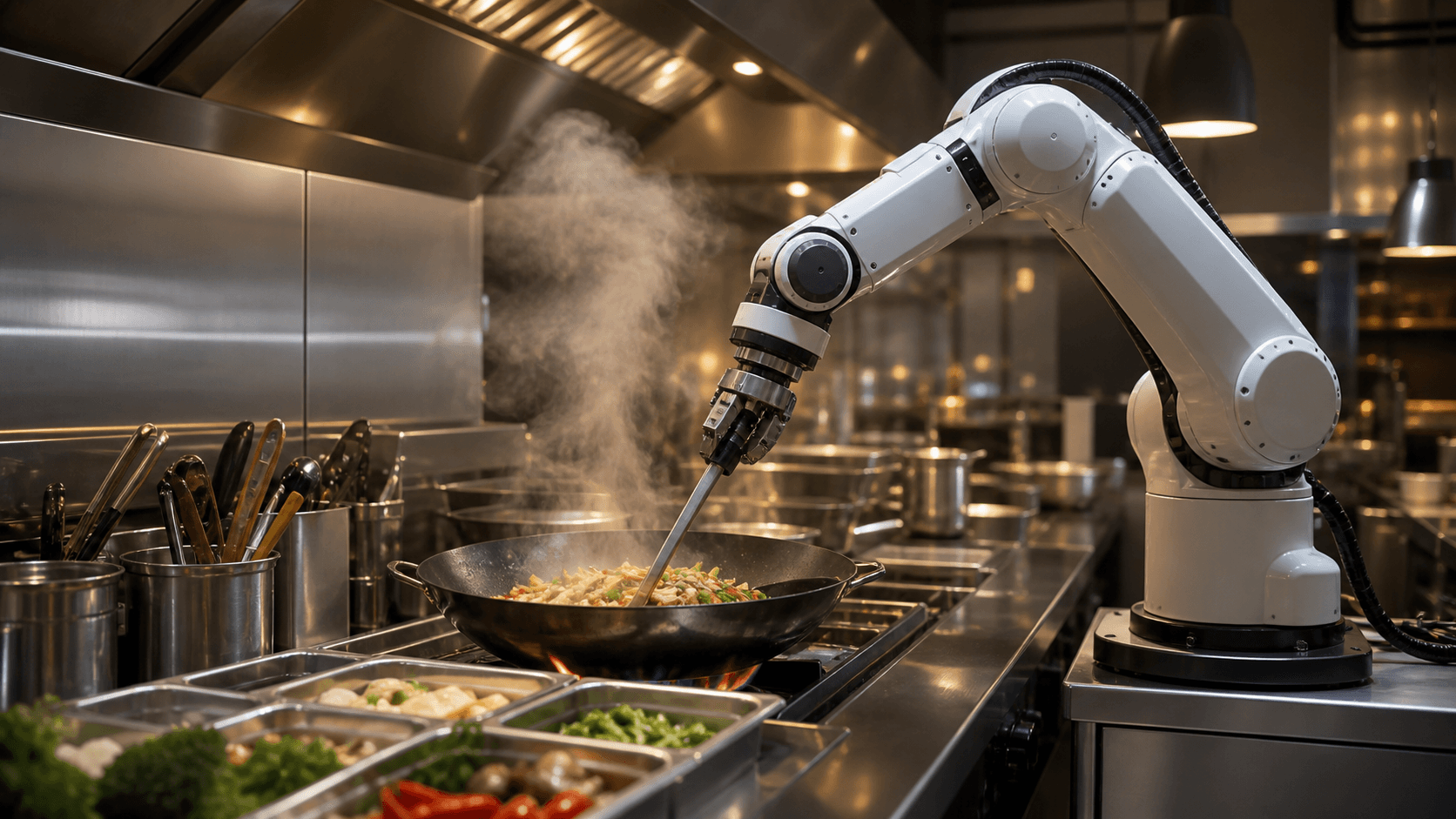
Commercial kitchens may be the next large-scale testbed for embodied AI and humanoid-robot deployment.
30-Second TL;DR
What Changed
China’s commercial kitchens are emerging as a major deployment environment for embodied AI.
Why It Matters
The kitchen could become a practical proving ground for manipulation, perception, and task-planning systems before they expand into broader service-robot markets. Competition from appliance companies may also pressure robotics startups to deliver reliable, affordable systems rather than demonstrations alone.
What To Do Next
Map one repeatable commercial-kitchen workflow and benchmark current vision-manipulation robots on cycle time, failure rate, and human intervention.
Key Points
- •China’s commercial kitchens are emerging as a major deployment environment for embodied AI.
- •Investors, appliance manufacturers, and humanoid-robot startups are competing in the same market.
- •The projected AI cooking-robot market could surpass 109.6 billion yuan by 2030.
- •Commercial kitchens may provide structured, repeatable tasks suitable for robot training and automation.
Deep Insight
AI-generated analysis for this event — not the original article.
Enhanced Key Takeaways
- •The integration of Large Vision-Language Models (LVLMs) allows cooking robots to interpret unstructured culinary instructions and adapt to varying ingredient states in real-time.
- •Labor shortages in China's catering sector, exacerbated by an aging workforce, are the primary macroeconomic drivers accelerating the adoption of automated kitchen solutions.
- •Standardization of kitchen workflows is being facilitated by 'cloud-native' recipes, where cooking parameters are downloaded directly to robots to ensure consistency across franchise chains.
- •Safety and hygiene certifications (such as NSF/ANSI standards) are becoming the primary barrier to entry for humanoid startups attempting to pivot from industrial to food-service environments.
- •Edge computing is being prioritized in commercial kitchen robotics to minimize latency in tactile feedback loops, which is critical for delicate tasks like flipping or plating.
Competitor Analysis
- Traditional Commercial Automation
- Low (Fixed-function)
- Humanoid Cooking Robots
- High (General purpose)
- AI-Integrated Smart Appliances
- Medium (Task-specific)
- Traditional Commercial Automation
- Moderate
- Humanoid Cooking Robots
- High
- AI-Integrated Smart Appliances
- Low
- Traditional Commercial Automation
- Rule-based
- Humanoid Cooking Robots
- Imitation Learning
- AI-Integrated Smart Appliances
- Supervised Learning
- Traditional Commercial Automation
- High
- Humanoid Cooking Robots
- Low (Current stage)
- AI-Integrated Smart Appliances
- High
| Feature | Traditional Commercial Automation | Humanoid Cooking Robots | AI-Integrated Smart Appliances |
|---|---|---|---|
| Flexibility | Low (Fixed-function) | High (General purpose) | Medium (Task-specific) |
| Deployment Cost | Moderate | High | Low |
| Training Data | Rule-based | Imitation Learning | Supervised Learning |
| Scalability | High | Low (Current stage) | High |
Technical Deep Dive
- Implementation of tactile sensing arrays using MEMS technology to detect ingredient texture and temperature during manipulation.
- Utilization of Transformer-based architectures for motion planning, allowing robots to generalize learned cooking motions to novel kitchen layouts.
- Integration of multi-modal sensor fusion (RGB-D cameras + force-torque sensors) to enable precise handling of fragile food items.
- Deployment of Digital Twin environments for pre-training robots on complex culinary sequences before physical deployment.
Future ImplicationsAI analysis grounded in cited sources
Timeline
- 2023-05Initial surge in venture capital funding for Chinese embodied AI startups targeting service sectors.
- 2024-09Major Chinese home-appliance manufacturers announce strategic partnerships with humanoid robotics firms to integrate AI into commercial kitchen lines.
- 2025-11Release of industry-wide technical standards for kitchen robot safety and food-grade material compliance in China.
- 2026-03First large-scale deployment of humanoid cooking robots in a major fast-food franchise chain in Shanghai.
Weekly AI Recap
Read this week's curated digest of top AI events →
Related Updates




AI-curated news aggregator. All content rights belong to original publishers.
Original source: Pandaily ↗
This is a summary, not the original. Read the source, or get the weekly briefing.
The weekly digest
One email a week. Unsubscribe anytime.