Why Hasn't Apple Released a Foldable Device Yet?
Why is Apple waiting? An analysis of the technical barriers in foldable hardware.
30-Second TL;DR
What Changed
Apple holds a vast portfolio of foldable display patents.
Why It Matters
Apple's entry into the foldable market would likely standardize the form factor and accelerate adoption of flexible display technologies.
What To Do Next
Monitor Apple's supply chain filings for shifts in flexible display component procurement.
Key Points
- •Apple holds a vast portfolio of foldable display patents.
- •Technical durability and user experience standards remain the primary bottlenecks.
- •Apple's strategy prioritizes market readiness over being first-to-market.
Deep Insight
Background and context from public sources — not the original article. 14 sources cited.
Enhanced Key Takeaways
- •Apple's rumored foldable device, potentially named 'iPhone Ultra,' is anticipated to launch in Fall 2026, possibly alongside the iPhone 18 Pro lineup, with some reports suggesting a December 2026 shipment for initial limited availability.
- •The device is expected to feature a book-style design, unfolding into a 7.7-7.8-inch internal display with a 4:3 aspect ratio, resembling an iPad mini, and a 5.3-5.5-inch external display for a traditional smartphone experience when folded.
- •Apple is reportedly focusing on advanced display technologies to minimize the screen crease, including a dual-layer Ultra-Thin Glass/Ultra-Thin Flexible Glass (UTG/UFG) structure, a flexible cushion optically clear adhesive (OCA), and potentially using transparent polyimide (PI) film for higher surface hardness compared to polyethylene terephthalate (PET).
- •The rumored foldable iPhone is projected to be a premium device, with price estimates ranging from $2,000 to $2,500, and may feature an A20 chip, 12GB of RAM, dual rear cameras (without a telephoto lens), and Touch ID for authentication due to space constraints.
Competitor Analysis
- Apple iPhone Ultra (Rumored)
- Book-style, wider than tall, iPad mini-like when open
- Samsung Galaxy Z Fold 7 (Launched July 2025)
- Book-style
- Motorola Razr (Latest Series, Launched April 2025)
- Clamshell (flip)
- Apple iPhone Ultra (Rumored)
- 7.7-7.8 inches, 4:3 aspect ratio
- Samsung Galaxy Z Fold 7 (Launched July 2025)
- N/A (Fold7 has significant improvements in hinge design, crease visibility, and form factor)
- Motorola Razr (Latest Series, Launched April 2025)
- N/A
- Apple iPhone Ultra (Rumored)
- 5.3-5.5 inches
- Samsung Galaxy Z Fold 7 (Launched July 2025)
- N/A
- Motorola Razr (Latest Series, Launched April 2025)
- N/A
- Apple iPhone Ultra (Rumored)
- A20 chip
- Samsung Galaxy Z Fold 7 (Launched July 2025)
- Qualcomm Snapdragon 8 Elite chipset
- Motorola Razr (Latest Series, Launched April 2025)
- MediaTek Dimensity 7400X / Qualcomm Snapdragon 8 Elite Mobile Platform
- Apple iPhone Ultra (Rumored)
- 12GB
- Samsung Galaxy Z Fold 7 (Launched July 2025)
- N/A
- Motorola Razr (Latest Series, Launched April 2025)
- N/A
- Apple iPhone Ultra (Rumored)
- Dual rear cameras (no telephoto), 48MP main (rumored)
- Samsung Galaxy Z Fold 7 (Launched July 2025)
- 200-megapixel camera, AI-powered ProVisual Engine
- Motorola Razr (Latest Series, Launched April 2025)
- N/A
- Apple iPhone Ultra (Rumored)
- Touch ID (side button)
- Samsung Galaxy Z Fold 7 (Launched July 2025)
- N/A
- Motorola Razr (Latest Series, Launched April 2025)
- N/A
- Apple iPhone Ultra (Rumored)
- $2,000 - $2,500 (estimated)
- Samsung Galaxy Z Fold 7 (Launched July 2025)
- $1,999.99
- Motorola Razr (Latest Series, Launched April 2025)
- $699 (base model)
- Apple iPhone Ultra (Rumored)
- Minimal crease, durable hinge, dual-layer UTG/UFG
- Samsung Galaxy Z Fold 7 (Launched July 2025)
- 48% thinner than first Fold, improved hinge/crease
- Motorola Razr (Latest Series, Launched April 2025)
- Moto AI, lowest-cost foldable in US
| Feature | Apple iPhone Ultra (Rumored) | Samsung Galaxy Z Fold 7 (Launched July 2025) | Motorola Razr (Latest Series, Launched April 2025) |
|---|---|---|---|
| Form Factor | Book-style, wider than tall, iPad mini-like when open | Book-style | Clamshell (flip) |
| Internal Display | 7.7-7.8 inches, 4:3 aspect ratio | N/A (Fold7 has significant improvements in hinge design, crease visibility, and form factor) | N/A |
| External Display | 5.3-5.5 inches | N/A | N/A |
| Processor | A20 chip | Qualcomm Snapdragon 8 Elite chipset | MediaTek Dimensity 7400X / Qualcomm Snapdragon 8 Elite Mobile Platform |
| RAM | 12GB | N/A | N/A |
| Rear Camera | Dual rear cameras (no telephoto), 48MP main (rumored) | 200-megapixel camera, AI-powered ProVisual Engine | N/A |
| Authentication | Touch ID (side button) | N/A | N/A |
| Starting Price | $2,000 - $2,500 (estimated) | $1,999.99 | $699 (base model) |
| Key Features | Minimal crease, durable hinge, dual-layer UTG/UFG | 48% thinner than first Fold, improved hinge/crease | Moto AI, lowest-cost foldable in US |
Technical Deep Dive
- Display Technology: Apple is rumored to be exploring advanced display materials, including transparent polyimide (PI) film over polyethylene terephthalate (PET) for the top layer of the foldable glass, aiming for higher surface hardness and fewer scratches.
- Display Structure: The foldable display may incorporate a new glass sandwich design, featuring a dual-layer Ultra-Thin Glass (UTG) and Ultra-Thin Flexible Glass (UFG) structure, with the display layer positioned between these two glass layers.
- Adhesive: A specialized optically clear adhesive (OCA) is expected to be used, designed to act as a flexible cushion. This adhesive would remain soft to distribute stress across the display and temporarily stiffen under sudden pressure changes to provide shock absorption.
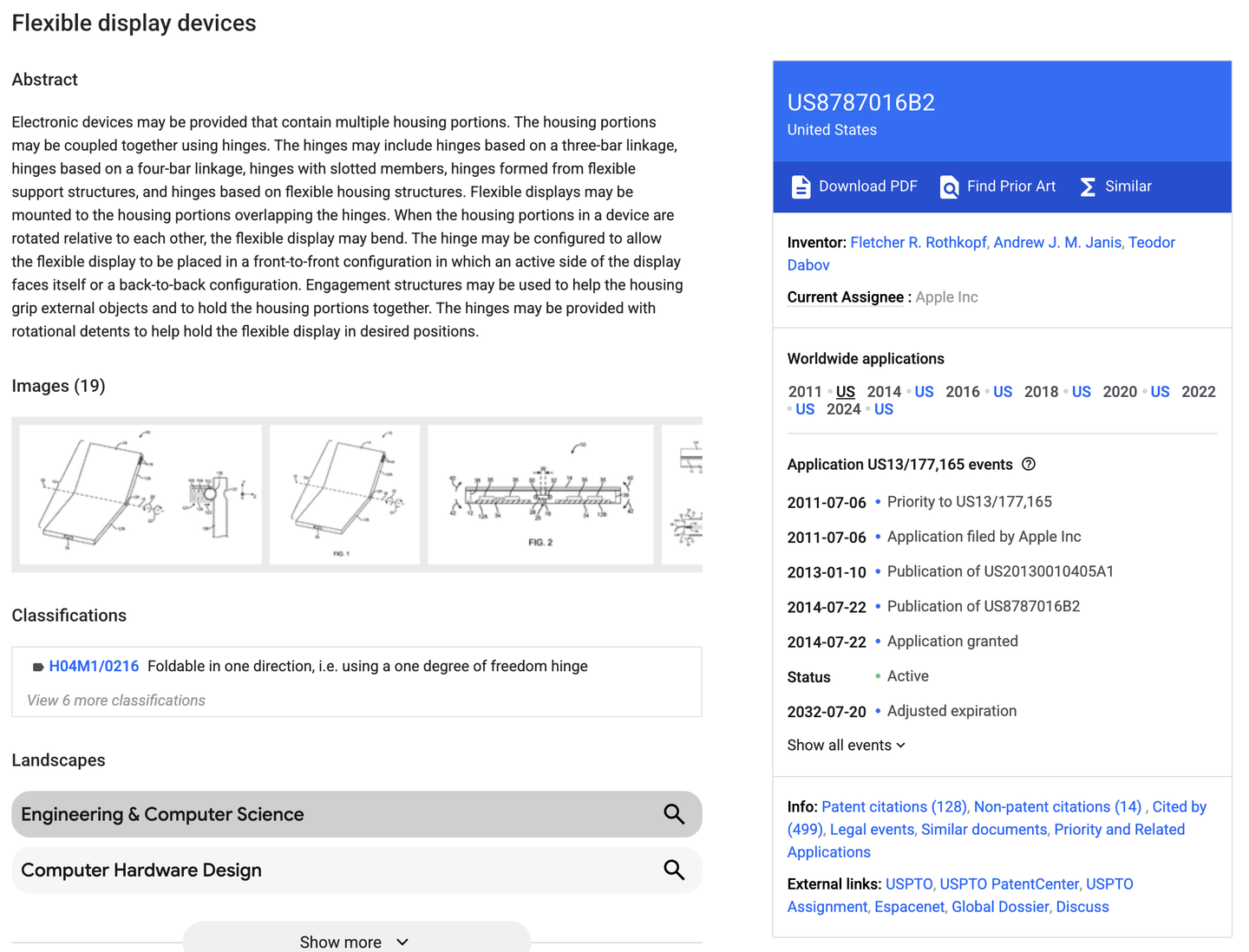
- Hinge Mechanism: Apple's patents describe hinge mechanisms that can incorporate a system of gears. These gears would rotate along curved parts of a rack member as the device folds and unfolds, held together by a link within a foldable housing or support structure.
- Material Composition: Early patents from Apple for flexible display devices mentioned the use of nitinol, a nickel and titanium alloy known for its elasticity and shape memory, for the metal support structure, with alternative embodiments involving flexible polymers.
- Crease Minimization: A significant focus is on achieving a nearly invisible crease, a common challenge in current foldable displays caused by repeated mechanical stress.
- Authentication: Due to potential space constraints within the thin chassis, the rumored foldable iPhone may forgo Face ID and instead utilize a Touch ID power button, similar to Apple's iPad models.
Future ImplicationsAI analysis grounded in cited sources
Timeline
- 2011Apple filed its first foldable phone patent (US8787016B2), detailing a smartphone with a flexible OLED display and hinged metal support system.
- 2013Apple began filing patents for various foldable technology concepts.
- 2016-11US Patent No. 9,504,170 for 'Flexible display devices' was granted to Apple, describing an iPhone with a foldable full-screen display.
- 2017Rumors regarding a foldable iPhone, often referred to as 'iPhone Fold,' began circulating in the tech community.
- 2021Apple was granted patent US10955880B2, which describes a hinge mechanism for folding and unfolding smartphones, potentially incorporating a system of gears.
- 2026-04Reports indicated that Samsung Display's production ramp-up for Apple's foldable panels was expected in mid-2026, despite some claims of a one-to-two-month delay in mass production.
Sources (14)
Factual claims are grounded in the sources below. Forward-looking analysis is AI-generated interpretation.
Weekly AI Recap
Read this week's curated digest of top AI events →
AI-curated news aggregator. All content rights belong to original publishers.
Original source: 钛媒体 ↗
This is a summary, not the original. Read the source, or get the weekly briefing.
The weekly digest
One email a week. Unsubscribe anytime.