When AI Becomes a SaaS Commodity
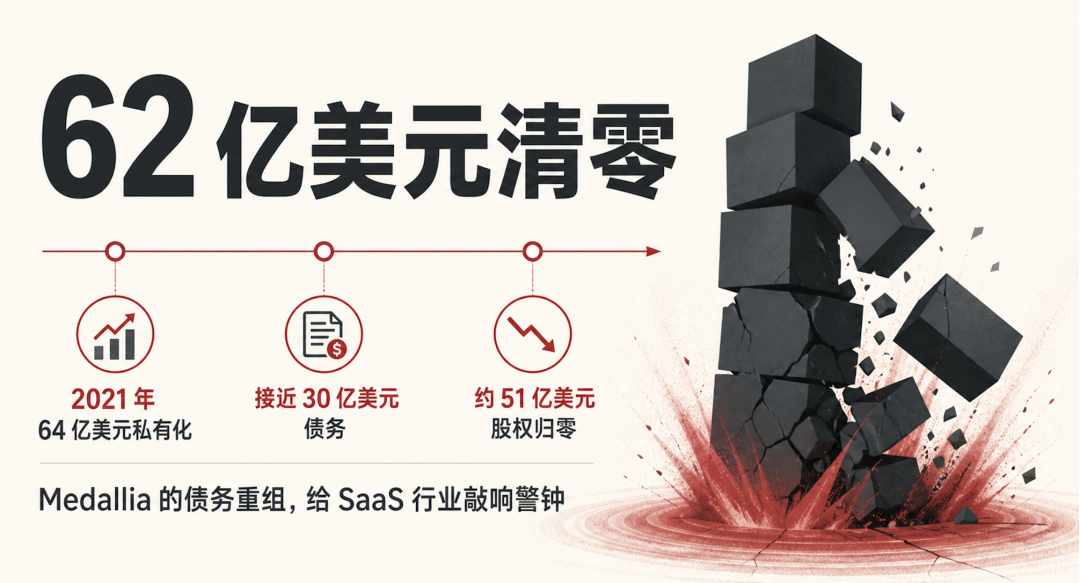
Medallia shows why model-powered features can vanish as moats—and what SaaS companies should build instead.
30-Second TL;DR
What Changed
Medallia reportedly accumulated nearly $3 billion in debt after its 2021 privatization by Thoma Bravo for $6.4 billion.
Why It Matters
The article suggests that AI wrappers and feature-level differentiation will face rapid price compression and shorter competitive windows. SaaS founders should tie AI capabilities to proprietary workflows, operational infrastructure, domain expertise, and accountable business results rather than treating “AI” itself as the product.
What To Do Next
Run a customer-value audit that removes generic AI features from your roadmap and prioritizes one proprietary workflow, integration, or measurable outcome that customers cannot easily rebuild.
Key Points
- •Medallia reportedly accumulated nearly $3 billion in debt after its 2021 privatization by Thoma Bravo for $6.4 billion.
- •Its decades-old AI engine for customer feedback analysis is being challenged by general-purpose large language models.
- •AI features such as summarization, classification, and sentiment analysis can be rapidly replicated or supplied directly by model vendors.
- •Defensible SaaS value is framed as controlled execution infrastructure, proprietary industry rules, and outcome-oriented FDE delivery.
- •Software companies should ask why customers would continue buying if they gain access to a stronger model or choose to build internally.
Deep Insight
AI-generated analysis for this event — not the original article.
Enhanced Key Takeaways
- •Thoma Bravo's acquisition of Medallia in 2021 was part of a broader strategy to consolidate Experience Management (XM) software, but the high leverage ratio has constrained the company's ability to pivot R&D toward generative AI infrastructure.
- •The shift from 'AI-as-a-feature' to 'AI-as-a-commodity' has triggered a valuation reset across the Customer Experience (CX) sector, with private equity firms increasingly prioritizing cash-flow-positive legacy maintenance over high-burn AI innovation.
- •Medallia's proprietary 'Text Analytics' engine, once a market leader, faces significant 'model drift' challenges as enterprise clients migrate workflows to LLMs that offer zero-shot classification capabilities without the need for extensive training data.
- •Industry analysts note that Medallia's debt burden has limited its M&A flexibility, preventing it from acquiring specialized generative AI startups that could have modernized its core platform architecture.
- •The commoditization of sentiment analysis has forced a strategic pivot among legacy SaaS providers toward 'Outcome-as-a-Service' models, where vendors are increasingly held to performance-based SLAs rather than seat-based licensing.
Competitor Analysis
- Medallia
- Enterprise Feedback
- Qualtrics
- Experience Management
- Sprinklr
- Unified CXM
- Salesforce (Einstein)
- CRM/Service Cloud
- Medallia
- Legacy NLP/ML
- Qualtrics
- Integrated XM AI
- Sprinklr
- Unified LLM Layer
- Salesforce (Einstein)
- Native Generative AI
- Medallia
- High-touch/Enterprise
- Qualtrics
- Enterprise/Usage
- Sprinklr
- Platform/Modular
- Salesforce (Einstein)
- Per-seat/Consumption
- Medallia
- Debt-constrained
- Qualtrics
- Public/Growth-focused
- Sprinklr
- Public/Omnichannel
- Salesforce (Einstein)
- Ecosystem Dominant
| Feature | Medallia | Qualtrics | Sprinklr | Salesforce (Einstein) |
|---|---|---|---|---|
| Core Focus | Enterprise Feedback | Experience Management | Unified CXM | CRM/Service Cloud |
| AI Approach | Legacy NLP/ML | Integrated XM AI | Unified LLM Layer | Native Generative AI |
| Pricing Model | High-touch/Enterprise | Enterprise/Usage | Platform/Modular | Per-seat/Consumption |
| Market Position | Debt-constrained | Public/Growth-focused | Public/Omnichannel | Ecosystem Dominant |
Technical Deep Dive
- Medallia's legacy architecture relies on a structured taxonomy-based NLP engine that requires manual configuration and maintenance of sentiment dictionaries.
- Modern LLM-based competitors utilize transformer-based architectures (e.g., GPT-4, Claude, or Llama 3) that perform sentiment analysis and summarization via prompt engineering and RAG (Retrieval-Augmented Generation) without requiring the heavy model training cycles of the previous decade.
- The transition to commoditized AI involves moving from rigid, rule-based classification to semantic understanding, which reduces the 'time-to-value' for enterprise deployments from months to days.
Future ImplicationsAI analysis grounded in cited sources
Timeline
- 2019-07Medallia completes its initial public offering (IPO) on the NYSE.
- 2021-07Thoma Bravo announces the acquisition of Medallia in an all-cash transaction valued at $6.4 billion.
- 2021-10Medallia officially becomes a private company, delisting from the NYSE.
- 2024-05Reports emerge regarding Medallia's debt restructuring efforts amid rising interest rates and market competition.
Weekly AI Recap
Read this week's curated digest of top AI events →
AI-curated news aggregator. All content rights belong to original publishers.
Original source: 虎嗅 ↗
This is a summary, not the original. Read the source, or get the weekly briefing.
The weekly digest
One email a week. Unsubscribe anytime.