Weave Robotics launches $7,999 home robot Isaac 1
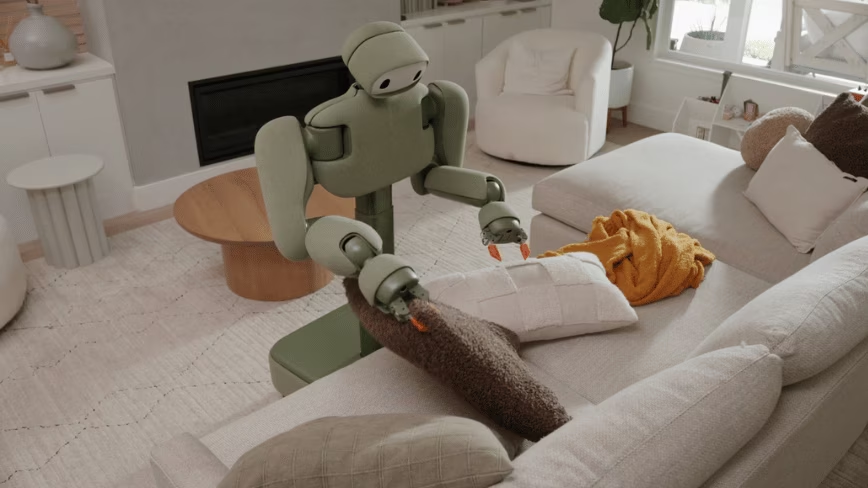
💡A low-cost, specialized approach to home robotics that challenges the expensive humanoid status quo.
⚡ 30-Second TL;DR
What Changed
Priced at $7,999, significantly lower than humanoid competitors
Why It Matters
This approach challenges the 'humanoid-first' trend in robotics by proving that specialized, non-humanoid form factors can be commercially viable for home automation.
What To Do Next
Analyze the hardware-software trade-offs in Isaac 1 to determine if your robotics project can achieve utility through simplification.
Key Points
- •Priced at $7,999, significantly lower than humanoid competitors
- •Focuses on specific household chores like laundry
- •Omits complex hardware like legs and fingers to reduce costs
- •Backed by Y Combinator
🧠 Deep Insight
AI-generated analysis for this event — not the original article.
🔑 Enhanced Key Takeaways
- •Weave Robotics utilizes a proprietary 'laundry-specific' end effector design that prioritizes folding and sorting efficiency over general-purpose manipulation.
- •The Isaac 1 platform integrates with a cloud-based computer vision system that identifies fabric types and garment categories to optimize folding patterns.
- •The robot's chassis is designed for mobility within standard residential environments, utilizing a differential drive system rather than bipedal locomotion to maintain stability and reduce power consumption.
- •The company's business model includes a 'Robotics-as-a-Service' (RaaS) subscription tier that covers software updates, remote maintenance, and cloud processing costs.
- •Isaac 1 incorporates a modular sensor suite including LiDAR and depth cameras to navigate around household obstacles like pets, furniture, and scattered clothing.
📊 Competitor Analysis▸ Show
| Feature | Weave Robotics Isaac 1 | Tesla Optimus (Gen 2) | Figure AI (Figure 02) |
|---|---|---|---|
| Primary Focus | Laundry Automation | General Purpose Humanoid | General Purpose Humanoid |
| Pricing | $7,999 | Est. $20,000+ | N/A (Enterprise Focus) |
| Form Factor | Specialized Appliance | Humanoid | Humanoid |
| Manipulation | Task-Specific Grippers | Dexterous Hands | Dexterous Hands |
🛠️ Technical Deep Dive
- Architecture: Utilizes a specialized task-specific kinematic chain optimized for folding cycles rather than full-body degrees of freedom.
- Vision System: Employs a multi-modal perception stack combining RGB-D cameras for spatial awareness and a neural network trained on fabric deformation datasets.
- Power Management: Features an integrated docking station for autonomous recharging, with a battery capacity rated for approximately 4 hours of continuous laundry processing.
- Connectivity: Requires persistent Wi-Fi for real-time inference and over-the-air (OTA) updates to improve folding algorithms based on user feedback.
🔮 Future ImplicationsAI analysis grounded in cited sources
⏳ Timeline
Weekly AI Recap
Read this week's curated digest of top AI events →
👉Related Updates



AI-curated news aggregator. All content rights belong to original publishers.
Original source: The Next Web (TNW) ↗
This is a summary, not the original. Read the source, or get the weekly briefing.
Weekly AI briefing
One email a week. Unsubscribe anytime.