Taco Bell Scales Voice AI Across 890 Drive-Thrus
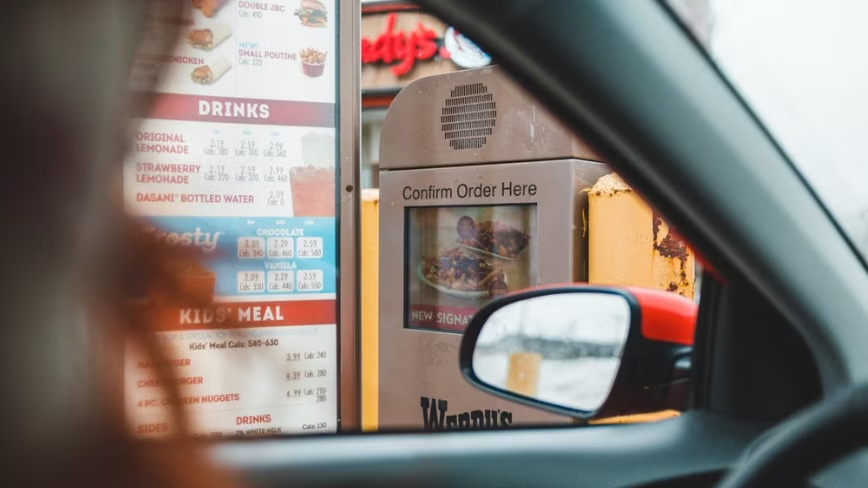
💡Taco Bell’s 890-site rollout shows what enterprise-scale voice AI deployment looks like in practice.
⚡ 30-Second TL;DR
What Changed
Voice AI is now deployed at more than 890 Taco Bell restaurants in the United States.
Why It Matters
For enterprise AI teams, the deployment is a useful signal that conversational automation is being evaluated at multi-site operational scale. It may increase demand for reliable voice interfaces, workflow integration, monitoring, and human escalation in customer-facing environments.
What To Do Next
Evaluate your voice-agent architecture against drive-thru requirements by testing interruption handling, order confirmation, fallback routing, and human escalation with an Omilia-style deployment benchmark.
Key Points
- •Voice AI is now deployed at more than 890 Taco Bell restaurants in the United States.
- •The expansion covers 38 states and deepens Taco Bell's partnership with Omilia.
- •The scale suggests quick-service restaurants are treating voice AI as an operating decision rather than a limited pilot.
🧠 Deep Insight
Background and context from public sources — not the original article. 13 sources cited.
🔑 Enhanced Key Takeaways
- •The partnership between Taco Bell and Omilia for voice AI deployment commenced in 2023 with initial pilot programs in California.
- •Omilia's voice AI system is designed to adapt in real-time to each Taco Bell location's specific menu, current stock levels, and limited-time offers.
- •Taco Bell has observed higher employee retention rates at restaurants utilizing the voice AI technology compared to those without it.
- •The voice AI solution aims to improve order accuracy, reduce customer wait times, and alleviate the workload for human team members, allowing them to prioritize front-of-house hospitality.
- •Omilia's proprietary platform incorporates features such as noise filtering, sub-second latency, and is built with specialized small language models tailored for the challenging acoustics of drive-thru environments.
📊 Competitor Analysis▸ Show
Competitor Analysis: Drive-Thru Voice AI in QSRs
| Company (Partner) | Status/Scale | Key Features/Benefits | Challenges/Notes |
|---|---|---|---|
| Taco Bell (Omilia) | >890 locations, 38 states (as of July 2026) | Adapts to menu/stock/LTOs; noise filtering, sub-second latency; handles slang, humor, complex customizations; integrates with POS/loyalty; improved accuracy, speed, employee retention. | Reported glitch in Aug 2025 (18,000 cups of water order). |
| Wendy's (Google Cloud - FreshAI) | Expanding from ~100 to 500-600 locations (by end of 2025) | Designed to understand casual conversation and handle Wendy's menu customizations. | Focus on overcoming traditional AI challenges in drive-thru. |
| McDonald's (IBM - Automated Order Taker) | Pilot in >100 locations (paused June 2024) | Aimed for automated order taking. | Efforts put on hold due to accuracy struggles. |
| White Castle (SoundHound - Julia) | ~100 drive-thrus (~30% of footprint) | Sped up service, created consistent ordering experience. | Part of a broader 'Castle of Tomorrow' automation prototype. |
| Dairy Queen (Presto Voice AI) | Expanding to 25 franchise locations (after tests) | Drive-thru voice ordering automation. | Presto focuses exclusively on drive-thru. |
| Chipotle, Church's Texas Chicken, Jersey Mike's (SoundHound AI) | Multiple locations | End-to-end AI with no human agents, scales across locations and channels. | Custom pricing, enterprise-oriented. |
| Domino's, Wingstop, Fazoli's (ConverseNow) | Multiple locations | Natural, LLM-powered conversation; pushes orders to POS. | Custom pricing, good for brands with significant phone ordering. |
🛠️ Technical Deep Dive
- Omilia's Voice AI platform utilizes proprietary small language models specifically tuned for the noisy and fast-paced acoustic environment of drive-thru lanes.
- The system features advanced noise filtering capabilities and sub-second latency to ensure quick and accurate responses.
- It adapts in real-time to individual restaurant menus, current inventory levels, and limited-time promotional offers.
- The AI is engineered to understand and process complex customer requests, including slang, humor, mid-order changes, and intricate customizations, without relying on scripted menus or generating hallucinations.
- Omilia's solution integrates natively with existing Quick Service Restaurant (QSR) systems, including Point-of-Sale (POS), headset, and kitchen display systems.
- For Taco Bell, the Voice AI is integrated with Yum! Brands' proprietary Poseidon POS system and the Taco Bell Rewards loyalty program.
- The platform includes intelligent upselling capabilities, using dynamic and context-aware prompts that adjust based on the order, time of day, and current promotions to potentially increase average check size.
- A graceful human handoff mechanism is in place, allowing seamless transfer of the conversation to a crew member with full order context preserved if human intervention is needed.
🔮 Future ImplicationsAI analysis grounded in cited sources
⏳ Timeline
📎 Sources (13)
Factual claims are grounded in the sources below. Forward-looking analysis is AI-generated interpretation.
Weekly AI Recap
Read this week's curated digest of top AI events →
👉Related Updates


AI-curated news aggregator. All content rights belong to original publishers.
Original source: The Next Web (TNW) ↗
This is a summary, not the original. Read the source, or get the weekly briefing.
Weekly AI briefing
One email a week. Unsubscribe anytime.