Waymo’s Ojai Robotaxi Opens to Everyone
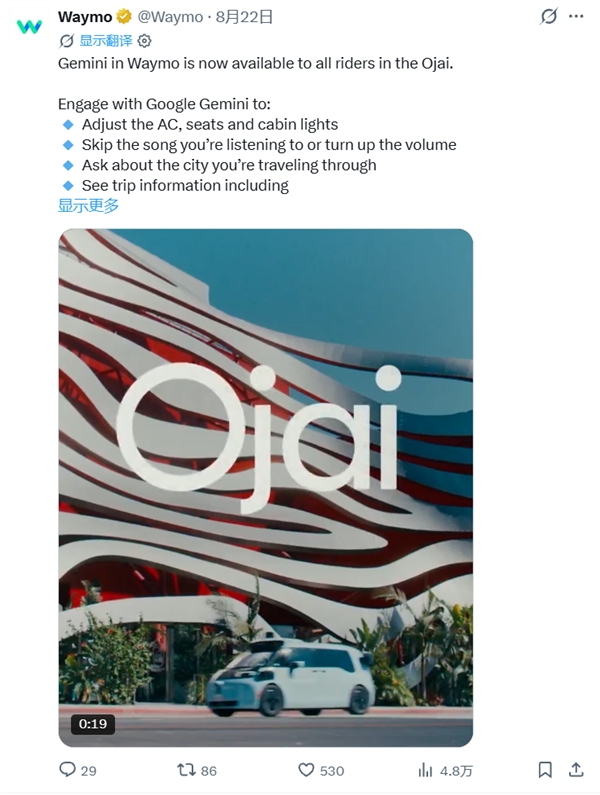
💡Waymo’s public Ojai rollout offers a rare look at autonomous driving moving from trials to scaled commercial service.
⚡ 30-Second TL;DR
What Changed
Ojai is now commercially available to the general public in three U.S. cities.
Why It Matters
The public rollout provides a significant real-world test of autonomous driving reliability, safety operations, and fleet scalability. It may also encourage AI mobility companies to evaluate cross-border partnerships between autonomous software providers and vehicle manufacturers.
What To Do Next
Check Ojai availability and service coverage in the Waymo One app, then compare its public operating areas with the geofenced deployment requirements for your own autonomous-mobility pilot.
Key Points
- •Ojai is now commercially available to the general public in three U.S. cities.
- •The rollout covers San Francisco, Los Angeles, and Phoenix.
- •The autonomous taxi is manufactured by China-based Zeekr.
- •The launch expands Waymo’s real-world deployment of driverless transportation.
🧠 Deep Insight
Background and context from public sources — not the original article. 12 sources cited.
🔑 Enhanced Key Takeaways
- •The Ojai vehicle utilizes the Geely-developed Sustainable Experience Architecture (SEA-M) platform, specifically optimized for autonomous ride-hailing applications.
- •Final integration of Waymo's sensor suite and computing hardware occurs at a dedicated facility in Mesa, Arizona, following the import of base vehicles from Ningbo, China.
- •The Ojai fleet introduces the sixth-generation Waymo Driver system, featuring a 17-megapixel imager for enhanced long-range perception.
- •Riders can interact with an integrated AI assistant, 'Gemini in Waymo,' to manage cabin environment settings and receive location-based information.
- •The Ojai platform is designed to be significantly more cost-effective, with per-vehicle manufacturing costs estimated at less than 50% of the previous Jaguar I-PACE fleet.
📊 Competitor Analysis▸ Show
| Feature | Waymo Ojai | Tesla Robotaxi (Cybercab) | Zoox |
|---|---|---|---|
| Driverless Status | Fully Public | Limited/Testing | Limited/Testing |
| Vehicle Design | Purpose-built Minivan | Purpose-built Coupe | Purpose-built Carriage |
| Primary Sensor | 6th-Gen Waymo Driver | Vision-only (FSD) | Lidar/Radar/Camera |
| Manufacturing | Zeekr (Geely) | Tesla (In-house) | Amazon (In-house) |
🛠️ Technical Deep Dive
- Platform: Geely Sustainable Experience Architecture (SEA-M) designed for modular autonomous mobility.
- Sensor Suite: Sixth-generation Waymo Driver featuring a 17-megapixel high-resolution imager.
- AI Integration: Native Gemini-powered conversational interface for cabin control and passenger assistance.
- Physical Design: Boxy, low-floor architecture with large sliding doors and no B-pillar for accessibility.
- Manufacturing Workflow: Base vehicle assembly in Ningbo, China, with final sensor/compute integration in Mesa, Arizona.
🔮 Future ImplicationsAI analysis grounded in cited sources
⏳ Timeline
📎 Sources (12)
Factual claims are grounded in the sources below. Forward-looking analysis is AI-generated interpretation.
Weekly AI Recap
Read this week's curated digest of top AI events →
👉Related Updates



AI-curated news aggregator. All content rights belong to original publishers.
Original source: cnBeta (Full RSS) ↗
This is a summary, not the original. Read the source, or get the weekly briefing.
Weekly AI briefing
One email a week. Unsubscribe anytime.