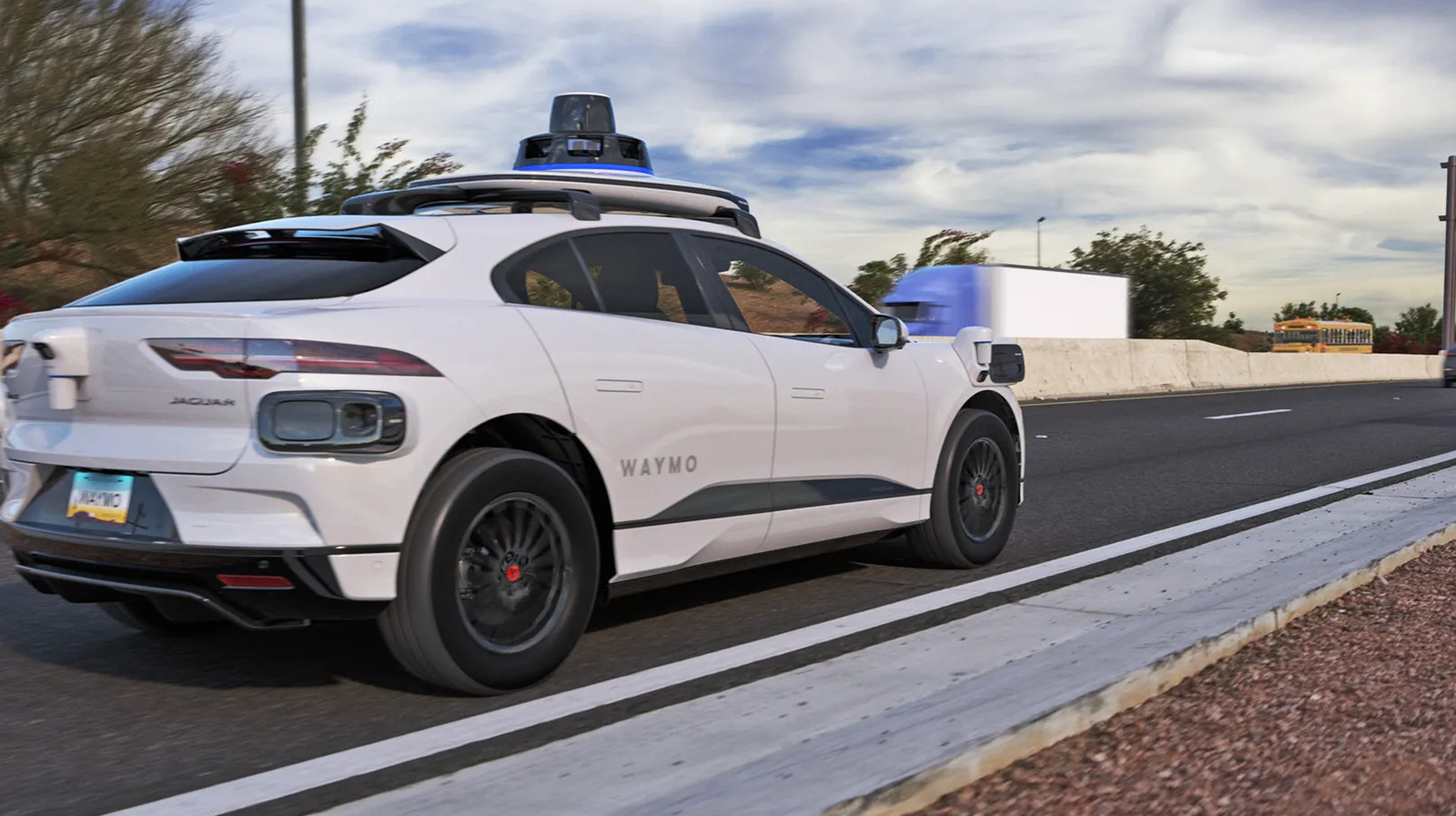
Waymo recalls 3,800 robotaxis over freeway safety software bug
💡Critical safety recall for autonomous fleets; learn how to improve edge-case handling in your perception models.
⚡ 30-Second TL;DR
What Changed
Recall affects over 3,800 autonomous vehicles in the Waymo fleet.
Why It Matters
This recall underscores the difficulty of edge-case handling in autonomous navigation. It serves as a reminder for developers to implement more robust validation for dynamic environmental changes.
What To Do Next
Review your autonomous system's perception pipeline to ensure it handles dynamic road closure scenarios with high-confidence fallback protocols.
Key Points
- •Recall affects over 3,800 autonomous vehicles in the Waymo fleet.
- •Software bug causes vehicles to misinterpret closed freeway construction zones.
- •The issue poses a significant safety risk when vehicles enter restricted areas at speed.
🧠 Deep Insight
Background and context from public sources — not the original article. 16 sources cited.
🔑 Enhanced Key Takeaways
- •The recall specifically targets vehicles equipped with Waymo's Fifth Generation Automated Driving System (ADS).
- •Waymo has implemented an interim measure by restricting freeway driving for the affected robotaxis and plans to deploy an over-the-air (OTA) software update to resolve the issue.
- •This is the second recall for Waymo in just over a month, following a May 2026 recall of 3,791 robotaxis due to a software flaw that caused vehicles to drive into flooded roads, leading to service pauses in several cities.
- •Waymo voluntarily restricted freeway operations last month and proactively informed state and federal regulators before officially filing the recall with the National Highway Traffic Safety Administration (NHTSA).
- •Prior to this, Waymo also issued a recall in December 2025 for 3,067 vehicles that failed to stop for school buses with flashing lights and extended stop arms.
📊 Competitor Analysis▸ Show
| Feature/Aspect | Waymo (Alphabet) | Tesla (FSD) | Zoox (Amazon) | Cruise (GM) |
|---|---|---|---|---|
| Core Technology | LiDAR-centric multi-sensor fusion (cameras, LiDAR, radar) | End-to-end pure vision (cameras only) | Purpose-built autonomous vehicle, multi-sensor fusion | Multi-sensor fusion (cameras, LiDAR, radar) |
| Target Market | L4 Robotaxi services | Consumer-grade FSD systems | Robotaxi services | Robotaxi services |
| Operational Maturity | Mature and consistent, ubiquitous in operating areas | Familiar, cost-efficient, but with reported issues | Newer, most visibly in progress, experiential | Operations suspended in 2023 due to safety problems |
| Safety Claims | Significantly lower accident rates than Tesla, major reduction in serious injuries/fatalities | Higher crash rate reported by NHTSA compared to other automakers | Focus on purpose-built safety | Operations suspended due to safety problems |
| Hardware Cost | High, LiDAR accounts for a significant portion (per-vehicle hardware costs exceeding $80,000) | Lower, due to pure vision approach | High, due to custom-built vehicle | High, due to custom-built vehicle |
| Scalability | Can be challenging due to hardware complexity and mapping requirements | Potentially high due to software-centric approach | Designed for scale with purpose-built vehicles | Scalability impacted by operational suspension |
🛠️ Technical Deep Dive
- Waymo's autonomous driving system, known as the Waymo Driver, utilizes a sophisticated custom suite of sensors including high-resolution cameras, LiDARs, and radar systems.
- The system employs a 'Think Fast and Think Slow' (System 1 and System 2) architecture, featuring a Sensor Fusion Encoder for rapid reactions and a Driving VLM (Vision-Language Model) for complex semantic reasoning.
- The Waymo Foundation Model integrates learned embeddings and structured representations (like objects, semantic attributes, and roadgraph elements) to enable powerful correctness and safety validation during inference.
- The fifth-generation architecture achieves high-precision perception through multi-sensor fusion, utilizing the PTP protocol for microsecond-level time synchronization (<1μs deviation) and the ICP algorithm for spatial registration with errors less than 0.1°.
- Fusion algorithms incorporate both target-level and feature-level strategies, with a 'Multimodal Transformer' playing a crucial role in integrating LiDAR and image features to enhance perception accuracy and decision-making in complex scenarios.
- Waymo leverages active learning for data collection and AutoML (Automated Machine Learning) to generate and select efficient neural network architectures for its perception and prediction systems.
- Detailed three-dimensional maps are built for each operational location, which include information on road profiles, curbs, lane markers, crosswalks, and traffic signals, aiding in precise localization.
🔮 Future ImplicationsAI analysis grounded in cited sources
⏳ Timeline
📎 Sources (16)
Factual claims are grounded in the sources below. Forward-looking analysis is AI-generated interpretation.
📰 Event Coverage
Weekly AI Recap
Read this week's curated digest of top AI events →
👉Related Updates

AI-curated news aggregator. All content rights belong to original publishers.
Original source: Engadget ↗
This is a summary, not the original. Read the source, or get the weekly briefing.
Weekly AI briefing
One email a week. Unsubscribe anytime.