Vertical Aerospace expands flight testing with second VX4 prototype
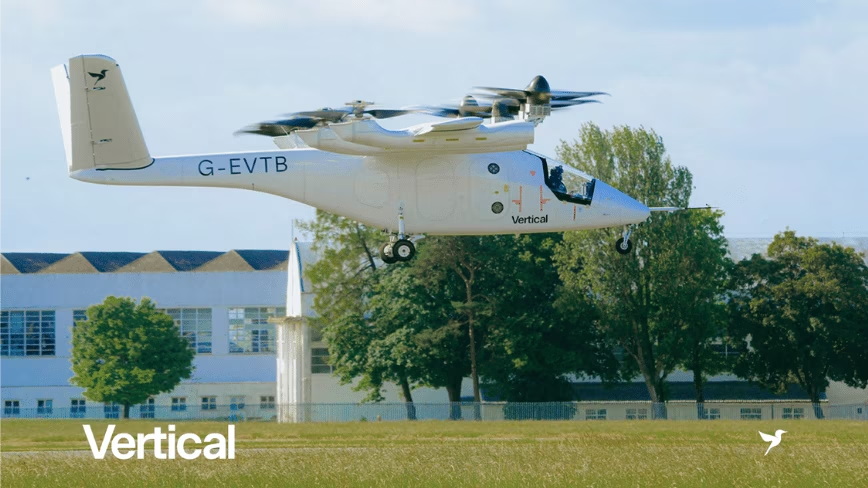
💡See how autonomous flight hardware is scaling testing to meet safety regulations.
⚡ 30-Second TL;DR
What Changed
Second full-scale VX4 prototype completed maiden flight
Why It Matters
Expanding the flight test fleet is a critical milestone for eVTOL companies. It demonstrates progress toward commercial viability in the urban air mobility sector.
What To Do Next
If you work in robotics or autonomous systems, monitor the sensor fusion and flight control telemetry data released by eVTOL firms.
Key Points
- •Second full-scale VX4 prototype completed maiden flight
- •Doubling test fleet to accelerate regulatory certification
- •Focus remains on iterative testing for safety validation
🧠 Deep Insight
Background and context from public sources — not the original article. 25 sources cited.
🔑 Enhanced Key Takeaways
- •The second VX4 prototype's maiden piloted flight on June 5, 2026, positions it as the final new aircraft before a Critical Design Review that will finalize the certifiable design of its Valo air taxi.
- •Vertical Aerospace achieved a full two-way piloted transition flight with its VX4 prototype in April 2026, making it only the second company globally to accomplish this maneuver in a full-scale tiltrotor eVTOL.
- •The company secured $850 million in new funding in April 2026, including $250 million from Yorkville Advisors and $500 million in credit facilities, providing significant capital for its certification path.
- •Vertical Aerospace is targeting type certification for the VX4/Valo by the end of 2028 with both the UK Civil Aviation Authority (CAA) and the European Union Aviation Safety Agency (EASA).
- •The VX4's airframe will be manufactured by Aciturri using high-performance composite and adhesive materials from Syensqo, with other key partners including Honeywell for flight control systems and E-One Moli Energy for battery cells.
📊 Competitor Analysis▸ Show
| Company/Aircraft | Design Type | Capacity (Pilot+Pax) | Cruise Speed | Range | Noise Level | Target Certification/Launch |
|---|---|---|---|---|---|---|
| Vertical Aerospace VX4 | Tilt-Rotor | 1+4 (Valo: 1+4-6) | 150-200 mph (241-322 km/h) | >100 miles (160 km) | ~65 dB | 2028 (CAA/EASA) |
| Joby Aviation S4 | Tilt-Rotor | 1+4 | 200 mph (322 km/h) | 150 miles (241 km) | ~65 dB | 2026-2027 (US) |
| Archer Aviation Midnight | Tilt-Rotor | 1+4 | 150 mph (241 km/h) | 100 miles (160 km) | ~65 dB | 2026 (Commercial Flights) |
| BETA Technologies ALIA | Lift+Cruise | 1+5 | 170 mph (274 km/h) | 250 miles (402 km) | ~60 dB | 2026-2027 |
| EHang EH216-S | Multicopter | 0+2 (Autonomous) | 62 mph (100 km/h) | 22 miles (35 km) | ~70 dB | Certified (China) |
| Volocopter VoloCity | Multicopter | 0+2 | 68 mph (109 km/h) | 22 miles (35 km) | ~65 dB | 2026 (EASA) |
| Supernal S-A2 | Lift+Cruise | 1+4 | 160 mph (257 km/h) | 186 miles (300 km) | ~45 dB | N/A |
🛠️ Technical Deep Dive
- Propulsion System: Features a fixed-wing configuration with four forward-tilting propellers for vertical and cruise flight, and some sources indicate eight electric motors, with four tilting at the front and four rear propellers dedicated to vertical lift.
- Passenger Capacity: Designed for one pilot and four passengers, with the production-ready Valo variant accommodating four to six passengers.
- Performance Metrics: Projected top speed of up to 200 mph (322 km/h), a cruise speed of 150 mph (241 km/h), and a range exceeding 100 miles (160 km).
- Acoustic Profile: Engineered to be near silent in flight, reportedly 30 times quieter than comparable helicopters, with a noise level around 65 dB.
- Structural Materials: The streamlined fuselage is constructed from lightweight composite materials, specifically high-performance composite and adhesive materials from Syensqo, and a carbon composite fuselage co-developed with Leonardo.
- Battery Technology: Utilizes an all-electric powertrain with rapid recharge capability, featuring high-power cylindrical lithium-ion cells supplied through a partnership with E-One Moli Energy, and a proprietary battery pack design. The Valo design incorporates a liquid-cooled, under-floor 700-volt battery system, reducing battery weight by approximately 20%.
- Avionics and Control: Integrates cutting-edge avionics and flight control systems, including fly-by-wire technology with redundant systems, and a compact Fly-by-Wire system provided by Honeywell Aerospace.
- Safety Features: Incorporates multiple redundancies in the propulsion system and a ballistic recovery system, aiming for certification at commercial airline safety levels by EASA.
- Dimensions (VX4): Measures approximately 35 feet in length, with a 40-foot wingspan and a 10-foot height, and a maximum takeoff weight exceeding 5,000 lbs.
- Hybrid-Electric Variant: A hybrid propulsion system is under development, targeting a significantly extended range of up to 1,000 miles and an 1,100 kg payload, expanding its mission flexibility.
🔮 Future ImplicationsAI analysis grounded in cited sources
⏳ Timeline
📎 Sources (25)
Factual claims are grounded in the sources below. Forward-looking analysis is AI-generated interpretation.
- thenextweb.com
- aerospacetestinginternational.com
- airtaxicentral.com
- ainonline.com
- aerospaceglobalnews.com
- vertical-aerospace.com
- mundogeo.com
- helis.com
- ainonline.com
- vertical-aerospace.com
- youtube.com
- verticalmag.com
- leonardo.com
- youtube.com
- wikipedia.org
- youtube.com
- aaminternational.com
- evtol.news
- vertical-aerospace.com
- vertical-aerospace.com
- motorwatt.com
- evtol.travel
- monolithai.com
- businessmodelcanvastemplate.com
- verticalmag.com
Weekly AI Recap
Read this week's curated digest of top AI events →
👉Related Updates


AI-curated news aggregator. All content rights belong to original publishers.
Original source: The Next Web (TNW) ↗
This is a summary, not the original. Read the source, or get the weekly briefing.
The weekly digest
One email a week. Unsubscribe anytime.