US Drafts Ban on Chinese Data-Center Devices
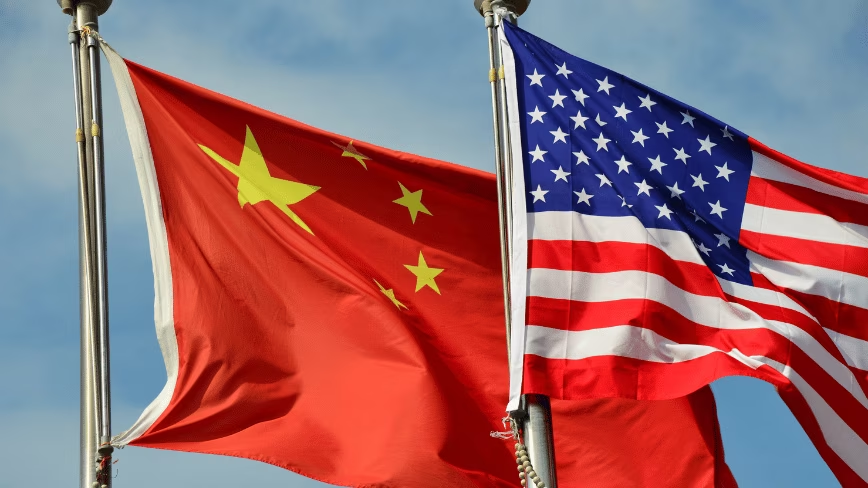
A US hardware ban could change AI data-center sourcing, compliance, and deployment economics.
30-Second TL;DR
What Changed
US officials are drafting restrictions on Chinese-made devices in American data centers.
Why It Matters
A ban could force AI operators to audit hardware provenance, replace affected equipment, and absorb higher procurement and migration costs. It may also fragment data-center supply chains and complicate cross-border infrastructure planning.
What To Do Next
Inventory the country of origin and supplier dependencies for every device in your AI data-center stack, then identify replacement vendors for any Chinese-made components.
Key Points
- •US officials are drafting restrictions on Chinese-made devices in American data centers.
- •The measure targets infrastructure supporting the US AI buildout.
- •The proposal would expand an already widening technology-separation campaign.
Deep Insight
AI-generated analysis for this event — not the original article.
Enhanced Key Takeaways
- •The proposed restrictions are expected to focus on hardware components such as advanced networking equipment, optical transceivers, and power management systems integrated into hyperscale data centers.
- •This initiative aligns with the Department of Commerce's broader strategy to secure the 'information and communications technology and services' (ICTS) supply chain against foreign adversary exploitation.
- •Industry groups have expressed concerns that such a ban could significantly increase capital expenditure (CAPEX) costs for US cloud providers, as alternative supply chains in Southeast Asia or domestic manufacturing may lack current scale.
- •The policy is reportedly being crafted under the authority of Executive Orders that grant the executive branch power to regulate transactions involving technology linked to 'foreign adversaries' like China.
- •Intelligence officials have specifically highlighted risks regarding 'backdoor' vulnerabilities in firmware and remote management interfaces that could allow unauthorized access to sensitive AI training data.
Technical Deep Dive
- Focus on hardware supply chain security: The ban targets components like SmartNICs (Network Interface Cards) and high-speed switches that manage data flow between GPU clusters.
- Firmware integrity: The policy aims to mitigate risks associated with proprietary Chinese firmware that may contain undocumented remote access protocols or 'kill switches'.
- Supply chain provenance: Implementation will likely require 'Bill of Materials' (SBOM) transparency for all critical data center infrastructure components to verify the origin of silicon and sub-assemblies.
Future ImplicationsAI analysis grounded in cited sources
Timeline
- 2023-12US expands export controls on advanced AI chips to China, tightening the technology blockade.
- 2024-05Department of Commerce initiates review of ICTS supply chain risks in cloud computing services.
- 2025-02US government signals intent to scrutinize hardware components within domestic data centers for security vulnerabilities.
- 2026-04Legislative discussions intensify regarding the total exclusion of 'high-risk' foreign hardware from critical AI infrastructure.
Event Coverage
Weekly AI Recap
Read this week's curated digest of top AI events →
Related Updates


AI-curated news aggregator. All content rights belong to original publishers.
Original source: The Next Web (TNW) ↗
This is a summary, not the original. Read the source, or get the weekly briefing.
The weekly digest
One email a week. Unsubscribe anytime.