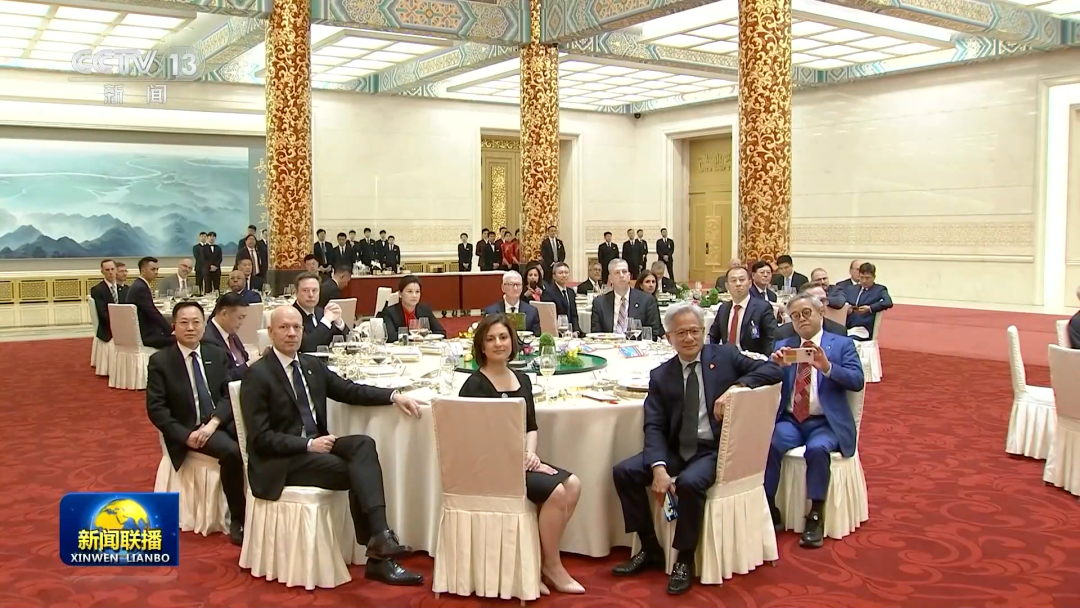
US-China business leaders meet in Beijing
Understand the deep industrial interdependence between US tech giants and Chinese manufacturing, crucial for AI infrastr
30-Second TL;DR
What Changed
Top executives from Apple, Tesla, and Nvidia attended, highlighting the critical nature of the Chinese market.
Why It Matters
The continued presence of major US tech giants in China suggests that despite export controls, the industrial and supply chain interdependence remains a stabilizing force.
What To Do Next
Monitor supply chain diversification strategies of major US tech firms to understand how they balance geopolitical risk with Chinese manufacturing efficiency.
Key Points
- •Top executives from Apple, Tesla, and Nvidia attended, highlighting the critical nature of the Chinese market.
- •Chinese firms like Haier, Hisense, and BYD demonstrate deep integration into the US market through local manufacturing and supply chains.
- •The event emphasizes that中美 (US-China) economic relations are deeply interdependent, moving beyond simple trade.
- •The meeting serves as a platform for finding 'incremental growth' and stabilizing expectations in a volatile global economy.
Deep Insight
Background and context from public sources — not the original article. 20 sources cited.
Enhanced Key Takeaways
- •The high-profile meeting on May 14, 2026, in Beijing involved both US President Donald Trump and Chinese President Xi Jinping, signaling a top-level political endorsement of the commercial discussions and a desire to enhance economic cooperation and market access despite geopolitical tensions.
- •Nvidia CEO Jensen Huang's attendance was particularly significant given the stringent US export controls on advanced AI chips to China, which have severely impacted Nvidia's market share in China, reportedly reducing it to zero from over 80% two years prior.
- •Apple is actively pursuing a strategy to diversify its supply chain beyond China, expanding production to countries like India and Vietnam, driven by rising labor costs, the US-China tariff war, and vulnerabilities exposed by supply disruptions.
- •Tesla's Shanghai Gigafactory has achieved a localization rate exceeding 95% for its components and serves as a primary global export hub, illustrating the deep integration of foreign companies within China's domestic supply chain ecosystem.
- •The discussions at the meeting aimed to expand market access for American businesses in China and increase Chinese investment, reflecting a pragmatic approach to finding 'incremental growth' amidst a volatile global economy and ongoing trade disputes.
Future ImplicationsAI analysis grounded in cited sources
Timeline
- 1979-01US and China normalize diplomatic relations
- 2001China joins the World Trade Organization (WTO)
- 2018-07US-China trade war begins with initial tariffs
- 2019-12Tesla's Shanghai Gigafactory opens
- 2025US President Donald Trump reignites tariff dispute with China
- 2026-05-14High-profile US-China business leaders meeting in Beijing
Sources (20)
Factual claims are grounded in the sources below. Forward-looking analysis is AI-generated interpretation.
Weekly AI Recap
Read this week's curated digest of top AI events →
AI-curated news aggregator. All content rights belong to original publishers.
Original source: 虎嗅 ↗
This is a summary, not the original. Read the source, or get the weekly briefing.
The weekly digest
One email a week. Unsubscribe anytime.