🌍Freshcollected in 2h

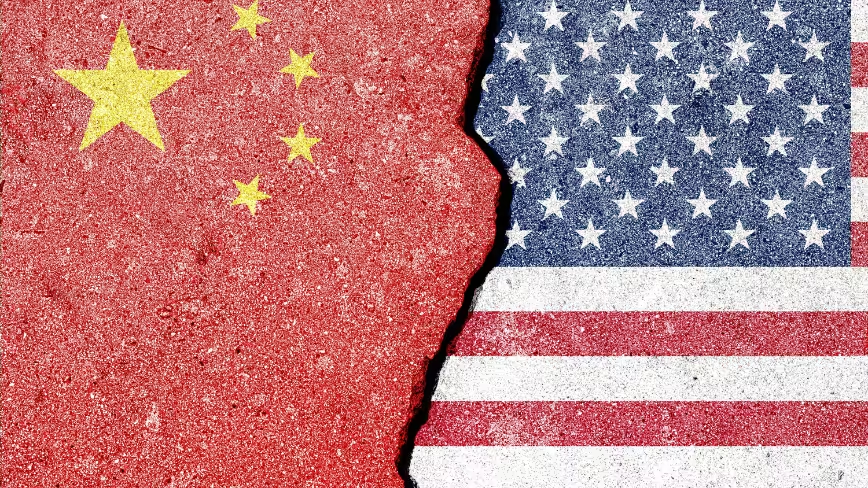
US-China AI Tensions Escalate Over Claude Code Security
US-China AI Tensions Escalate Over Claude Code Security
PostLinkedIn
🌍Read original on The Next Web (TNW)

💡Geopolitical bans on AI tools like Claude Code are changing the global development landscape—check your compliance.

⚡ 30-Second TL;DR

What Changed

China's Ministry of Industry and Information Technology claims Claude Code contains a security back-door.

Why It Matters

This geopolitical friction creates a bifurcated AI ecosystem, forcing global companies to choose between US and Chinese AI stacks to ensure compliance and security.

What To Do Next

Review your supply chain and development tools to ensure compliance with emerging cross-border AI regulations and security directives.

Who should care:Founders & Product Leaders

Key Points

  • China's Ministry of Industry and Information Technology claims Claude Code contains a security back-door.
  • Chinese companies have been ordered to discontinue the use of Anthropic’s coding tool.
  • US lawmakers are pushing back against American firms utilizing low-cost Chinese AI models.

🧠 Deep Insight

AI-generated analysis for this event.

🔑 Enhanced Key Takeaways

  • The Chinese government's directive specifically targets the 'Claude Code' CLI tool, citing concerns over its autonomous file-system access and potential for unauthorized data exfiltration during code execution.
  • US lawmakers are drafting the 'AI Sovereignty and Security Act,' which aims to mandate transparency audits for any foreign-developed AI models integrated into critical US infrastructure.
  • Anthropic has publicly denied the existence of back-doors, offering to provide the source code of the Claude Code agent to independent third-party auditors to verify its security protocols.
  • Industry analysts note that this escalation follows a broader trend of 'AI decoupling,' where both nations are increasingly restricting cross-border access to developer tools and integrated development environments (IDEs).
  • Several major Chinese tech conglomerates, including Alibaba and Tencent, have accelerated the development of domestic alternatives to Claude Code to mitigate the impact of the government-mandated ban.
📊 Competitor Analysis▸ Show
FeatureClaude CodeGitHub CopilotDeepSeek Coder
Primary FocusAutonomous Agentic CodingIDE Integration/AutocompleteOpen-Weights Model
Security ModelLocalized Execution/SandboxingCloud-Based/Enterprise GradeSelf-Hosted/On-Premise
PricingUsage-based (API)Subscription ($10-$19/mo)Free/Open Source
BenchmarksHigh (SWE-bench Verified)Moderate (Code Completion)High (Competitive)

🛠️ Technical Deep Dive

  • Claude Code utilizes a multi-agent architecture where a primary orchestrator model manages file system operations and terminal commands.
  • The tool employs a restricted sandbox environment using gVisor to isolate execution processes from the host operating system.
  • Security concerns raised by Beijing focus on the 'tool-use' capability, where the model can autonomously execute shell commands to install dependencies or run tests.
  • Anthropic implements strict egress filtering on the agent's environment to prevent unauthorized data transmission to non-Anthropic endpoints.

🔮 Future ImplicationsAI analysis grounded in cited sources

Global software development will fragment into 'AI-siloed' ecosystems.
Increasing restrictions on cross-border AI tools will force multinational companies to maintain separate codebases and development environments for different regions.
Open-source AI models will face stricter export controls.
Governments are likely to classify high-performance coding agents as 'dual-use' technology, limiting their distribution to prevent potential cyber-espionage.

Timeline

2024-03
Anthropic releases Claude 3 family, marking its entry into high-performance coding tasks.
2025-02
Anthropic officially launches Claude Code, an agentic CLI tool for software engineering.
2026-05
US Department of Commerce adds specific AI coding agents to the Entity List for export review.
2026-07
China's MIIT issues formal directive banning the use of Claude Code in state-affiliated enterprises.
📰

Weekly AI Recap

Read this week's curated digest of top AI events →

👉Related Updates

AI-curated news aggregator. All content rights belong to original publishers.
Original source: The Next Web (TNW)