US bars Polestar EVs under Connected Vehicle Rule
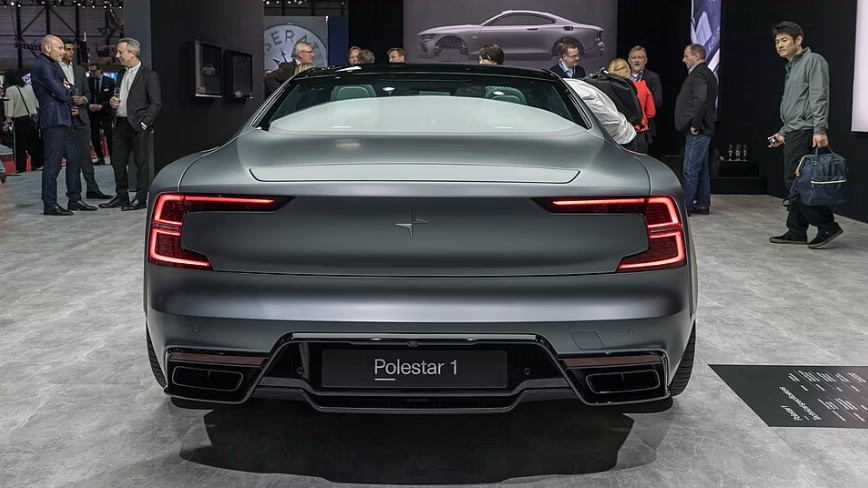
Regulatory crackdown on connected vehicle software could disrupt the automotive AI and IoT ecosystem.
30-Second TL;DR
What Changed
Polestar denied authorization under the Connected Vehicle Rule
Why It Matters
This move signals heightened regulatory scrutiny on software-defined vehicles and their supply chains. It may force other manufacturers to re-evaluate their software sourcing and connectivity architectures.
What To Do Next
If you are building automotive software, audit your connectivity stack for compliance with new US software-defined vehicle regulations.
Key Points
- •Polestar denied authorization under the Connected Vehicle Rule
- •Ban applies to new EV models in the US market
- •Decision stems from software security and connectivity concerns
- •Impacts Geely-owned automotive operations in the US
Deep Insight
AI-generated analysis for this event — not the original article.
Enhanced Key Takeaways
- •The Connected Vehicle Rule specifically targets software and hardware components originating from 'foreign adversaries,' with China being the primary focus of the Department of Commerce's enforcement.
- •Polestar's reliance on Geely's centralized vehicle operating systems and cloud infrastructure was cited as a critical vulnerability by US regulators regarding data sovereignty.
- •The ban encompasses not just the sale of new vehicles, but also prohibits the importation of connected vehicle components from Geely-affiliated supply chains into the US.
- •Polestar had previously attempted to mitigate these concerns by announcing plans to localize some software development and data hosting, but regulators deemed these measures insufficient to meet the new security standards.
- •This regulatory action follows a broader trend of the Trump administration utilizing the International Emergency Economic Powers Act (IEEPA) to restrict technology integration in the automotive sector.
Competitor Analysis
- Polestar (Impacted)
- China/Geely-based
- Tesla (Compliant)
- US-developed
- Rivian (Compliant)
- US-developed
- Polestar (Impacted)
- Geely Cloud (Restricted)
- Tesla (Compliant)
- US-based Servers
- Rivian (Compliant)
- US-based Servers
- Polestar (Impacted)
- Sales Blocked
- Tesla (Compliant)
- Operational
- Rivian (Compliant)
- Operational
- Polestar (Impacted)
- High China Dependency
- Tesla (Compliant)
- Diversified
- Rivian (Compliant)
- North American Focus
| Feature | Polestar (Impacted) | Tesla (Compliant) | Rivian (Compliant) |
|---|---|---|---|
| Software Origin | China/Geely-based | US-developed | US-developed |
| Data Hosting | Geely Cloud (Restricted) | US-based Servers | US-based Servers |
| Market Status | Sales Blocked | Operational | Operational |
| Supply Chain | High China Dependency | Diversified | North American Focus |
Technical Deep Dive
- The Connected Vehicle Rule mandates the removal of Chinese-linked V2X (Vehicle-to-Everything) hardware and software modules.
- Polestar vehicles utilize the Android Automotive OS with Geely-specific middleware layers that facilitate data transmission to servers located in jurisdictions deemed high-risk by the US government.
- The restriction targets the integration of telematics control units (TCUs) and Bluetooth/Wi-Fi modules that lack independent, third-party security audits acceptable under the new federal guidelines.
- Compliance requires a complete decoupling of the vehicle's OTA (Over-the-Air) update architecture from Geely's centralized backend systems.
Future ImplicationsAI analysis grounded in cited sources
Timeline
- 2021-06Polestar announces plans to go public via SPAC merger with Gores Guggenheim.
- 2022-06Polestar begins trading on the Nasdaq under the ticker PSNY.
- 2024-02Volvo Cars announces it will cease further funding for Polestar, shifting focus to its own EV transition.
- 2025-11US Department of Commerce finalizes the Connected Vehicle Rule, setting strict deadlines for compliance.
- 2026-06Polestar is officially denied authorization to sell new vehicles in the US under the new security mandate.
Weekly AI Recap
Read this week's curated digest of top AI events →
Related Updates


AI-curated news aggregator. All content rights belong to original publishers.
Original source: The Next Web (TNW) ↗
This is a summary, not the original. Read the source, or get the weekly briefing.
The weekly digest
One email a week. Unsubscribe anytime.