US AI export controls impact NATO summit agenda
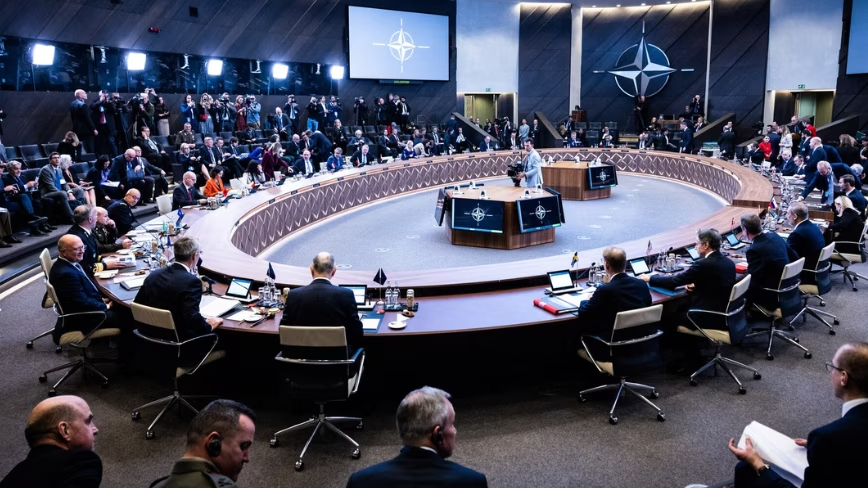
💡Understand how US AI export controls are reshaping international security and model accessibility for global partners.
⚡ 30-Second TL;DR
What Changed
US holds leverage over NATO allies regarding access to frontier AI models
Why It Matters
This signals a shift toward AI being treated as a strategic military asset, potentially leading to restricted access for international developers.
What To Do Next
Review your cross-border data compliance and export control policies if your AI product involves high-compute frontier models.
Key Points
- •US holds leverage over NATO allies regarding access to frontier AI models
- •AI security and strategic sharing are central to the Ankara summit agenda
- •New capabilities in Anthropic and OpenAI models raise urgent defense questions
🧠 Deep Insight
AI-generated analysis for this event — not the original article.
🔑 Enhanced Key Takeaways
- •The Ankara summit marks the first time NATO has formally integrated 'AI Sovereignty' as a primary pillar of the Strategic Concept, moving beyond mere interoperability standards.
- •The US Department of Commerce has reportedly drafted a 'Tiered Access Framework' that would allow NATO allies to utilize frontier models for defense simulations while restricting access to underlying model weights.
- •European member states, led by France and Germany, are pushing for a 'European AI Defense Cloud' to reduce reliance on US-based providers like OpenAI and Anthropic for classified military intelligence.
- •Recent intelligence reports suggest that adversarial actors have attempted to exploit API vulnerabilities in frontier models to conduct automated cyber-reconnaissance against NATO infrastructure.
- •The summit is expected to finalize the 'Ankara Protocol,' a set of binding guidelines for the ethical deployment of AI in autonomous weapon systems among alliance members.
🛠️ Technical Deep Dive
- Frontier models involved are utilizing multi-modal architectures with enhanced reasoning capabilities for tactical decision-making support.
- Security protocols under discussion include 'Federated Model Training' which allows member states to fine-tune models on sovereign data without exposing raw training sets.
- Implementation of 'Hardware-Rooted Trust' (HRT) is being mandated for all edge devices accessing frontier AI to prevent model tampering or unauthorized inference.
- Integration of 'Differential Privacy' layers is required for all cross-border intelligence sharing to ensure compliance with NATO data sovereignty mandates.
🔮 Future ImplicationsAI analysis grounded in cited sources
⏳ Timeline
Weekly AI Recap
Read this week's curated digest of top AI events →
👉Related Updates

AI-curated news aggregator. All content rights belong to original publishers.
Original source: The Next Web (TNW) ↗
This is a summary, not the original. Read the source, or get the weekly briefing.
Weekly AI briefing
One email a week. Unsubscribe anytime.