Unmanned Tanks Tackle Munitions-Fueled Wildfires
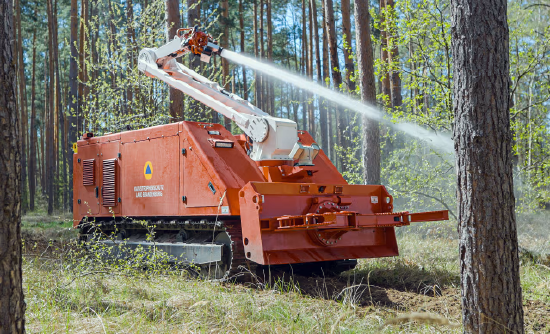
💡See how unmanned ground robots could keep responders away from WWII-era unexploded ordnance.
⚡ 30-Second TL;DR
What Changed
The Hürtgen Forest fire burned hundreds of acres and threatened a nearby village.
Why It Matters
Hazardous-fire robotics could become an important application for embodied AI, especially where remote sensing and autonomous navigation are safer than direct human intervention. However, the article does not provide details about a specific tank model or confirmed deployment.
What To Do Next
Prototype a ROS 2 remote-operation workflow for unmanned ground vehicles and test navigation, video relay, and fail-safe controls in a simulated hazardous-fire environment.
Key Points
- •The Hürtgen Forest fire burned hundreds of acres and threatened a nearby village.
- •Nearly 2,000 emergency personnel and 10 helicopters were deployed.
- •Unmanned ground vehicles could reduce human exposure to unexploded-ordnance hazards.
🧠 Deep Insight
Background and context from public sources — not the original article. 26 sources cited.
🔑 Enhanced Key Takeaways
- •The Hürtgen Forest wildfire in August 2026 necessitated the evacuation of approximately 1,800 residents from the nearby village of Gey.
- •The blaze consumed nearly 300 hectares (1.16 square miles) of forest and was considered by authorities to be potentially the largest forest fire in North Rhine-Westphalia's history.
- •Unexploded ordnance (UXO) from World War II in the Hürtgen Forest, when heated by the fire, caused sporadic detonations, compelling firefighters to maintain a safe distance, sometimes up to 1,000 meters, from the active fire zones.
- •Germany continues to uncover an estimated 2,000 tons of unexploded munitions annually, with some estimates suggesting that up to 300,000 tonnes of UXO still remain buried across the country.
- •The challenge of wildfires exacerbated by unexploded ordnance is not unique to Hürtgen Forest; other German national parks, such as Müritz, have also experienced similar incidents requiring bomb disposal teams to work alongside firefighting crews.
📊 Competitor Analysis▸ Show
Unmanned Firefighting Vehicle Competitor Analysis
| Feature / Company | Shark Robotics (Colossus, Barakuda) | Hyundai Rotem (HR-Sherpa platform) | Jinjia Special Equipment | Lockheed Martin (Fire Ox) | Guoxing Intelligent / Baijirobot China (General UGVs) |
|---|---|---|---|---|---|
| Primary Application | Fire suppression, casualty evacuation, reconnaissance, equipment transport in extreme environments. | Firefighting, hazard assessment in high-risk industrial sites. | UXO wildfire suppression, general emergency response. | Multimission fire management (suppression, trenching, hazmat). | Firefighting, rescue in hazardous, toxic, explosive areas. |
| Key Features | Modular architecture (10+ modules), IP67, heat-shielding, 45° slope climbing, 3,800 L/min water cannon. | Rugged electric 6x6 in-wheel motor, water cannon, self-cooling, thermal imaging, military-derived chassis. | Armored UGVs, UAV reconnaissance, AI-assisted route planning, edge command systems, mesh communication. | Semiautonomous, 250-gallon water tank, foam cell, EO/IR cameras, 6x6 hydrostatic drive. | Explosion-proof, high-temperature resistance, anti-interference millimeter-wave radar, auto ignition point capture, 63cm vertical obstacle climb, 60cm water depth. |
| Autonomy Level | Remote-controlled with evolving autonomy. | Remote-controlled, designed for deployment ahead of humans. | Remote and autonomous deployment, AI-assisted. | Semiautonomous. | Remote-controlled, some with autonomous capabilities (e.g., auto ignition point capture). |
| Payload Capacity | Colossus: Equipment transport, casualty evacuation. Barakuda: 500 kg. | Not specified for firefighting variant, but rugged platform. | Not specified, but designed for armored vehicles. | Not specified, but carries 250-gallon tank. | Customizable functional tops. |
| Pricing | Null | Null | Null | Null | Null |
| Benchmarks | Null | Null | Null | Null | Null |
🛠️ Technical Deep Dive
- Platform Design: Unmanned firefighting vehicles are often built on rugged, all-terrain platforms, sometimes adapted from military designs (e.g., Hyundai Rotem's HR-Sherpa 6x6 in-wheel motor system). They feature robust construction with heat-resistant alloys, ceramic insulation, and advanced cooling systems to withstand extreme temperatures.
- Mobility: These UGVs are designed for high maneuverability in challenging environments, capable of climbing steep slopes (e.g., 45° for Colossus, 35° for Baijirobot), traversing obstacles (up to 63cm vertical for Baijirobot), and operating in water (up to 60cm deep for Baijirobot). Tracked systems provide superior traction and stability over varied terrain like mud, sand, snow, and rubble.
- Sensor Suites: Equipped with advanced sensors for situational awareness, including thermal imaging cameras, high-definition optical zoom modules, and IR sensors capable of penetrating dense smoke. Some also integrate gas detectors to identify toxic atmospheres.
- Fire Suppression Systems: Feature powerful water cannons with high flow rates (e.g., Colossus delivers 3,800 L/min) and self-spraying cooling systems for the robot itself. They can deliver water or foam.
- Autonomy and Control: Primarily remotely operated, allowing human firefighters to control them from a safe distance. Increasingly, systems incorporate autonomous capabilities such as AI scene recognition, fire source locking algorithms, GPS + RTK centimeter-level positioning, and multi-direction obstacle avoidance.
- Communication: Utilize robust communication links, including mesh networks for continuous operation in network-denied or complex environments, ensuring low latency for video transmission (e.g., less than 250 ms for Baijirobot).
- Additional Capabilities: Beyond fire suppression, many UGVs are modular and can be equipped for reconnaissance, casualty evacuation (e.g., stretchers), smoke extraction, equipment transport, and creating firebreaks.
🔮 Future ImplicationsAI analysis grounded in cited sources
⏳ Timeline
📎 Sources (26)
Factual claims are grounded in the sources below. Forward-looking analysis is AI-generated interpretation.
- pbs.org
- lasvegassun.com
- manilatimes.net
- ua.news
- youtube.com
- arizona.edu
- scmp.com
- smithsonianmag.com
- north.io
- dailypioneer.com
- shark-robotics.com
- facebook.com
- tecrow.com
- responsemobility.com
- fireapparatusmagazine.com
- gxsuprobot.com
- baijirobot.com
- shark-robotics.com
- hcrot.com
- terrahexen.com
- shark-robotics.com
- energyrcjetengine.com
- handlergp.com
- mineactionreview.org
- copernicus.eu
- sana.sy
Weekly AI Recap
Read this week's curated digest of top AI events →
👉Related Updates


AI-curated news aggregator. All content rights belong to original publishers.
Original source: cnBeta (Full RSS) ↗
This is a summary, not the original. Read the source, or get the weekly briefing.
Weekly AI briefing
One email a week. Unsubscribe anytime.