University of Utah achieves 20-second holographic 3D printing
💡A potential leap in rapid prototyping speed that could redefine how we manufacture complex hardware components.
⚡ 30-Second TL;DR
What Changed
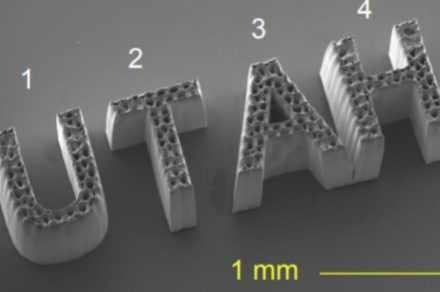
New holographic method reduces 3D printing time to 20 seconds
Why It Matters
This breakthrough could eventually revolutionize rapid prototyping for micro-scale components. If scaling issues are resolved, it may significantly accelerate hardware development cycles.
What To Do Next
Monitor research papers on 'volumetric additive manufacturing' to track when material constraints for larger-scale prints are overcome.
Key Points
- •New holographic method reduces 3D printing time to 20 seconds
- •Technology enables rapid formation of complex tiny structures
- •Current hardware limitations prevent immediate industrial application
🧠 Deep Insight
AI-generated analysis for this event — not the original article.
🔑 Enhanced Key Takeaways
- •The process utilizes tomographic volumetric additive manufacturing, which solidifies entire 3D objects simultaneously rather than layer-by-layer.
- •Researchers employed a digital micromirror device (DMD) to project light patterns from multiple angles into a photosensitive resin vat.
- •The method relies on a mathematical algorithm known as the Radon transform to calculate the necessary light projections for complex geometries.
- •A primary technical hurdle identified is the 'light scattering' effect within the resin, which degrades resolution as the object size increases.
- •The team is currently investigating the use of specialized photo-absorbers to control light penetration depth and improve structural fidelity.
📊 Competitor Analysis▸ Show
| Technology | Speed | Resolution | Primary Limitation |
|---|---|---|---|
| University of Utah Holographic | ~20 Seconds | Micro-scale | Scaling/Scattering |
| Traditional SLA/DLP | Minutes/Hours | High | Layer-by-layer speed |
| Standard Volumetric (CAL) | Seconds | Medium | Material transparency |
🛠️ Technical Deep Dive
- Utilizes a tomographic reconstruction approach where 2D projections are computed to form a 3D volume.
- Employs a high-speed digital micromirror device (DMD) to modulate light intensity and spatial distribution.
- The resin system is based on a photopolymer that undergoes rapid polymerization when exposed to specific light wavelengths.
- The system architecture requires precise synchronization between the rotation of the resin container and the projection of holographic patterns.
- Resolution is currently constrained by the pixel pitch of the DMD and the optical diffraction limits of the projection system.
🔮 Future ImplicationsAI analysis grounded in cited sources
⏳ Timeline
Weekly AI Recap
Read this week's curated digest of top AI events →
👉Related Updates
AI-curated news aggregator. All content rights belong to original publishers.
Original source: Digital Trends ↗
This is a summary, not the original. Read the source, or get the weekly briefing.
Weekly AI briefing
One email a week. Unsubscribe anytime.