Unitree’s IPO Tests Embodied AI
Unitree’s IPO may reset embodied-AI valuations—but the real test is whether robots can deliver reliable work outside dem
30-Second TL;DR
What Changed
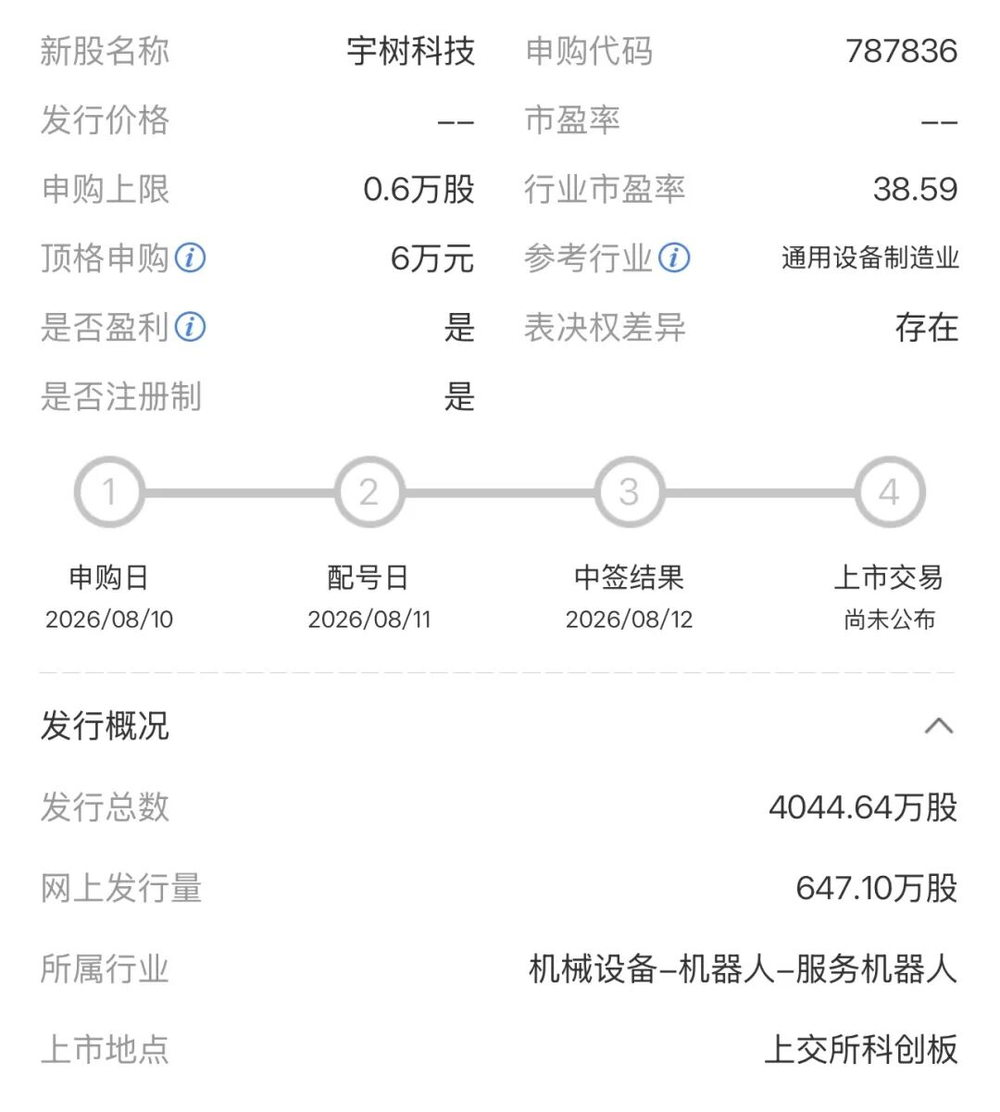
Unitree’s planned IPO subscription requires STAR Market access, with an estimated online winning rate of only 0.02%–0.05%.
Why It Matters
Unitree’s listing could become a valuation benchmark for Chinese embodied AI startups preparing to go public. Its performance may affect late-stage financing, government-backed projects, acquisition strategies, and the willingness of investors to fund robot intelligence rather than only mechanical hardware.
What To Do Next
Before building a humanoid-robot product, benchmark manipulation speed, task success rate, and total operating cost in an industrial or retail pilot rather than relying on IPO valuations.
Key Points
- •Unitree’s planned IPO subscription requires STAR Market access, with an estimated online winning rate of only 0.02%–0.05%.
- •At an indicative issue price of 103 yuan, the company would be valued at about 71x adjusted P/E and 24.7x P/S.
- •About half of the expected 4.2 billion yuan raised is planned for embodied AI foundation models and related “brain” capabilities.
- •The strongest near-term scenarios appear to be industrial manufacturing and retail, while household robots remain slow, expensive, and unreliable.
- •The article warns that forced deployments and excessive valuations could damage trust in the broader robotics industry.
Deep Insight
AI-generated analysis for this event — not the original article.
Enhanced Key Takeaways
- •Unitree has strategically shifted from its origins in quadrupedal robotics to a dual-focus strategy emphasizing humanoid platforms like the G1 and H1 models to capture the broader embodied AI market.
- •The company's R&D expenditure has surged significantly in the last 24 months, specifically targeting the integration of large language models (LLMs) and vision-language models (VLMs) into their proprietary robot control stacks.
- •Unitree has established a specialized manufacturing facility in Hangzhou designed for mass-producing humanoid actuators, aiming to reduce unit costs by approximately 40% compared to previous prototype iterations.
- •The IPO proceeds are also earmarked for expanding international distribution channels, specifically targeting North American and European research institutions to compete with Western robotics firms.
- •Unitree has faced increasing scrutiny from domestic regulators regarding data privacy and security protocols for robots operating in public and household environments, a factor influencing their IPO disclosure requirements.
Competitor Analysis
- Unitree (G1/H1)
- Agile Locomotion/Cost
- Tesla (Optimus)
- Mass Production/Scale
- Figure AI (Figure 02)
- General Purpose AI
- Unitree (G1/H1)
- $16,000 - $90,000
- Tesla (Optimus)
- $20,000 - $30,000 (Target)
- Figure AI (Figure 02)
- High (Enterprise/Pilot)
- Unitree (G1/H1)
- High-speed dynamic balance
- Tesla (Optimus)
- End-to-end neural control
- Figure AI (Figure 02)
- Human-like manipulation
| Feature | Unitree (G1/H1) | Tesla (Optimus) | Figure AI (Figure 02) |
|---|---|---|---|
| Primary Focus | Agile Locomotion/Cost | Mass Production/Scale | General Purpose AI |
| Pricing (Est.) | $16,000 - $90,000 | $20,000 - $30,000 (Target) | High (Enterprise/Pilot) |
| Key Benchmark | High-speed dynamic balance | End-to-end neural control | Human-like manipulation |
Technical Deep Dive
- Actuator Technology: Utilizes proprietary high-torque density joint motors with integrated planetary gearboxes to achieve high force-to-weight ratios.
- Control Architecture: Employs a hierarchical control system where a high-level embodied AI model generates task-level plans, while a low-level Whole-Body Control (WBC) layer manages real-time stability and locomotion.
- Sensing Suite: Integrates multi-modal sensor fusion including 3D LiDAR, depth cameras, and tactile sensors in the hands for fine-grained object manipulation.
- Simulation: Heavily relies on NVIDIA Isaac Gym for reinforcement learning (RL) training, allowing for millions of simulated hours to refine gait and interaction policies before deployment.
Future ImplicationsAI analysis grounded in cited sources
Timeline
- 2017-08Unitree Robotics founded by Wang Xingxing.
- 2021-06Launch of the B1 industrial quadruped robot.
- 2023-08Official unveiling of the H1 general-purpose humanoid robot.
- 2024-05Release of the G1 humanoid agent, targeting a lower price point for mass market.
- 2026-02Unitree officially files for IPO on the Shanghai STAR Market.
Weekly AI Recap
Read this week's curated digest of top AI events →
AI-curated news aggregator. All content rights belong to original publishers.
Original source: 虎嗅 ↗
This is a summary, not the original. Read the source, or get the weekly briefing.
The weekly digest
One email a week. Unsubscribe anytime.