Unitree's 42 billion valuation and the embodied AI market
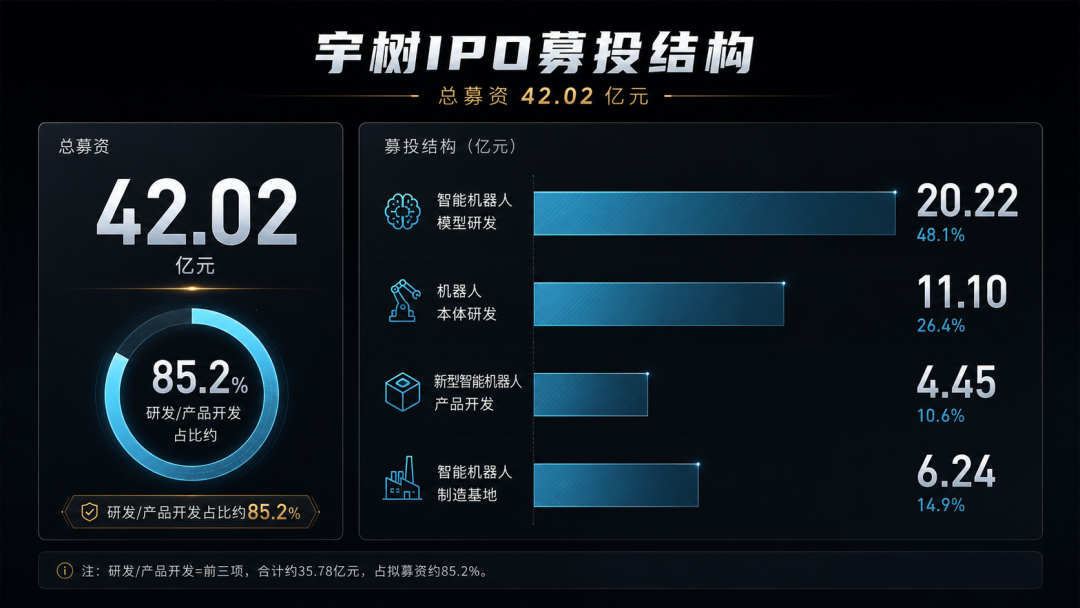
💡Understand the valuation reality of leading humanoid robotics firms to gauge the maturity of the embodied AI market.
⚡ 30-Second TL;DR
What Changed
Unitree Robotics faces a critical valuation test at 42 billion RMB.
Why It Matters
The valuation of Unitree sets a benchmark for the entire Chinese humanoid robotics industry. Investors and founders should monitor how market reception influences future funding rounds for embodied AI startups.
What To Do Next
Analyze Unitree's hardware-software integration roadmap to identify gaps in current embodied AI deployment strategies.
Key Points
- •Unitree Robotics faces a critical valuation test at 42 billion RMB.
- •The embodied AI sector is under scrutiny for commercial viability.
- •Market skepticism persists regarding the path to profitability for humanoid robotics.
🧠 Deep Insight
AI-generated analysis for this event — not the original article.
🔑 Enhanced Key Takeaways
- •Unitree's valuation surge is largely driven by its aggressive cost-reduction strategy, specifically the G1 humanoid robot which launched with a starting price point under $16,000.
- •The company has shifted its focus from purely industrial applications to the 'general-purpose' consumer and research market, aiming to replicate the smartphone industry's hardware-software ecosystem model.
- •Unitree has secured significant backing from major Chinese tech conglomerates and venture capital firms, which are betting on the company's proprietary motor and joint actuator technology to maintain a cost moat.
- •Despite the high valuation, Unitree faces intense pressure to demonstrate 'embodied intelligence' capabilities that go beyond pre-programmed movements, specifically in real-world unstructured environments.
- •The company's supply chain integration, including in-house production of core components like speed reducers and motors, is a primary differentiator cited by analysts to justify its premium over pure-play robotics integrators.
📊 Competitor Analysis▸ Show
| Feature | Unitree (G1/H1) | Tesla (Optimus) | Figure AI (Figure 02) |
|---|---|---|---|
| Target Market | Consumer/Research/Industrial | Mass Manufacturing/Consumer | Industrial/Logistics |
| Pricing Strategy | Low-cost (Entry ~$16k) | Projected mass-market low cost | Premium/Enterprise-focused |
| Key Advantage | Vertical integration/Cost | FSD/AI stack/Scale | OpenAI partnership/Dexterity |
🛠️ Technical Deep Dive
- Actuation: Utilizes proprietary high-torque density joint motors with integrated planetary gearboxes to achieve high power-to-weight ratios.
- Control Architecture: Employs a hierarchical control system combining traditional model-based control for locomotion and deep reinforcement learning (DRL) for complex manipulation tasks.
- Sensing: Integrates multi-modal sensor suites including 3D LiDAR, depth cameras, and force/torque sensors at the end-effectors for tactile feedback.
- Compute: Leverages onboard edge computing modules capable of running lightweight transformer-based models for real-time path planning and object recognition.
🔮 Future ImplicationsAI analysis grounded in cited sources
⏳ Timeline
Weekly AI Recap
Read this week's curated digest of top AI events →
👉Related Updates

AI-curated news aggregator. All content rights belong to original publishers.
Original source: 钛媒体 ↗
This is a summary, not the original. Read the source, or get the weekly briefing.
Weekly AI briefing
One email a week. Unsubscribe anytime.