Bridging the Gap: Embodied AI in Industrial Production

💡Learn why most embodied AI demos fail in factories and what it takes to build robots that actually generate profit.
⚡ 30-Second TL;DR
What Changed
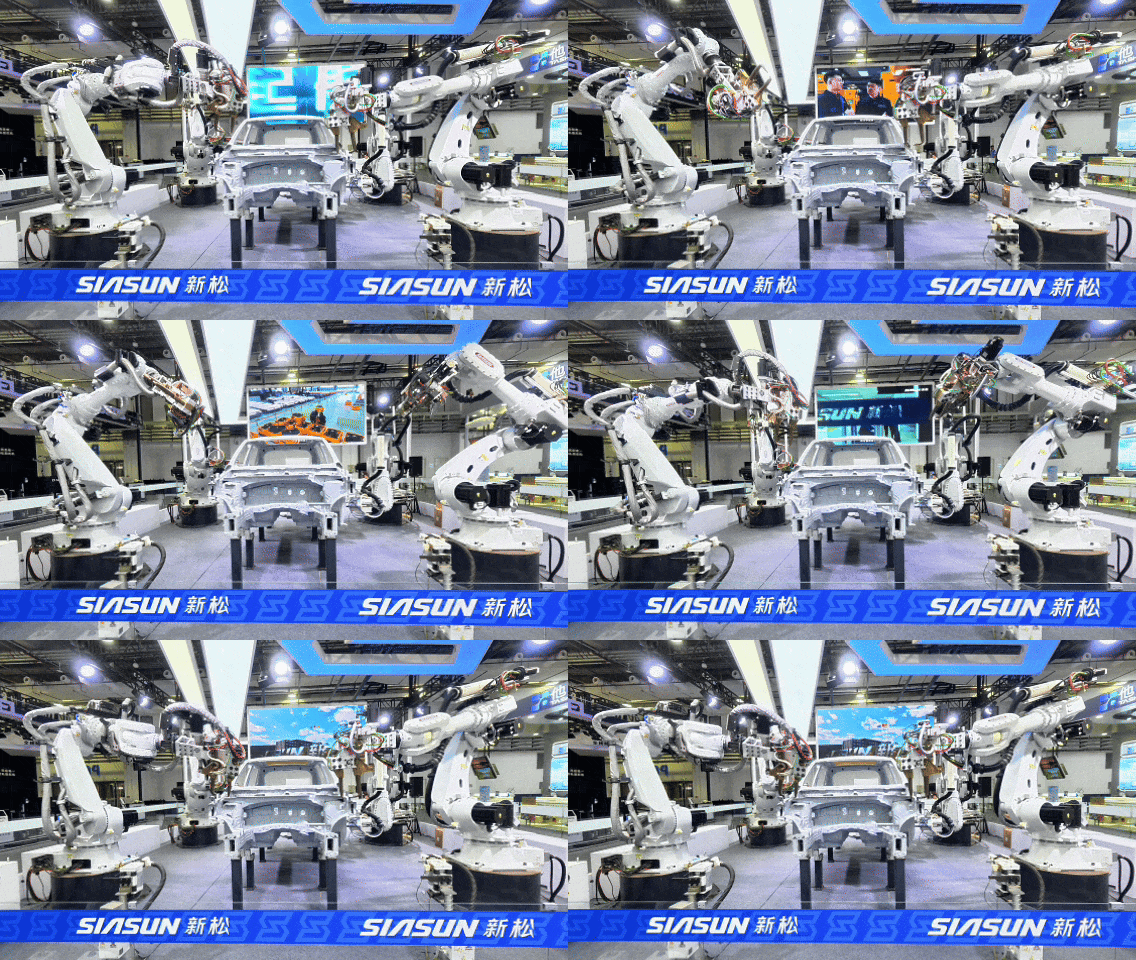
There is a significant gap between 'demo-ready' robots and those capable of stable, profitable industrial operation.
Why It Matters
The industry is shifting focus from model architecture to engineering reliability, which will likely accelerate the deployment of specialized, rather than general-purpose, robots.
What To Do Next
If building for industrial robotics, prioritize integrating your VLA model with a deterministic control loop to ensure sub-millimeter precision.
Key Points
- •There is a significant gap between 'demo-ready' robots and those capable of stable, profitable industrial operation.
- •VLA (Vision-Language-Action) models alone are insufficient for high-precision industrial tasks requiring sub-millimeter accuracy.
- •Successful industrial AI requires integrating VLA with world models and real-time control systems.
- •ROI and stability are the primary metrics for factory adoption, superseding model novelty.
🧠 Deep Insight
AI-generated analysis for this event — not the original article.
🔑 Enhanced Key Takeaways
- •Industrial adoption is currently driven by the 'Sim-to-Real' gap, where synthetic data generation via NVIDIA Isaac Sim and similar platforms is becoming the standard for training robust industrial policies.
- •The shift toward 'Foundation Agents' involves moving from end-to-end VLA models to hierarchical architectures where a high-level LLM/VLM planner delegates to low-level, deterministic control loops.
- •Edge computing requirements for embodied AI are forcing a transition toward on-device inference chips (e.g., specialized NPUs) to minimize latency in safety-critical factory environments.
- •Standardization efforts, such as the integration of ROS 2 (Robot Operating System) with modern AI middleware, are critical for ensuring interoperability between legacy PLC systems and new AI-driven controllers.
- •Data privacy and security concerns in manufacturing are leading to the rise of 'Federated Learning' for embodied AI, allowing robots to improve performance without sharing proprietary factory floor data.
📊 Competitor Analysis▸ Show
| Feature | VLA-Centric Models (e.g., RT-2) | Hybrid Industrial Agents (e.g., Figure/Tesla) | Traditional PLC/Automation |
|---|---|---|---|
| Precision | Moderate | High | Ultra-High |
| Flexibility | High | High | Low |
| Latency | High | Low (Edge-optimized) | Ultra-Low |
| Cost | High (Training) | High (Hardware) | Moderate |
🛠️ Technical Deep Dive
- Hybrid Architecture: Combines Vision-Language-Action (VLA) models for semantic understanding with Model Predictive Control (MPC) for kinematic stability.
- Latency Management: Implementation of real-time kernels (RT-Linux) to ensure control loop frequency remains above 500Hz, which is necessary for stable industrial manipulation.
- Sensor Fusion: Integration of tactile feedback sensors (e.g., GelSight-style) with visual inputs to overcome the limitations of pure vision-based depth estimation in occluded environments.
- World Model Integration: Utilization of latent dynamics models to predict the physical consequences of actions before execution, reducing the error rate in high-speed assembly tasks.
🔮 Future ImplicationsAI analysis grounded in cited sources
⏳ Timeline
Weekly AI Recap
Read this week's curated digest of top AI events →
👉Related Updates


AI-curated news aggregator. All content rights belong to original publishers.
Original source: 虎嗅 ↗
This is a summary, not the original. Read the source, or get the weekly briefing.
Weekly AI briefing
One email a week. Unsubscribe anytime.