Unitree Robotics: Balancing Cost Engineering with AI Capability
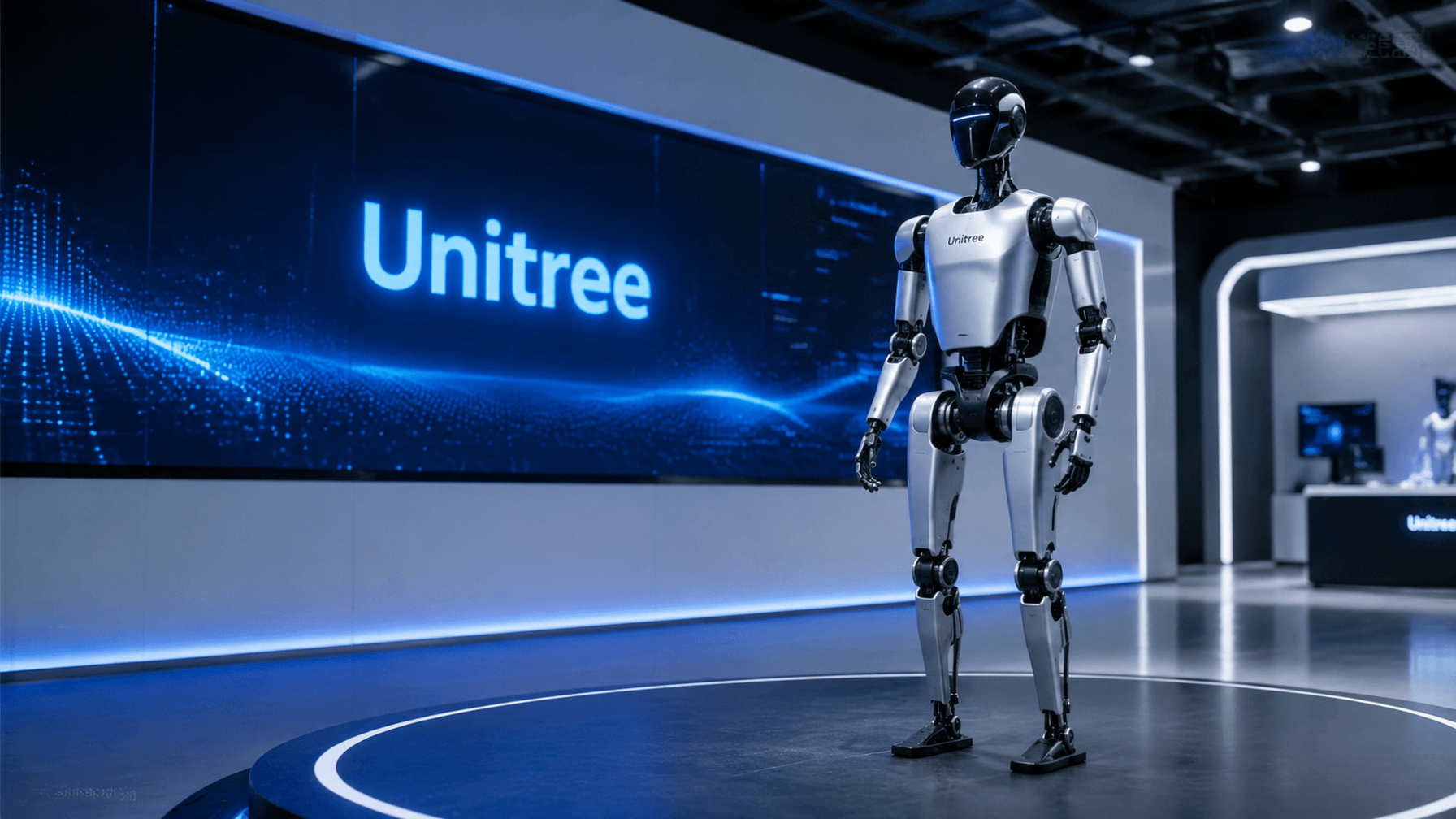
Understand why hardware-focused robotics firms are struggling to compete with AI-native software stacks.
30-Second TL;DR
What Changed
Unitree has achieved profitability via advanced cost engineering.
Why It Matters
The shift highlights that hardware commoditization in robotics is accelerating, forcing manufacturers to pivot toward software-defined intelligence. Companies failing to bridge the AI gap will likely lose market share to software-first robotics firms.
What To Do Next
Evaluate the integration of open-source embodied AI frameworks like Isaac Gym or Habitat to enhance your robot's perception stack.
Key Points
- •Unitree has achieved profitability via advanced cost engineering.
- •Hardware cost dominance is no longer sufficient to maintain market leadership.
- •The company faces a critical gap in high-level AI software integration.
- •The humanoid robot race is shifting from mechanical design to embodied AI intelligence.
Deep Insight
AI-generated analysis for this event — not the original article.
Enhanced Key Takeaways
- •Unitree has pioneered the use of high-torque density joint motors developed in-house, which significantly lowers the Bill of Materials (BOM) compared to competitors relying on third-party harmonic drives.
- •The company has transitioned from a focus on quadrupedal robots (like the Go series) to mass-producing the G1 and H1 humanoid platforms, leveraging shared supply chain components to achieve economies of scale.
- •Unitree is increasingly adopting end-to-end imitation learning and reinforcement learning (RL) frameworks to bridge the gap between hardware agility and cognitive task execution.
- •Strategic partnerships with domestic Chinese component suppliers have allowed Unitree to maintain a price point for its humanoid robots that is often 50-70% lower than Western counterparts.
- •The company is actively expanding its 'Unitree World' simulation environment to accelerate the training of embodied AI models, addressing the data scarcity issue inherent in physical robot training.
Competitor Analysis
- Unitree (G1/H1)
- Cost-optimized hardware
- Tesla (Optimus)
- Vertical AI integration
- Figure AI (Figure 02)
- Industrial/Commercial focus
- Unitree (G1/H1)
- ~$16,000 - $90,000
- Tesla (Optimus)
- Projected <$20,000 (scale)
- Figure AI (Figure 02)
- Premium/Enterprise pricing
- Unitree (G1/H1)
- Mechanical agility/Cost
- Tesla (Optimus)
- FSD-derived AI stack
- Figure AI (Figure 02)
- Human-like dexterity
- Unitree (G1/H1)
- Consumer/Education/R&D
- Tesla (Optimus)
- Mass manufacturing
- Figure AI (Figure 02)
- Logistics/Manufacturing
| Feature | Unitree (G1/H1) | Tesla (Optimus) | Figure AI (Figure 02) |
|---|---|---|---|
| Primary Strategy | Cost-optimized hardware | Vertical AI integration | Industrial/Commercial focus |
| Pricing | ~$16,000 - $90,000 | Projected <$20,000 (scale) | Premium/Enterprise pricing |
| Key Strength | Mechanical agility/Cost | FSD-derived AI stack | Human-like dexterity |
| Market Focus | Consumer/Education/R&D | Mass manufacturing | Logistics/Manufacturing |
Technical Deep Dive
- Actuators: Utilizes proprietary joint motors with integrated planetary gearboxes and high-speed communication buses to minimize latency.
- Control Architecture: Employs a hierarchical control system where low-level motor control is handled by high-frequency loops, while high-level navigation and task planning are offloaded to onboard compute modules (NVIDIA Jetson or similar).
- Embodied AI: Transitioning from traditional Model Predictive Control (MPC) to transformer-based policies trained via large-scale simulation and real-world teleoperation data.
- Sensing: Multi-modal sensor fusion incorporating 3D LiDAR, depth cameras, and IMU arrays to maintain balance in unstructured environments.
Future ImplicationsAI analysis grounded in cited sources
Timeline
- 2017-08Unitree Robotics founded by Xing Wang in Hangzhou, China.
- 2021-06Launch of the Go1 quadruped, marking the company's entry into the consumer-accessible robot market.
- 2023-08Unveiling of the H1 humanoid robot, Unitree's first foray into general-purpose bipedal locomotion.
- 2024-05Release of the G1 humanoid, emphasizing mass-producibility and a lower entry price point for developers.
- 2025-11Unitree announces the integration of advanced generative AI models into its humanoid control software.
Event Coverage
Weekly AI Recap
Read this week's curated digest of top AI events →
Related Updates


AI-curated news aggregator. All content rights belong to original publishers.
Original source: Pandaily ↗
This is a summary, not the original. Read the source, or get the weekly briefing.
The weekly digest
One email a week. Unsubscribe anytime.