Unitree Reaches 18,000 Humanoid Robots
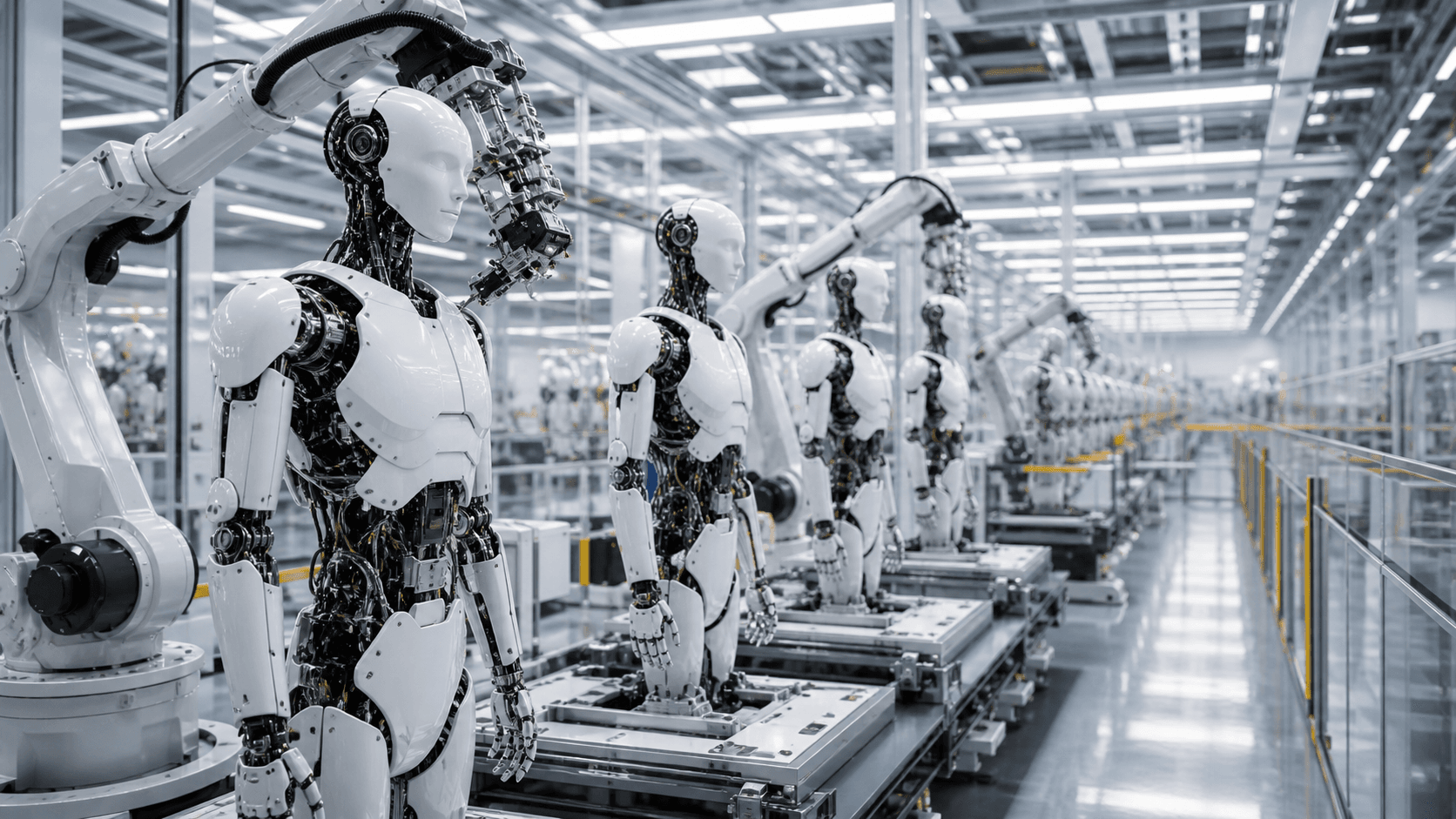
💡Unitree’s 18,000-unit milestone signals a major shift in the scale of embodied AI hardware.
⚡ 30-Second TL;DR
What Changed
Unitree reported cumulative production of 18,000 pure bipedal humanoid robots.
Why It Matters
The production gap suggests Unitree has built a substantial manufacturing and deployment advantage in embodied AI hardware. For developers and founders, Unitree’s scale may make its platforms more accessible for robotics experiments, fleet pilots, and real-world data collection.
What To Do Next
Evaluate Unitree’s current SDK and hardware availability by running a small manipulation or locomotion pilot before committing to a larger humanoid fleet.
Key Points
- •Unitree reported cumulative production of 18,000 pure bipedal humanoid robots.
- •AgiBot ranks second in pure bipedal output with 7,000 units, despite 15,000 humanoids across all categories.
- •UBTECH and Galbot trail significantly with approximately 3,000 and 1,000 units respectively.
🧠 Deep Insight
AI-generated analysis for this event.
🔑 Enhanced Key Takeaways
- •Unitree's rapid scaling is largely attributed to its 'G1' humanoid model, which was designed for mass production with a starting price point under $16,000, significantly lowering the barrier for entry compared to industrial-grade competitors.
- •The Chinese government's 'Robot + Application' action plan has provided substantial subsidies and industrial park support, which Unitree has leveraged to accelerate its supply chain localization and reduce component costs.
- •Unitree has shifted its manufacturing strategy toward a 'consumer-to-industrial' pipeline, utilizing high-volume production techniques originally developed for its quadruped robots to optimize humanoid assembly lines.
- •The 18,000-unit figure includes both the G1 and the H1 series, with the G1 accounting for the majority of the volume due to its focus on research and educational markets.
- •Unitree has established a dedicated 'Robot Brain' research division to integrate large language models (LLMs) and vision-language models (VLMs) directly into their humanoid firmware to improve autonomous task execution.
📊 Competitor Analysis▸ Show
| Company | Primary Model | Market Focus | Estimated Price | Key Differentiator |
|---|---|---|---|---|
| Unitree | G1 / H1 | Mass Market/Research | $16,000+ | High-volume manufacturing efficiency |
| AgiBot | Expedition A1 | Industrial/Logistics | $20,000 - $30,000 | Specialized industrial task training |
| UBTECH | Walker S | Automotive/Factory | $50,000+ | Deep integration with automotive assembly lines |
| Galbot | Galbot G1 | Service/Logistics | $25,000+ | Advanced manipulation and grasping capabilities |
🛠️ Technical Deep Dive
- Unitree G1 utilizes a proprietary joint actuator system with high torque density, allowing for dynamic balancing and complex locomotion without external support.
- The architecture employs a distributed control system where low-level motor control is handled by dedicated microcontrollers, while high-level perception and planning are processed by an onboard NVIDIA Jetson-based module.
- The robots feature 360-degree LiDAR and depth camera arrays for SLAM (Simultaneous Localization and Mapping) and real-time obstacle avoidance.
- Firmware supports reinforcement learning (RL) based gait control, enabling the robots to recover from pushes and navigate uneven terrain autonomously.
🔮 Future ImplicationsAI analysis grounded in cited sources
⏳ Timeline
Weekly AI Recap
Read this week's curated digest of top AI events →
👉Related Updates


AI-curated news aggregator. All content rights belong to original publishers.
Original source: Pandaily ↗