🗾Stalecollected in 75m

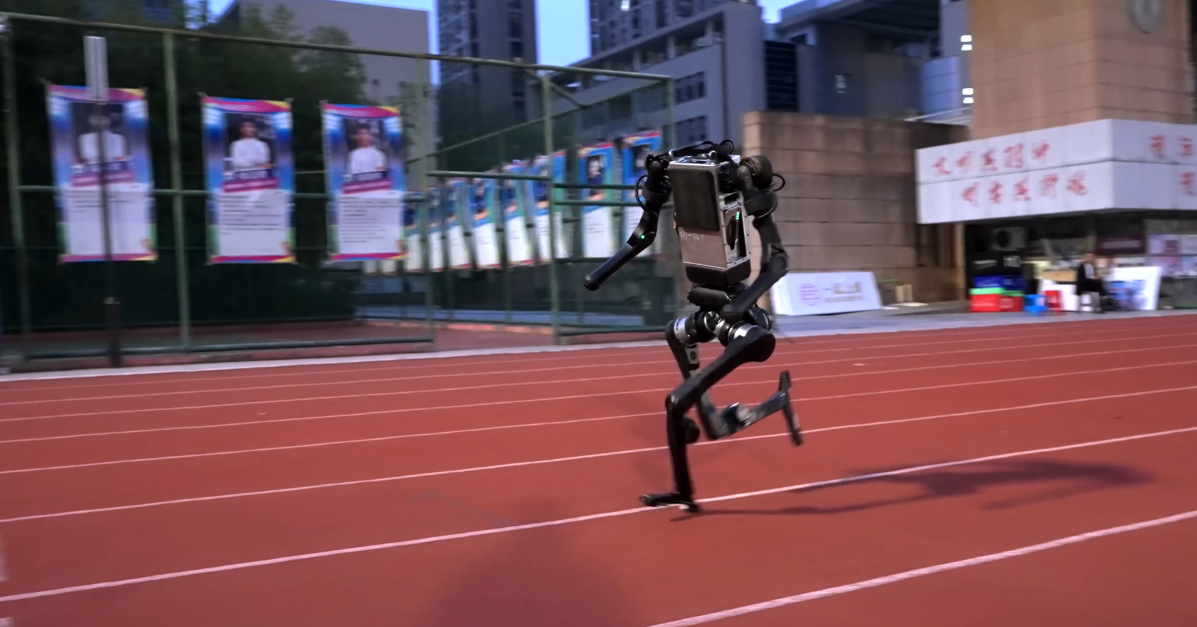
Unitree H1 Runs 36 km/h, Claims World Champion Level
Unitree H1 Runs 36 km/h, Claims World Champion Level
PostLinkedIn
🗾Read original on ITmedia AI+ (日本)

💡Unitree H1 sprints 36km/h – fastest humanoid yet, redefining embodied AI agility

⚡ 30-Second TL;DR

What Changed

Unitree H1 humanoid robot achieves 36 km/h top speed

Why It Matters

This demo pushes humanoid robot speed boundaries, advancing embodied AI for real-world applications like logistics and disaster response.

What To Do Next

Watch Unitree's H1 speed demo video to analyze state-of-the-art bipedal locomotion techniques.

Who should care:Researchers & Academics

🧠 Deep Insight

AI-generated analysis for this event.

🔑 Enhanced Key Takeaways

  • The H1 is Unitree's first general-purpose humanoid robot, utilizing a proprietary high-torque joint motor system and a 3D LiDAR sensor for environmental perception.
  • The 3.3 m/s (approx. 12 km/h) speed was the initial record set at launch, with the 10 m/s (36 km/h) figure representing a significant later performance milestone achieved through software optimization and gait control refinement.
  • Unitree positions the H1 as a cost-effective platform, targeting a sub-$90,000 price point to accelerate commercial adoption compared to more expensive research-focused humanoids.
📊 Competitor Analysis▸ Show
FeatureUnitree H1Boston Dynamics Atlas (Electric)Tesla Optimus Gen 2
Primary FocusSpeed/AgilityVersatility/ManipulationMass Production/Cost
Speed~10 m/s (Sprint)N/A (Dynamic)~1.5 m/s (Walking)
Pricing<$90,000 (Target)High (Research/Enterprise)Projected <$20,000
Key DifferentiatorHigh power-to-weight ratioAdvanced control softwareIntegration with FSD stack

🛠️ Technical Deep Dive

  • Actuation: Utilizes Unitree's self-developed high-torque density joint motors with integrated planetary gearboxes.
  • Sensing: Equipped with a 3D LiDAR sensor for real-time SLAM and depth perception, complemented by an Intel RealSense depth camera.
  • Degrees of Freedom (DoF): Features 5 DoF per leg and 4 DoF per arm, totaling 19 DoF in the base configuration.
  • Power: Powered by a high-discharge rate battery pack designed to support the high-current demands of high-speed locomotion.

🔮 Future ImplicationsAI analysis grounded in cited sources

Humanoid robots will achieve parity with human running speeds in commercial settings by 2027.
The rapid iteration of Unitree's gait control algorithms suggests that high-speed locomotion is becoming a standard capability rather than a specialized research achievement.
Unitree will shift focus from raw speed to dexterous manipulation in the next H-series iteration.
Having established a world-leading speed benchmark, the company must now address the primary barrier to industrial utility: complex object interaction.

Timeline

2023-12
Unitree officially unveils the H1 humanoid robot.
2024-03
Unitree demonstrates the H1 performing a backflip, showcasing advanced dynamic control.
2024-08
Unitree announces the G1, a successor model focusing on lower cost and mass production.
📰

Weekly AI Recap

Read this week's curated digest of top AI events →

👉Related Updates
AI-curated news aggregator. All content rights belong to original publishers.
Original source: ITmedia AI+ (日本)