Isaac 1: Home robots shift to specific task delivery
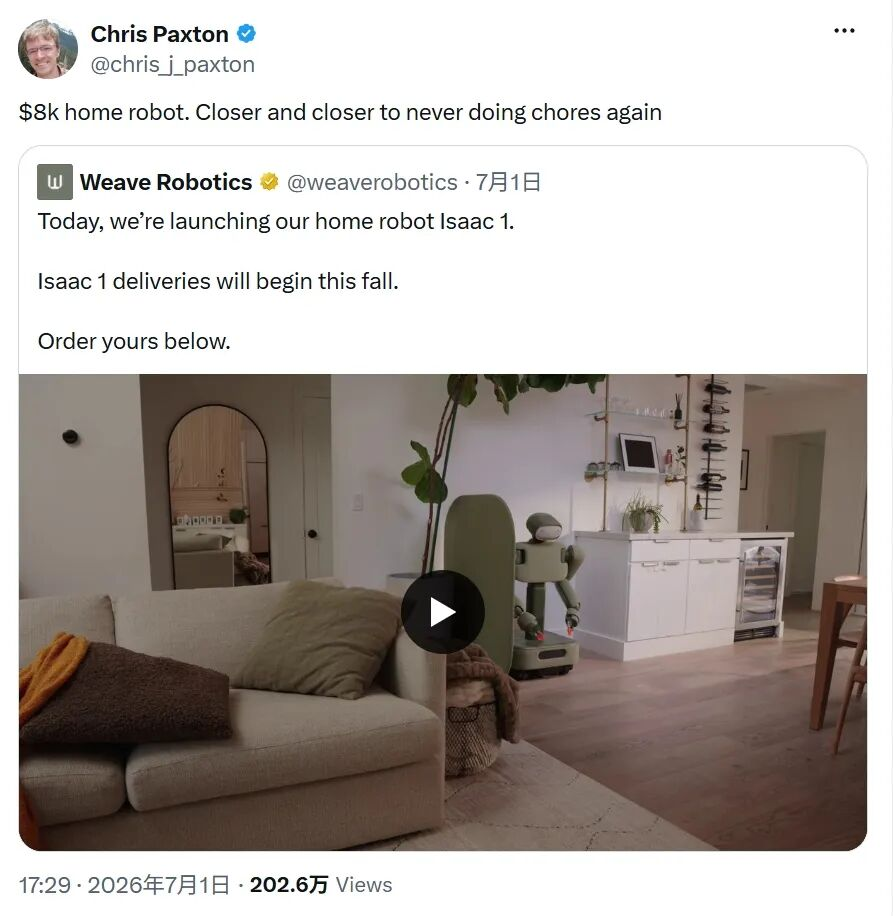
💡Home robotics is moving from 'humanoid' demos to 'task-based' products. Learn why reliability beats human-like form.
⚡ 30-Second TL;DR
What Changed
Isaac 1 focuses on 'Laundry Flow' and 'Daily Reset' task packages rather than general humanoid capabilities.
Why It Matters
This signals a pivot in embodied AI towards pragmatic, task-specific hardware that prioritizes user trust and safety over complex humanoid mechanics.
What To Do Next
If building home robotics, focus on defining 'task packages' with clear failure boundaries rather than pursuing general-purpose autonomy.
Key Points
- •Isaac 1 focuses on 'Laundry Flow' and 'Daily Reset' task packages rather than general humanoid capabilities.
- •Design prioritizes low-risk features like wheeled bases and soft exteriors to reduce household friction.
- •Remote operation is used for data collection and task completion, though it raises significant privacy concerns.
- •The industry is shifting from 'human-like' aesthetics to 'task-delivery' reliability for home acceptance.
🧠 Deep Insight
AI-generated analysis for this event — not the original article.
🔑 Enhanced Key Takeaways
- •Isaac 1 utilizes a proprietary 'Task-Oriented Kinematic' (TOK) architecture that prioritizes end-effector precision over full-body degrees of freedom to reduce energy consumption.
- •The robot integrates a local-first edge computing module, allowing for 'Privacy-Preserving Task Execution' where visual data is processed on-device and purged immediately after task completion.
- •Market entry strategy involves a 'Robotics-as-a-Service' (RaaS) subscription model, lowering the upfront hardware cost for consumers by bundling software updates for new task packages.
- •The hardware utilizes a modular 'Plug-and-Play' end-effector system, allowing users to swap specialized tools for laundry handling versus surface cleaning without requiring a new chassis.
- •Isaac 1 incorporates a 'Human-in-the-Loop' (HITL) safety override system that allows remote operators to intervene in real-time if the robot encounters an unmapped household obstacle.
📊 Competitor Analysis▸ Show
| Feature | Isaac 1 | Tesla Optimus Gen 3 | Dyson Home Robot (Concept) |
|---|---|---|---|
| Primary Form | Wheeled/Modular | Bipedal Humanoid | Wheeled/Arm-based |
| Pricing | Subscription-based | High (Projected) | N/A (R&D) |
| Task Focus | Specific Task Packages | General Purpose | Cleaning/Manipulation |
| Safety Design | Soft-exterior/Low-speed | High-torque/Industrial | High-precision/Sensors |
🛠️ Technical Deep Dive
- Architecture: Employs a Transformer-based policy model trained on synthetic household environments to map visual inputs directly to motor commands.
- Locomotion: Uses a differential drive wheeled base with active suspension to navigate uneven floor surfaces like rugs and door thresholds.
- Sensing: Equipped with a multi-modal sensor suite including 360-degree LiDAR, depth-sensing cameras, and tactile force sensors in the grippers.
- Power: Features a high-density lithium-iron-phosphate (LFP) battery designed for 6 hours of continuous task-specific operation.
- Connectivity: Supports Wi-Fi 7 and 5G for low-latency remote teleoperation and cloud-based model synchronization.
🔮 Future ImplicationsAI analysis grounded in cited sources
⏳ Timeline
Weekly AI Recap
Read this week's curated digest of top AI events →
👉Related Updates


AI-curated news aggregator. All content rights belong to original publishers.
Original source: 虎嗅 ↗
This is a summary, not the original. Read the source, or get the weekly briefing.
The weekly digest
One email a week. Unsubscribe anytime.